
Subscribe
When Chazhikattu Hospital was set up in Thodupuzha municipality in Idukki district in 1933, health facilities were rare in the area. What began as a nursing home under Dr CK Stephen grew over the years into a reputed private hospital run by his family. The family’s establishment survived for 91 years. Then, in October 2024, it was acquired by the Kozhikode-based Baby Memorial Hospital (BMH).
BMH acquired Chazhikattu for an undisclosed amount in October 2024, just months after the US-based private equity firm Kohlberg Kravis Roberts & Co (KKR) acquired a controlling stake in BMH. Chazhikattu, now rebranded as Baby Memorial Hospital, serves as one of BMH’s satellite hospitals, with a focus on orthopedic surgery.
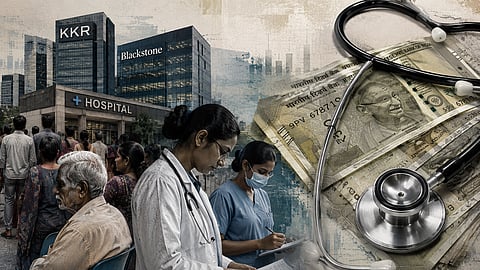
Over the last few years, there has been a spate of global PE firms acquiring hospitals across Kerala. The money that has been poured into the state’s healthcare sector by PE firms in the last five years reportedly exceeds Rs 20,000 crore.
This trend raises questions about the future of healthcare in the state, especially because 65–70% of Kerala’s population depend on the private sector for healthcare.
The state’s private health sector, along with its public health institutions, has been instrumental in building its renowned healthcare model. Small private clinics and hospitals play a significant role in ensuring that the state maintains many of the healthcare statistics it boasts of, like the lowest child mortality rate in India (five per 1000 live births, which is lower than 5.6 of the USA) and maternal mortality rate (24, while the national average is 87).
With global PE firms having found a lucrative market in Kerala, public health experts warn that the state’s accessible model may be replaced by an insurance-driven system that prioritises profit over people. There are also concerns that expenses will further surge. While the average Indian household spends Rs 2,767 on healthcare every year, those in Kerala spend three times more: Rs 8,388. Annually, Keralites’ out-of-pocket expenditure on health crosses Rs 30,197 crore. Even the state’s budgetary allocations for health is less than half that amount.
TNM examined several hospital acquisitions and financial statements, from multi-speciality chains such as KIMS Healthcare, Baby Memorial Hospital (BMH), and Aster DM Healthcare to small and medium hospitals in tier 3 and tier 4 towns. We spoke to medical professionals, public health experts, and hospital managements to understand how private equity ownership is changing hospitals and what it could mean for Kerala's healthcare system. This story also explores why Kerala has become a hotspot for private equity investment, whether these takeovers could accelerate a shift towards an insurance-driven healthcare model, and how the state plans to respond. TNM also spoke to former Health Minister Veena George and current Health Minister K Muraleedharan about the need for greater oversight of private equity-backed hospitals and the government's plans to explore a monitoring mechanism.
For a long time, Kerala’s private healthcare sector has been shaped by a mix of corporates, missionary or charity-driven institutions, and family-run establishments. Some of the leading multispeciality private hospitals in the state are helmed by doctors-turned-healthcare entrepreneurs. That landscape is now shifting with the entry of global PE firms.
In September 2023, US-based Blackstone, considered the world’s largest alternative asset manager, entered the Indian healthcare market by acquiring Quality Care India Limited (QCIL), which owns a network of multi-speciality hospitals across multiple cities named Care Hospitals.
QCIL’s next major move was a high profile investment in Kerala, where it bought 80-85% stake in Thiruvananthapuram-based KIMS Healthcare, with an investment of Rs 3,500 crore.
In the next year, QCIL had a share swap merger (exchange of shares between firms) with Aster DM Healthcare, another leading private hospital. As per a statement issued at the time of merger, the hospital was rebranded as Aster DM Quality Care, a combined portfolio of Aster DM, CARE Hospitals, KIMS Health, and Evercare. The merged entity was jointly controlled by Aster promoters and Blackstone, holding 24% and 30.7% ownership respectively, it said.
KIMS Healthcare chairman and managing director MI Sahadulla told TNM that the valuation and shareholder patterns are different from what is reported in the media, but refused to divulge the details. He said that the firm would go for an initial public offering (IPO) this year itself. “The money is staying here, the hospital is staying here,” he said.
Sahadulla added that he did not understand the need for so much debate on the topic when India allows 100% foreign direct investment in the health sector.
