
Subscribe
“This family adheres to Hindu traditions and beliefs.”
The notice pasted outside Sreekala’s house in Keraladithyapuram, on the outskirts of Thiruvananthapuram, is hard to miss. Fixed just below the nameplate carrying the names of Sreekala and her husband Satheesh, a retired Air Force officer, the board is one of the many visible assertions of Hindu identity that have begun appearing in everyday spaces across parts of Kerala.
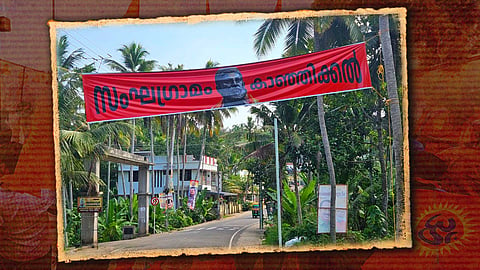
In fact a few kilometres away, at Keraladithyapuram Junction, that assertion takes on a more explicitly political form. When TNM visited the area in late April, a large red banner stretched across the road, carrying the image of 17th-century Maratha ruler Shivaji and the words “sangha gramam,” literally meaning “Sangh village.”
Residents say the banner has remained there for several months, and it sticks out, especially in Kerala’s landscape, for two reasons.
The first is Shivaji himself. The Maratha ruler has little historical connection to Kerala, but his image has increasingly appeared in Sangh-linked festivals, rallies, and processions in the state in recent years, alongside saffron flags, Hanuman imagery, and other symbols associated with Hindutva mobilisation in north and western India.
The second is the open declaration of the locality as a “Sangh village.” It is notable that the Hindu nationalist organisation Rashtriya Swayamsevak Sangh (RSS) and its affiliates have had a strong organisational presence in Kerala for decades, but much of this work has taken place through everyday community spaces rather than direct electoral politics. The RSS has built grassroots networks ranging from shakhas that conduct regular ideological training sessions to cultural organisations and trade unions, community welfare initiatives, and involvement in temple committees and festival organising.
Despite this groundwork, however, the Bharatiya Janata Party (BJP) has historically struggled to translate the Sangh’s organisational strength into major electoral success at the Assembly level in Kerala. But the Sangh’s influence has often grown in ways that electoral numbers alone do not capture. In several pockets of the state, particularly at the local body level, these networks have helped the BJP establish strongholds and build sustained neighbourhood-level influence.
What is changing now is the visibility of that influence. In many such areas, a presence that was often channelled through cultural, religious, and community networks is increasingly being claimed more openly, including through banners and signboards, politically charged cultural events, and neighbourhoods identifying themselves as “Sangh villages.”
Though villages in Kannur (like Pareekadavu and Diamond Mukku) have been called Sangh villages, TNM visited several such new pockets in Thiruvananthapuram and Palakkad districts. Here, Sangh-linked organisations have become deeply and visibly embedded in local communities. While supporters describe this as cultural revival and community work, these networks are vehicles for the Sangh’s ideological expansion.
The banner at Keraladithyapuram Junction was put up by people associated with the Bharatiya Mazdoor Sangh (BMS), the trade union affiliated with the BJP. “It is an area where there are RSS shakhas and active workers. People from all political parties live here, but among the younger generation, more volunteers and workers are emerging now,” said Deepuraj, BJP ward councillor of Powdikonam. “This is also a region with one of the highest numbers of shakhas.”
Ushering us inside her house, Sreekala pointed back to 2018, when she said her family’s views on religion and identity began to change. “Hindus are being attacked and tortured like never before. It was during the 2018 Sabarimala issue that we decided to put up this signboard,” she said. “Christians have stickers saying ‘Yesu bhavanam’ and ‘Jesus is the saviour of this home’. Then why can’t we have something similar?”
Sreekala added that “during the Sabarimala issue,” her family would stay up watching television till midnight. “We were all in tears. My mother, who was a Congress worker, cried her heart out.”
