
Subscribe
Follow TNM's WhatsApp channel for news updates and story links.
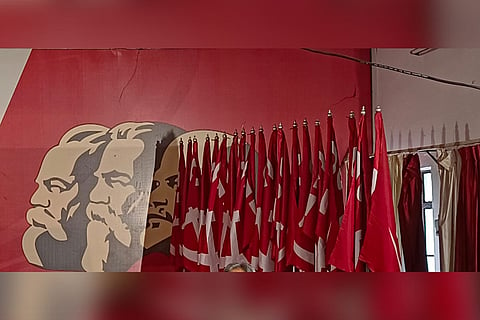
The fall of the communist government in Kerala marks another low in the overall trend of decay and decline in the Left movement in India. This decline marks a definitive end to the Left's political relevance, driven by a failure to engage the post-1991 workforce and a geriatric leadership that has sacrificed ideological renewal for control.
The Communist Manifesto was written by a 29-year-old Karl Marx—not from caution, but from revolutionary clarity. Bhagat Singh, Rajguru, and Sukhdev were in their early 20s, yet uncompromising in their fight against imperialism.
Communism does not depend on aged leadership; it demands politically strong leadership, backed by revolutionary organisation, capable of driving change, galvanising movements, and challenging power. It is not an age-bound ideology, but a people’s mandate for equality. Its force lies not in years, but in ideological depth, dialectical strength, and militant conviction—an energy once carried forward by youth who refused to wait and chose to act.
Today’s Indian Left comprises the Communist Party of India (Marxist) [CPI(M)], the Communist Party of India (CPI), the CPI (Marxist–Leninist) Liberation, the Revolutionary Socialist Party (RSP), and the All India Forward Bloc (AIFB) and many small factions under different names.
Unlike the Indian National Congress, which grew under the banner of the independence movement, or the Bharatiya Janata Party (BJP), which draws its organisational strength from the Rashtriya Swayamsevak Sangh (RSS) and its affiliated networks, the Communist parties in India were built on a fundamentally different foundation.
Their strength emerged from trade unions, farmers’ movements, student organisations, and various mass associations rooted in class consciousness. These were not merely support bases, but active participants who contributed both financially and ideologically, sustaining the party structure and driving it forward as a collective political force.
The Indian Left reached its political peak when it was led by men in their prime youth during the 1950s, 1960s, and 1970s. During that period, men and women, students and families, workers and artists, labourers and farmers—every section of society— were infused with a sense of class consciousness. Membership in the Communist movement was not exceptional; it was almost a social norm. In many households, at least one member belonged to a Communist party. The imagery was unmistakable—a jute bag, a long kurta, and conversations steeped in Marx and class struggle.
From tea stalls to buses, from college campuses to village squares, Left politics was not confined to party offices; it lived and breathed in everyday life. During this period, youth in West Bengal and Kerala came to be seen as the intellectual vanguard of the country, while people from the Telangana region and Tamil Nadu emerged as strong voices of state rights and regional assertion. Bihar and Tripura, too, drew their political strength from vibrant Communist movements that shaped mass politics on the ground.
This was also the era when educational institutions became powerful centres of political thought and mobilisation. Universities such as JNU, Delhi University, Osmania University, and Hyderabad Central University, along with colleges across Kerala and many in Tamil Nadu, were not merely academic spaces but active hubs of student politics and ideological engagement.
Together, this phase is widely regarded as the golden era of the Indian Left, when it combined intellectual depth with widespread mass mobilisation. This political atmosphere in India produced a generation of young leaders who went on to shape not only the Communist movement but also leadership across various political parties.
After the Emergency, the Left consolidated its position by capturing power in key states such as West Bengal and Tripura, marking a phase of significant regional dominance. From 1991 to 2026, however, the Left parties’ representation in India transitioned from national ‘kingmakers’ to a regionally concentrated force.
Their parliamentary peak came in 2004 with 61 seats, enabling them to provide crucial outside support to the UPA-I government. This was followed by a steady decline, with the Left securing only eight seats in the 2024 general elections. At the state level, the trajectory has been equally sharp. The Left Front’s 34-year rule in West Bengal ended in 2011 and collapsed to zero representation by 2021 and in these elections, they have managed to win just one seat in Bengal. Tripura was lost in 2018.
Kerala, long considered the last stronghold, saw the Left Democratic Front retain power in 2016 and 2021, but by 2026, it too was pushed out, marking a near-complete erosion of Left governance across the country. Who bears responsibility for this collapse—the masses, Gen Z, or the party leadership that sacrificed renewal to preserve its control?
The 1991 reforms opened India to global capital, expanded MNCs, and privatised education, creating a new corporate workforce. Trade union leadership failed to grasp this shift in class composition. The Indian Left misread the transition, as youth were drawn into aspirational illusions while remaining exploited labour.
Power corrupts
Leaders of AITUC and CITU failed to organise IT and corporate workers or understand modern labour contracts and state–capital alignment. Even in struggles like Samsung Union, their approach exposed this failure. This is not a systemic limitation but a leadership failure—outdated methods applied to a transformed economy. As a result, workers remain unorganised and union relevance has sharply declined.
The generation shaped by the post-1991 economy understands new trends and commands social media and IT. Yet it was never effectively politicised. Even the children of many party communist leaders were not trained in party ideology or mass work; they were sent abroad or into secure careers, while poorer cadres remained at home, carrying the movement forward across generations.
A section of leadership that benefited from the party did not reinvest in it; in some cases, they distanced themselves or shifted to other formations. This has deepened the disconnect between leadership and cadre, and weakened the party’s capacity to reproduce itself politically. Leaders who are unwilling to bring their own children into Left movements—because they demand devotion, discipline, and sacrifice—cannot expect other youth to commit to what they themselves avoid.
This contradiction signals a deeper self-interest at the top. When leadership shields its own from the burdens of the movement, it erodes credibility and discourages new entrants. Such an attitude is a foundational reason for the steady decline in party membership and the weakening of its organisational base.
Politically, the failure stems largely from leadership that refused to yield space for a new generation of youths. The generation forged in the golden era continues to dominate, blocking the entry of new leaders emerging from the post-1991 workforce. Senior comrades have held on to decision-making roles, preventing the rise of leadership from IT, services, and other new sectors. As a result, the expanding labour force has remained underrepresented and unorganised. The crisis, therefore, is not of numbers but of control—a leadership unwilling to renew itself, even at the cost of relevance. Mikhail Gorbachev, in his autobiography, characterised such systems as gerontocratic—an underlying factor in the collapse of the USSR.
Post-1990s, a nationwide mobilisation of youth saw Ambedkarite movements emerge as a decisive force in mainstream politics. The Left leadership failed to engage with or lead these currents, despite Dalits forming a significant segment of India’s labour force. Instead of forging alliances grounded in class and caste realities, the Left remained distant, missing an opportunity to integrate these movements into a broader transformative politics.
Internally, after the 1990s, there was almost no real space for youth in the Communist parties—even when they were in power and had strong representation in Parliament and State Assemblies. Senior leaders who had tasted electoral success, especially through alliances, held on tightly to power. They refused to give space to the younger generation, both in elections and within the party. This was not hesitation—it was control. In protecting their positions, they blocked new leadership, shutting out the very youth needed to carry the movement forward.
Such tight control by senior leaders left no space to respond to new political currents. When the anti-corruption wave around Anna Hazare reshaped public discourse before the 2014 elections, the Left had no younger leadership to interpret or engage with it. At the same time, it failed to understand the growing power of IT and social media, which were redefining mass mobilisation.
A new class consciousness
The Left was not merely absent—it was unprepared, watching its traditional strengths being overtaken. Even the wave of Gen Z uprisings in Sri Lanka, Bangladesh, and Nepal was treated as distant news, not as a lesson. The leadership failed to grasp the power of narrative, visibility, and digital mobilisation, leaving the Left disconnected from the new terrain of politics.
Through the expansion of global capital, a new form of class consciousness emerged, shaped by MNC labour, Dalit mobilisation, and digital networks. The Indian Left remained absent from this transformation. Without strong youth representation within the party and a militant, forward-looking approach, it cannot reclaim mainstream political space. It is reduced to surviving through alliances, dependent on regional forces rather than shaping national politics on its own terms.
The leadership of the Indian Left grew complacent, relying on electoral alliances for survival rather than building independent strength. For decades, particularly since the 1990s and even during the UPA-I phase, they failed to shape or lead any national narrative during major mass movements. This was not a tactical pause—it was a loss of political will. By choosing comfort over confrontation, the leadership surrendered its role as a driving force in national politics.
Seats in the decision-making bodies of Left parties are routinely reserved for those who serve the interests of the top leadership, turning the organisation into an instrument of control rather than collective politics. This is not an aberration—it is an entrenched practice that corrodes internal democracy. Unless this structure is dismantled and replaced with genuine representation from active movements and grassroots cadres, the Left will continue to decline. Internal democracy is not a slogan; it is a structural necessity. Without it, the Left cannot reclaim relevance in mainstream politics.
Only an active, interconnected Communist organisation can truly reflect social realities—both within the party and in society. Such grounded representation is what can attract and inspire new youth to join. It is this layer that can read political trends, respond to change, and shape direction. Age, in this context, is not merely a number—it is about representation and relevance.
A Communist leader must command a clear understanding of contemporary politics and the conditions shaping youth. Politicised youth is essential for any meaningful transformation. A party capable of producing leaders with political maturity, clarity, and commitment at a young stage is the only one that can inspire people. Without cultivating leadership in youth, no party can mobilise or sustain a revolutionary future.
Subash Mohan is an activist and Advocate practising in the Madras High Court. Views expressed here are the author’s own.
