
Subscribe
Follow TNM's WhatsApp channel for news updates and story links.
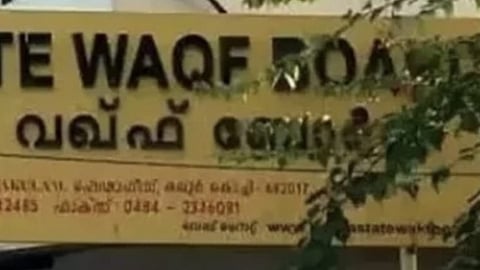
The Supreme Court on Tuesday, July 21, removed the Kerala High Court's direction requiring the Kerala State Waqf Board to function under the supervision of a state government Joint Secretary or Additional Secretary. It also asked the High Court to expeditiously decide the challenge to the Board's constitution.
The Kerala High Court, while hearing petitions challenging the constitution of the Board, had observed that it did not include two non-Muslim members and one Shia member as required under the amended Waqf law. Based on that prima facie finding, the High Court imposed restrictions on the Board's functioning pending further consideration of the petitions. One of the petitions, filed by BJP leader Shone George, sought directions to the state government to appoint two non-Muslim members to the Board.
A bench headed by Chief Justice of India BR Gavai, however, declined to interfere with the High Court's interim restrictions preventing the Board from taking major policy decisions or incurring capital expenditure, noting that the matter was scheduled to be heard by the High Court on Wednesday.
"The direction that the Board shall function under the supervision of the Joint Secretary is hereby deleted. The Joint Secretary/Additional Secretary, being a member of the Board, shall continue to function in that capacity," the Supreme Court said.
The Kerala State Waqf Board had approached the apex court challenging the High Court's July 15 interim order, arguing that it had effectively paralysed the Board's functioning. The High Court had restrained the Board from taking major policy decisions, exercising significant administrative powers or incurring capital expenditure without its prior permission after observing that the Board was prima facie not constituted in accordance with the amended Waqf law.
The High Court had also directed that the Board function under the supervision of a Joint Secretary or Additional Secretary appointed by the state government. The Supreme Court has now deleted only this part of the order.
While refusing to stay the remaining restrictions, the apex court directed the High Court to hear and dispose of the matter at the earliest after giving all parties an opportunity to present their case.
"The matter is coming up before the High Court on Wednesday. We direct the High Court to decide it expeditiously after giving a fair opportunity to the parties," the Bench observed.
During the hearing, senior advocate Jaideep Gupta, appearing for the Kerala government, submitted that the High Court's order was only an interim arrangement and did not warrant interference by the Supreme Court at this stage.
Appearing for the Waqf Board, senior advocates V Chidambaresh and Huzefa Ahmadi argued that the interim order had been passed without hearing the Board and had severely hampered its statutory functioning. They contended that vacancies in the Board's composition did not render it non-functional under the Waqf Act and that the absence of two non-Muslim members could not justify freezing its activities.
The Bench orally observed that it was primarily concerned with the High Court's restriction on the Board's functioning and noted that any prejudice arising from the interim order could be addressed before the High Court, which was already scheduled to hear the matter.
Welcoming the order, Kerala State Waqf Board chairperson KS Hamsa described it as a victory for the Board.
"We had challenged the High Court's direction that the Waqf Board should function under the supervision of a government secretary, and the Supreme Court has removed that direction. There were also other restrictions imposed by the High Court, including on taking major policy decisions and incurring capital expenditure. Since the High Court is scheduled to consider those issues on Wednesday, the Supreme Court has not gone into them for now," he told reporters.
The issue has also triggered a political row in Kerala, with the opposition CPI(M) accusing the Congress-led UDF government of supporting implementation of the amended Waqf law before the High Court despite challenging the legislation before the Supreme Court. The IUML, a constituent of the UDF, has denied the allegation, maintaining that it continues to oppose the appointment of non-Muslims to Waqf Boards.
Follow TNM's WhatsApp channel for news updates and story links.
