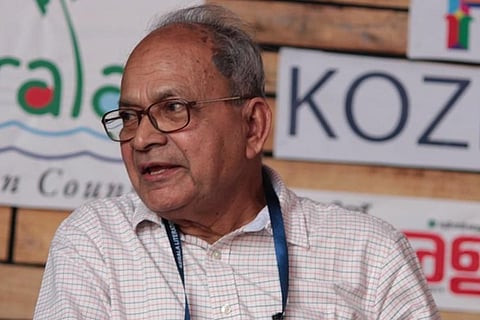

Eminent Malayalam writer and public intellectual Anand said that the political situation currently prevailing in India is alarming by all means and that the judiciary is almost in a state of paralysis. In an exclusive interview with TNM, the writer also said that the bureaucracy in the country is showing an attitude of slavery.
“The Supreme Court of India refused to grant a stay on the ‘love jihad’ law in Uttar Pradesh. The SC didn’t have the courage to declare that an obviously wrong thing was wrong. The condition of the courts is disgusting,” Anand said in the interview.
The 84-year-old writer, who has written a number of novels, short stories and essays, is also a public intellectual who dissects politics, society and culture with a deep historical perspective and independence. He currently resides in New Delhi. He has to his credit a number of monumental novels in Malayalam – Aalkoottam (Crowd), Abhayarthikal (Refugees), Govardhanantey Yathrakal (The Travels of Govardhanan), to name a few. He is the recipient of the 2019 Ezhuthachan award, the highest literary honour given by the Kerala government.
Replying to a question on comparisons between the BJP government currently ruling the country and the Congress government under Prime Minister Indira Gandhi, which displayed an authoritarian streak even declaring an Emergency, he said that unlike the Congress there is no space for dissent within the BJP. “There were dissidents in the Congress party at all times, however the case of the BJP is different,” he said.
Referring to the protests by a large segment of farmers in New Delhi, he said if there is a strike in a democracy, those responsible will be summoned and a solution will be arrived at. “However, currently the country does not have a democratic atmosphere. Fascism is prevalent, and all educational and government institutions are in paralysis. In contemporary India, there is no space for dissent. If I’m asked the question ‘Is there a way ahead?’ I don’t know. I’m very disturbed,” he maintained.
Recalling the declaration of Emergency by Indira Gandhi in 1975, Anand said that it had unified all the communal parties and the Jan Sangh, the precursor to the BJP, gained immense respect. “Though the movement led by Socialist leader Jayaprakash Narayan was against the Emergency, it helped the Jan Sangh earn respectability among the political parties in the country. Since then, the Jan Sangh has not looked back,” Anand observed.
The writer said that the need of the hour is politics that helps solve the problems of the common man, saying, “The test of every ideology is how it is experienced in the life of the common man. If an ideology is not able to provide solace to the common man, then there is no point in that ideology.” He added that civilisation and culture is supreme to political parties and politics.
Anand observed that the greatest achievement of the Congress party, and particularly Jawaharlal Nehru, was that they were able to keep the country united.
“The main strength of the Congress was keeping the country united due to the absence of any ideological background. Though Congress was not able to bring about reforms in the social realm, in the economic realm it was able to sustain through the five-year plans that began during Nehru’s time, and by building the public sector institutions in the country,” Anand said.
“Though the Congress was not declared as socialist, Nehru tried to build a socialist pattern of society. After Nehru, the Congress was left without strength, orientation and direction. That was the tragedy,” he added.
He said that it needs to be investigated why a person of Nehru’s stature was not capable of providing a strong ideological underpinning to the Congress party. “It may be due to the absence of a clear-cut approach towards issues. The inability to take decisions was apparent and he was forced to satiate various interests,” Anand said.
Through initiatives such as bank nationalisation and abolishment of the Privy Purse to ex-royals, Indira Gandhi tried to move towards the Left, but the initiatives were more of a political stunt than a concrete decision or adhering to Left politics.
Talking about the scenario in Kerala, Anand said the Congress doesn’t have any ideology; it functions as a party bereft of any conviction except orientation towards power. In general, the Congress and the United Democratic Front (UDF) lacks orientation, Anand maintained. “In the education sector, the Congress promoted religion. Moreover, the liberation struggle of 1959 was carried out by the Congress to overthrow the Communist government, thereby befriending religious forces. The irony is that the Communist party befriended the communal forces in the election held after the liberation struggle.
“I’m a critic of the Communist parties, but we cannot deny that they have adopted a principled stance. In the context of the recent Sabarimala women’s entry issue, the CPI(M) has taken a bold stand. Previously they have not bothered to take a stand,” he recalled.
Anand said that from the first Communist government led by EMS Namboodiripad it was the Communist party that gave an orientation to education in the state. “Strides in education, land reforms, cooperative movement all occurred as a result of the contribution of the Communist party. The strength of the panchayat was realised in Kerala due to the role of the Communist party,” he said.
Anand opined that it was due to the renaissance movements that the Communist party could exert influence in the polity of the state. “Various groups contributed to the Kerala renaissance movements, including Christian missionaries, Sree Narayana Guru, Ayyankali, to name a few. The Communist party succeeded on the platform of renaissance. The renaissance movements were the legacy of the Communist party and they could propel themselves from this platform.”
Though it may come as a surprise, revolutionary decisions such as temple entry for oppressed castes in the erstwhile Travancore state happened during the rule of the royal family. “No political party was able to carry forward such moves post-Independence,” Anand maintained.
Abhish K Bose is a journalist based in Kerala.