
Subscribe
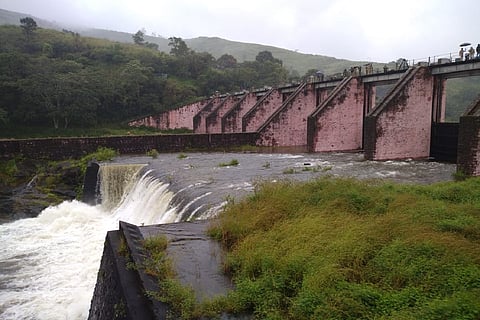
Kerala has assured Tamil Nadu that it is ready to provide the State with the entire water from a proposed new Mullaperiyar dam, provided Tamil Nadu agrees to the project. Kerala has also offered to bear the entire cost of constructing the new dam, while leaving its location, design and construction to Tamil Nadu.
Chief Minister VD Satheesan made the assurance at the 31st Southern Zonal Council meeting held in Mahabalipuram, Tamil Nadu, on Thursday, August 20.
Kerala has maintained that the existing 130-year-old Mullaperiyar dam in Idukki needs to be replaced with a new structure. Satheesan reiterated the State’s willingness to move ahead with a new dam while assuring Tamil Nadu that its existing water interests would not be affected.
The proposal comes against the backdrop of the long-running dispute between the two States over the safety of the Mullaperiyar dam and Tamil Nadu’s use of its water.
Satheesan also raised a series of issues concerning Kerala and the wider southern region at the meeting, calling for greater cooperation among the States.
He sought regional cooperation for Kerala’s plans under Mission Samudra, aimed at strengthening the State’s development as a port-oriented region. He also urged the union government to annul the amendments to the Mineral Act, while reiterating Kerala’s concerns over offshore mining of mineral resources along its coast.
On offshore mineral mining, Satheesan said Kerala was cooperating with the Geological Survey of India and the Union Ministry of Mines in auctioning mineral blocks, including those containing bauxite, beach sand and critical minerals. However, he opposed the auction of offshore mineral blocks off the Kerala coast until a scientific assessment is conducted and a robust standard operating procedure is put in place, citing possible environmental and social impacts on coastal ecosystems and fishing communities.
The Chief Minister also called for greater representation of women in Parliament. He suggested that one-third reservation for women could be provided without increasing the overall strength of Parliament.
Among Kerala’s other demands was greater financial support from the union government for the Ayushman Bharat-Pradhan Mantri Jan Arogya Yojana. Satheesan said Kerala spent around Rs 1,493 crore under the scheme in the last policy year, while it received only around Rs 151 crore from the National Health Authority, leaving the State to bear nearly 90% of the expenditure.
He sought State-specific premiums instead of a uniform national premium, alignment of eligibility with the National Food Security Act database, and an increase in the union government’s share based on actual expenditure on centrally sponsored beneficiaries.
Satheesan also sought exemption or concessional toll rates for State road transport undertakings. He pointed out that the Kerala State Road Transport Corporation paid more than Rs 2.16 crore in toll charges in June 2026 despite providing an essential public service, including services to remote areas.
Kerala’s concerns over coastal erosion also figured in his speech. Satheesan said around 63% of the State’s 586-km coastline was classified as eroding, with nearly 30% of the population living along the coast. He sought permission to undertake coastal protection and resettle families displaced by erosion using the National and State Disaster Response and Mitigation Funds.
On connectivity with neighbouring States, he sought cooperation from Karnataka and the union government to finalise the alignment and Detailed Project Report for the Thalassery-Mysore and Nilambur-Nanjangud railway lines.
He also called for a review of night traffic restrictions on forest roads connecting Kerala with Karnataka and Tamil Nadu, suggesting scientifically determined least-sensitive time windows and regulated convoy movement instead of blanket restrictions.
Satheesan sought the continuation of the Fast Track Special Courts Scheme and assured funding for it, noting that Kerala has operationalised 54 of the 56 sanctioned courts, including 14 e-POCSO courts. He also proposed stronger inter-State cooperation in sharing forensic reports and producing witnesses in cases involving sexual offences and crimes against children.
On security, he proposed that each southern State designate a senior police officer as an Inter-State Police Nodal Officer to facilitate real-time intelligence sharing, prisoner information exchange, joint operations and coordinated patrolling along State borders.
Satheesan said the Southern Zonal Council should remain a model of cooperative federalism by enabling States to resolve disputes through dialogue and work together on development and security issues.
Follow TNM's WhatsApp channel for news updates and story links.
