
Subscribe
Aneesh* read Kunju Kaaryangalude Odeythampuran, the Malayalam translation of Arundhati Roy’s The God of Small Things, when he was in college. He picked up the book prompted by a casual remark from a classmate.
“He told me that there’s a character called Velutha in the novel who reminded him of me,” Aneesh recalled.
“Velutha was a Dalit Christian like me, who was in love with a Syrian Christian woman,” he said, a faint, painful smile crossing his face.
In the novel, Velutha is brutally tortured and killed for his ‘forbidden’ love. Though Aneesh, who belongs to the Pulaya community, has never faced physical violence like Velutha, he has encountered caste abuse, public humiliation, and social exclusion.
“It was 2010. Ours was a hilly village in Kannur district. A girl from my parish and I were in a relationship. We went to the same school and attended catechism classes together. Our families were not very different financially,” he said.
The relationship ended when the girl’s family came to know about it. “They publicly called me ‘Pelayan’, a casteist slur for Pulaya, ‘parassala christian’, and many other things. My skin colour, my caste, my family, everything was dragged out in public and insulted,” Aneesh said. ‘Parassala Christian’ is a derogatory term used for landless Dalit Christian families who moved from Parassala in Thiruvananthapuram to northern Kerala in search of work and land.
Aneesh’s grandparents had converted to Christianity long ago. His parents had migrated to the village in Kannur nearly five decades earlier from Parassala.
When the abuse began, Aneesh said there was no support from the church. “The church, the priest, no authority stood with us. It was a Syrian Christian-dominated area under the Syro Malabar Church. With that one incident, my family was casually ostracised,” he said.
Unable to continue living there, Aneesh left the village and went to north India to pursue further studies. His parents eventually moved back to Thiruvananthapuram.
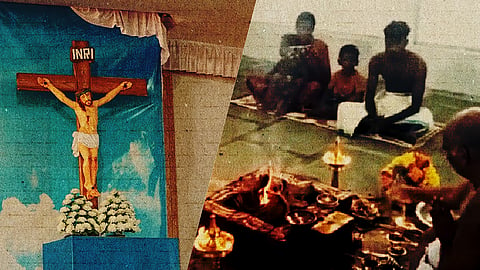
Today, Aneesh is 40, married, and the father of two children. A few months ago, he, his wife, and their two children – both below the age of 10 – formally converted to Hinduism.
The conversion, Aneesh said, was facilitated by the Vishva Hindu Parishad (VHP), a prominent right-wing Hindutva organisation. A ceremony was organised at a nearby temple. Volunteers helped him with the paperwork, to change his name through a gazette notification and obtain a caste certificate from the government.
Aneesh’s decision to convert was not rooted in faith but in paperwork. Like several others TNM spoke to, his move was driven by the loss of reservation benefits after generations within Christianity. This motivation runs through the data as well. Though the number of Dalit Christians who converted to Hinduism is a small portion of their total numbers in the state, a majority cited access to reservation in affidavits submitted to the VHP, which has been facilitating these conversions under the banner of ‘Ghar Wapsi’.
Activists and church representatives argue that this is not incidental. They point out that people like Aneesh who felt that they were in the margins were being identified by right-wing organisations to convert to Hinduism.
They also say that the continued denial of Scheduled Caste status to Dalit Christians is part of a long-term political design, one that leaves families with little choice but to return to Hinduism on paper to access constitutional protections. Conversion then becomes less a matter of belief and more a survival strategy shaped by law, caste, and state policy. A VHP leader told us that they had identified taluks in Kerala where they were keeping constant watch.
