
Subscribe
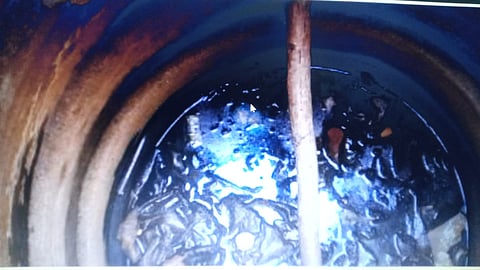
On the seafront, roughly 50 metres from Thottappally Harbour at Purakkad in Kerala’s Alappuzha district, 58-year-old Sainabha Zakkir relies on the shallow well beside her kitchen for her water needs. A recurring plumbing issue has recently cut the piped water supply to six panchayats including her household, forcing her family back to the 32-year-old household well.
While there is substantial tap-water coverage in her village, many households remain outside the network and still rely on groundwater sources like wells.
Although Zakkir’s well is close to the Arabian Sea, its water has fortunately not become saline like many others in the neighbourhood, making it a community lifeline. “This well supports all my neighbours too,” Zakkir explains as she fills vessels. “Many old wells in this area have become unusable. During water shortages, people come here.”
But salinity is not the only issue with the groundwater in the area. A new study published in Scientific Reports examined groundwater quality in Alappuzha’s coastal aquifers, focusing on heavy metal concentrations before and after the monsoon. It found that 32% of pre-monsoon and 34% of post-monsoon samples exhibited medium to high pollution levels with the critical hotspots at Ambalapuzha, Anandheswaram, and Thottapally for arsenic; Alappuzha, Kanjikuzhi and Paravoor for aluminium; and Paravoor, Alappuzha, Chennakari, and Ambalapuzha for iron.

The study attributes the contamination of Alappuzha’s coastal aquifers to a combination of natural geological processes and human activities. Arsenic and aluminium were the principal contaminants identified. Arsenic in 8-10% of samples and aluminium in 8% samples across the seasons, exceeded the WHO limits.
The study notes that this contamination was largely from commercial debris, agricultural runoff, domestic sewage, and tourism-related activities. Iron levels were also elevated in 4-8% of samples, especially in Paravoor, though researchers largely attributed this to naturally occurring geological processes.
The lead researcher, S. Selvam, a senior assistant professor of geology at V.O. Chidambaram College, emphasised that the findings point to localised contamination rather than widespread groundwater degradation in Alappuzha. “Overall, the system is not severely polluted, but it shows localised and process-driven contamination, especially in shallow coastal aquifers,” he says.
However, Shaji E., a professor of geology at the University of Kerala, says the results about arsenic exceeding safe limits warrant further verification. Such concentrations differ from earlier academic studies and Central Ground Water Board assessments of Kerala’s coastal aquifers, he notes. While calling for improved high precision analytical techniques and standard protocol, he shares that the study, while academically valuable, “may overstate the environmental and public health risk without sufficient corroborative evidence, potentially leading to unnecessary concern.”
In response, Selvam says the research followed standard quality assurance procedures, including repeat sampling and the use of reference materials certified by the National Institute of Standards and Technology, to verify analytical accuracy.
The study also notes that prolonged exposure to elevated concentrations of arsenic, aluminium and iron may have health implications. Arsenic exposure has been associated with carcinogenic and cardiovascular risks, while aluminium and excessive iron can affect the nervous system and cardiovascular health respectively.
Separately, local health officials pointed out the concerns related to fluoride, to Mongabay-India. A medical officer at Purakkad Primary Health Centre, on condition of anonymity, says that cases of dental fluorosis, including brown staining of teeth among children, have been observed in some areas where groundwater is still used for drinking.
Sherleena J., a teacher at Government High School (GHS) Nalamchira near Thottappally, says a medical camp had identified dental fluorosis among students, prompting the school to provide reverse osmosis (RO)-treated water for drinking and cooking.
Apart from heavy metal contamination, residents continue to face more immediate water-quality challenges linked to changes in the coastal environment. In Paravoor, a village near Purakkad, several homes stand barely 50 metres from the sea, where shallow wells often become saline during summer, forcing families to depend on the government’s water-supply schemes. Mariyamma, 63, says that after the 2019 flood, the community has relied on the pipeline, rarely using wells for drinking because of increasing salinity. In Alappuzha town, residents described other concerns during the monsoon, when flooding and canal backflow affect the quality and smell of well water.
Lata John, 57, says her family faces water scarcity and salinity during summer, while heavy rains often leave well water unsuitable for use. “The runoff from Vembanad lake and adjacent paddy fields carries decomposed straw and organic matter from submerged fields, rendering the well water unpotable,” she says. This unreliability has also increased dependence on alternative sources of drinking water. “I refuse to use the pipeline water because of the chlorine taste,” says Anit Nirmala, a 32-year-old pregnant resident. “We buy a 20-litre RO water can every day for drinking and cooking. If that supply ever stops, we have to use the canals for everything else.”
In the villages of Kanjikuzhi (also in Alappuzha) and Paravoor, residents say that recurring waterlogging and saline intrusion have led to greater reliance on privately supplied RO water. The burden falls unevenly across communities. Families that still depend on shallow wells, households experiencing interruptions in piped supply, pregnant women, elderly residents and lower-income families often have fewer options when local water sources become unsuitable for drinking.
The study authors say the contamination patterns are majorly linked to the region’s hydrology. The groundwater system around the Vembanad wetland which extends across Alappuzha, Kottayam, and Ernakulam (Kochi) districts, experiences significant fluctuations in water levels. According to the study, flooding, intense rainfall and rising sea levels may influence the movement and mobilisation of metals within shallow coastal aquifers, affecting groundwater quality in the surrounding regions over time.
Residents point to other longer-term environmental changes. Lalitha, a 67-year-old resident of Kanjikuzhi, recalls when households relied primarily on ponds and wells. “I recall a time when our dependency was decentralised across ponds and wells. Because we were engaged in coir-making for so long, our groundwater and ponds have a yellowish-brown tint. Now, my family uses Jal Jeevan water for drinking, which we boil first, and we chlorinate our wells and bore wells as backup whenever the piped supply fails,” she said.
A panchayat secretary in Alappuzha who asked to remain anonymous, confirmed that dependence on household wells has declined among many Jal Jeevan Mission beneficiaries who now receive piped water at home.
Medical officers at Purakkad and Ambalapuzha who requested anonymity (as they were not authorised to speak to the media), stated that no (health or medical) cases linked to high contamination have been officially reported so far. Primary Health Centres (PHC) and Urban Health Centres (UHC) also conduct periodic testing of water supplied by hotels and RO plants. Officials say follow-up action is taken whenever water-quality concerns are identified.
However, officials from the water department acknowledge that household-level monitoring of private shallow wells remains limited. Residents who wish to test water from private wells can approach their local PHC or UHC. A junior health inspector collects the sample, which is then analysed at the district laboratory for a fee starting from ₹100 for basic single-parameter tests.
The researchers recommend a combination of treatment technologies and preventive measures to manage groundwater quality. They suggest interventions such as iron-based adsorption techniques for arsenic removal, coagulation-filtration methods for aluminium, and nature-based approaches such as phytoremediation.
The study also highlights the importance of protecting groundwater recharge zones from sewage discharge and agricultural runoff, while strengthening land use regulation in environmentally-sensitive coastal areas. “Continuous long-term monitoring is essential to validate findings of this study and ensure a reliable groundwater quality in these dynamic coastal settings,” the researchers conclude.
Follow TNM's WhatsApp channel for news updates and story links.