
Subscribe
The Foreign Contribution (Regulation) Amendment (FCRA) Bill, 2026 has triggered a sharp pushback from Christian churches and political parties in Kerala, including the Left and the Congress. The Catholic Bishops' Conference of India (CBCI) has termed several provisions in the Bill as "dangerous and alarming," and Church leaders across denominations have warned of executive overreach into minority institutions.
During Palm Sunday services on March 29, various bishops of the Syro-Malabar Church, while addressing the laity, expressed serious concern over the proposed amendment, according to a report in The Hindu.
The controversy has put the Bharatiya Janata Party (BJP) on the back foot in Kerala, where it had been making sustained efforts to woo Christian voters ahead of the Assembly elections.
Baselios Marthoma Mathews III, the Catholicos of the Malankara Orthodox Syrian Church, demanded that the Union government reconsider the amendments and warned of a coordinated protest with other churches if the government did not relent. He said the Malankara Church's FCRA accounts had already been frozen and that there was no resolution even after directly approaching state BJP president Rajeev Chandrasekhar.
The Catholicos said it was unjust to view even the offerings made by church members with suspicion and questioned whether the Union government's attitude towards minorities was shifting.
Archbishop Mar Thomas Tharayil of the Changanassery Archdiocese of the Syro-Malabar Church on Sunday raised serious concerns over the proposed amendments and stated that they approached the Union government seeking a total reconsideration of the Bill.
However, the Christian Association and Alliance for Social Action (CASA) criticised his statement. Speaking to Janam TV, CASA president Kevin Peter called his statement politically motivated and alleged that it was designed to favour the United Democratic Front (UDF) and Kerala Congress (M) leader Jose K Mani ahead of the Assembly elections. Peter asserted that the FCRA amendments are not anti-minority.
Kerala Chief Minister Pinarayi Vijayan wrote to Prime Minister Narendra Modi on Monday, March 30, urging him to withdraw the Bill's provisions on asset takeover, arguing that the existing law was adequate to deal with violations. "The present Act confers enough powers to deal with the misuse of benefits by the certificate holders who have been permitted to accept foreign contributions. The amendment proposes to enable takeover of assets, which will include religious places of worship and charitable organisations, even in a situation involving a technical question of time limit," Vijayan said in his letter.
The Chief Minister warned that the "clauses of the amendment bill can put the functioning of institutions which are rendering selfless service in education, health and care of the poor and marginalised sections in difficulty, even when there are no substantial lapses on their part."
The CPI(M) Kerala State Secretariat also issued a statement calling the Bill a draconian measure designed to dismantle the institutional foundations of minority communities and civil society. In its statement, the Secretariat alleged that the proposed "sweeping powers" to seize assets for even minor technical omissions are a direct assault on religious and charitable organisations that provide essential services in education and healthcare.
Congress leader KC Venugopal also condemned the Bill on March 30, alleging that it targeted minority communities and charitable organisations, calling it a sword of Damocles hanging over minorities.
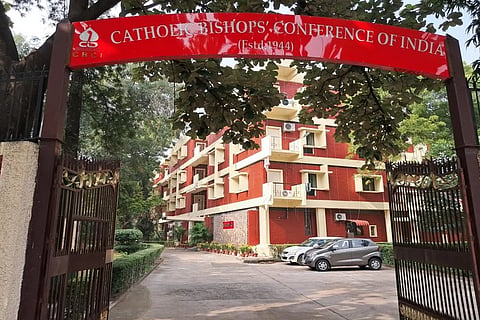
The CBCI, the apex body of Catholic bishops in India, has said that the Bill's provisions empower the Central Government to deny licence renewals and subsequently assume control over the institutions, funds, properties and assets of minority organisations and NGOs. It called such measures "undemocratic, unconstitutional, and contrary to the principles of natural justice," warning that excessive regulatory powers risk arbitrary decisions and executive overreach into constitutionally guaranteed freedoms.
Follow TNM's WhatsApp channel for news updates and story links.
