
Subscribe
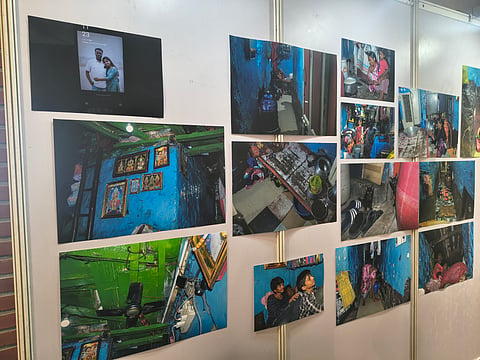
A woman sorting waste, children in one-room homes painted blue and green, a woman fruit vendor waiting to cross the road amidst rush-hour traffic, another woman labourer effortlessly carrying a sack almost her size—documentation of marginalised communities often stops there, on the peripheries of the subjects’ lives.
A photo exhibition in Bengaluru challenges this with shots of everyday life set alongside photographs that reveal what is often invisible: a worker’s phone lock screen showing her and her husband with their arms around each other, or aerial photographs of Banashankari, Chickpet, and other neighbourhoods, where apartment blocks rise over sprawling stretches of smaller homes.
These photographs show a city that its residents recognise but rarely examine closely. They also show the people who serve as its backbone, beyond the work they do.
What makes this possible is that the people behind the camera are not outsiders. The eight young photographers whose work is displayed at the exhibition come from waste-picker communities themselves. For this project, they set out to photograph the people, homes, and neighbourhoods they have lived among and grown up around.
The exhibition, Whose Lives Do We See?, featuring the works of Sujitha, Kusuma, Sharmila, Anusha, Keshvi, Keerthana, and Gokul Raj, was hosted at Samagatha Space on September 1 and 2.
What sets these photographs apart could be the absence of the distance that usually sits between a photographer and the subject. Keerthana, one of the eight photographers, says that comes from spending time with the people. “When we spend a day with them, travel with them, and see what they do, we begin to understand their lives,” she says.
For the eight photographers, the project meant learning to look at their own neighbourhoods differently. “We have lived and grown up in this community, in this area, and we have seen all of this around us,” says Gokul Raj, one of the contributors. All eight photographers hail from the same community in the Banashankari neighbourhood.
The mentorship gave him a reason to point a camera at what he had seen all his life, particularly the children around him who drop out of school to work. “In this area, many children who drop out of school and even young children work. I started making stories about them.”
Another one of the contributors, Keerthana, who is studying journalism at BMS College for Women, was driven by something else. Before this, she says she had mostly seen photography aimed at making someone “look beautiful”. It took the project to show her that a camera could do something else. “We didn’t know that we could photograph working people like this,” she says. “Thats how we learned to make stories about people”.
The six-month mentorship
Whose Lives Do We See? is the result of six months of mentorship from the photographer Palani Kumar, organised by Hasiru Dala, the city’s waste pickers’ collective.
This project is Palani’s first in Bengaluru; he has previously worked in Tamil Nadu, photographing manual scavenging and caste violence, and was the cinematographer of the documentary Kakoos.
In Chennai, he founded People’s Photographer Collective (PPC), which trains young people from marginalised communities to photograph their own lives. “Journalism is always about giving a voice to people who are not heard, and I'm trying to bring those voices into the media through photography. That's why I'm teaching photography,” he says.
PPC is also training young people from marginalised communities across the country to do the same: photograph their own lives rather than have someone else photograph them.
According to the contributors, the mentorship involved making the group sit for three or four days at a stretch, going over the same photographs and videos again and again, asking questions and explaining how to approach a person and build a story around a life rather than a single image.
“For many years, photographers did not come from marginalised communities,” says Palani. “Even today, when you look at decision-making and the media, who are the people occupying these spaces? Marginalised communities have largely not been represented in these spaces.”
Stressing on the importance of “decolonising” photography, he says training people to photograph their own communities cuts out a familiar dynamic: an outsider spends a few days with a community and leaves with a story that belongs to the photographer more than the subjects.
“You cannot tell these stories in a single day, or in three or four days. Outsiders often miss that opportunity to spend quality time with a community because they come with a project in mind. But for these photographers, this is their life. This is their responsibility to document their own lives.”
The exhibition is expected to travel to multiple venues and districts, while the eight photographers will continue to be mentored as they document their own communities.
(This article was written by a student interning with TNM.)
Follow TNM's WhatsApp channel for news updates and story links.
