
Subscribe
The Bangalore International Centre’s (BIC) July 5 panel discussion titled “Call Me Ishmael, Unless the Algorithm Has Other Ideas,” turned out to be an hour and a half of uneasy laughter, sharp disagreement, and the occasional groan over what happens to storytelling when artificial intelligence (AI) enters the room.
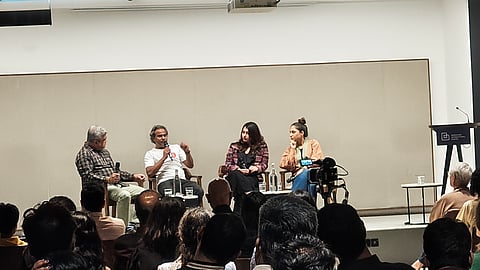
Framed as a discussion on literature in the age of AI, the panel included Natasha Joshi, director of The Deodar Prize, a platform for emerging Indian writing in English; Lavanya Lakshminarayan, author of The Ten Percent Thief; Ranjeet Pratap Singh, co‑founder and CEO of the digital storytelling platform Pratilipi; and Karthik Venkatesh, executive editor at Penguin Random House India, who moderated the conversation. Together, they debated whether AI is a convenient tool, a competent collaborator, or something that could “destroy the very soul of human artistry” as it changes how books are written, read, and discovered.
The title itself, “Call Me Ishmael…”, is a reference to the opening line of Herman Melville’s Moby Dick, a sentence that announces a specific, embodied narrator before anything else in the book. In this room, that nod to Melville worked less as a literary reference and more as a provocation: if an algorithm can so easily call itself “Ishmael,” what does it mean to trust the name on a book, or to feel any kind of connection to the person you imagine on the other side of the page?
That question kept resurfacing in different guises. Ranjeet Pratap Singh argued that AI acts like a hive mind, drifting toward the median whenever there is no single right answer. So, he said, its output reflects what works for the “50th percentile” rather than the quirks of individual taste or intuition. But that didn’t make AI redundant for him; it just defined its role. Human judgement, he suggested, is what gives writing its edge, while AI can “act in service of humans and not replace humans because it’s largely about what do I like as a human.”
About the reader’s perception, Ranjeet Pratap was more blunt: “You are not going to care if a writer wrote it, if an AI wrote it, if an alien wrote it… Do you like this story or not?”
Natasha Joshi stressed that reading, by nature, is not a neutral act. “Taste or preference is one,” she said. Some readers “will read only women writers because it’s part of their politics,” or will stick to certain ideological positions, which means they end up shaping the market, acting as “curators and gatekeepers”.
At the same time, she said AI has already warped how some writers think about trust. When allegations of AI use in submissions to the Commonwealth Short Story Prize surfaced, The Deodar Prize reached out to its contributors. Natasha recalled that some described almost-dystopian workarounds like “basically writing and doing screen recordings of ourselves writing” to prove their work was human, while others half‑joked that they might “write a bit badly” so that smooth, fluent prose does not get flagged as AI. She called this “absurd,” seeing it as a sign of how suspicion can start reshaping style itself.
Lavanya Lakshminarayan, meanwhile, centred her interventions on “stealing”. She described how “all of these LLMs have ripped off writers,” training on books that took “years of life” to produce, without consent or compensation, and warned that a new AI‑driven witch hunt sits on top of older prejudices about who is allowed to lay claim to “good English”. For writers from India and Africa, she argued, the danger lies in the idea that polished language from a postcolonial author will be read as evidence of machine help rather than genuine craft.
As for the future, Natasha reached for a familiar adage: “There’s no putting this toothpaste back in the tube.” She followed that up with the argument that AI’s path will be shaped by its own inevitability, much like industries dealing in tobacco or sugary drinks that once seemed untouchable, but are now in decline.
A young audience member described an emerging trust deficit: when he sees a debut novel by an author who hasn’t published before 2022, he now pauses to ask, “Is it AI? Should I read this?”
Lavanya’s response pointed back to the human on the other side of the page. At least at this point, she said, machines can produce “incredibly well‑crafted, generic, slick‑sounding prose,” but cannot recreate what she calls a writer’s “raw world,” a specific, situated point of view that carries a “human spirit” precisely because it is not machine‑made.
This article was written by a student interning with TNM.
