
Subscribe
Follow TNM's WhatsApp channel for news updates and story links.
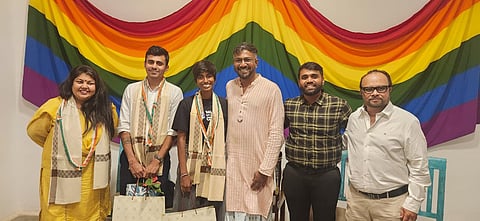
Bengaluru’s queer community gathered at 1Shanthiroad Studio/Gallery on Thursday, August 6, to felicitate athletes Gowthami Kandhasami (Goaty) and Sumit Pawar, who represented India at the Gay Games 2026 in València, Spain. The event, titled Celebrating Queer Excellence, was organised by the LGBTQIA+ and sports verticals of the All India Professionals’ Congress (AIPC), the Indian National Congress’ professional wing, along with Queer Nilayam and Dark Vibe Society.
Goaty won seven medals — four gold and three silver — at the Games. Competing in the 25–29 age category, she won gold in the high jump, the 5 km road race, the 10,000 m indoor run, and the marathon. She also won silver in the 10 km road race, the mixed 4x400 m relay, and the overall women's marathon standings. Sumit won gold in the javelin throw.
The felicitation was led by Priyank Sukanand, head of AIPC Karnataka’s LGBTQIA+ vertical, in the presence of writer, art curator, and historian Suresh Jayaram, founder of 1Shanthiroad Studio/Gallery. Lawyer and human rights activist Arvind Narain, and former Congress MLA from Jayanagar and Karnataka Pradesh Mahila Congress president Sowmya Reddy, presided over the event.
Speaking at the event, both athletes said cost was the biggest barrier to competing.
Goaty said she wanted to attend the previous Gay Games, held across Hong Kong and Guadalajara in 2023 after pandemic-related disruptions split the event between two cities, but could not afford the trip as a student. She later secured funding through the International Front Runners network and the Federation of Gay Games, and helped Sumit join the Indian contingent as a second nominee for the València Games.
Sumit described the Games’ opening ceremony on June 7, when India’s three-member contingent marched behind the national flag, as one of the most significant moments of his life.
Goaty said the Games gave her a sense of belonging. While running is often an individual sport, she said interacting with LGBTQIA+ athletes from countries including Argentina and Lebanon made her realise that many faced similar struggles for acceptance back home.
“Having a space like that where we all came together made us realise we are not alone,” she said. “We have people who are supporting each other.”
She also recounted a lighthearted exhibition race where participants ran in wigs and were awarded tiaras, a recurring Gay Games tradition.
Addressing the gathering, Arvind Narain, who was part of the legal team that challenged Section 377 from the Delhi High Court to the Supreme Court, said sport has the power to bring people together across divisions of caste, religion, and identity, and judges people by ability rather than background. He linked the athletes’ achievements to the constitutional values of justice, liberty, equality, and fraternity.
Sowmya Reddy said the athletes’ achievements pointed to the need for governments to invest more in sporting infrastructure. Responding to a request from the athletes and Bengaluru Front Runners, she said she would arrange a meeting with Karnataka Chief Minister DK Shivakumar to discuss institutional support and recognition for LGBTQIA+ athletes.
Priyank Sukanand said inclusion “must extend beyond policy into every sphere of public life, including sports.” Tejas Raju, chairperson of AIPC Karnataka’s sports vertical, also called for more inclusive sports cultures and greater institutional support for LGBTQIA+ athletes.
Sumit invoked sprinter Dutee Chand, who came out publicly in 2019 and is India’s first openly gay athlete. He said he hoped queer athletes would eventually be seen simply as athletes.
Both athletes also pledged to help build a larger Indian contingent for the XIII Gay Games in Perth, Australia, in 2030, with a target of at least 20 Indian athletes.
This story was written by a student interning with the TNM.
