
Follow TNM’s WhatsApp channel for news updates and story links.
On the first day of the New Year, 2026, in a blow to the democratic process, peaceful protesters in Karnataka’s Vijayapura were aggressively detained to break an agitation for a public cause. A sustained protest over more than 100 days at Ambedkar Circle to safeguard the crucial Vijayapura district hospital from being handed over to an unregulated private sector and demand the setting up of a medical college has been systematically ignored in spite of legitimate demands and concerns.
A planned march toward the residence of the district-in-charge Minister MB Patil, was only because of this lack of response. If the government had acted on the demands of the protesting activists, leaders, and citizens, there would not have been a need to take the protest further. However, many protesters were taken into custody. The way the situation evolved suggests that this was not incidental but premeditated—an attempt to destabilise and silence a people’s movement that had grown in strength and legitimacy with each passing day. And as midnight fell on January 1, the protest shed itself was dismantled.
The arrests and dismantling must be understood against the backdrop of the indefinite protest that had transformed Ambedkar Circle into a living commons. Since September 2025, the Sarkari Vaidyakeeya College Sthapana Horatta Samithi had sustained an agitation that drew men, women, and children into daily acts of resistance. The shed was never silent.
Students filled in postcards – over one lakh in total – addressed to the Chief Minister Siddaramaiah, demanding a government medical college. Groups spoke to morning walkers, ensuring that the issue entered everyday conversations. Even as winter temperatures dropped, the determination of the people did not falter.
On December 1, more than ten thousand people, mostly students and women, gathered under the Samithi’s banner for a massive protest in Vijayapura. Blood signature campaigns and torchlight marches conveyed urgency and sacrifice, while children dropped their savings into donation boxes, proving that the struggle belonged to everyone. By mid‑December, the protest had deepened further, with a round‑the‑clock sit‑in beginning on December 15. Provisions flowed in, cooking began on site, and the shed became not only a protest but a community sustained by solidarity and care.
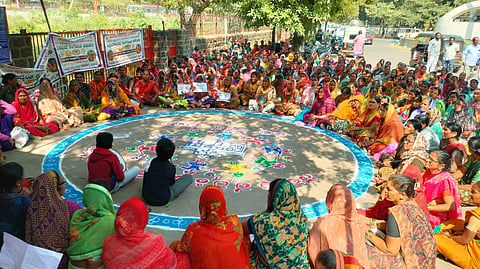
Several networks and organisations came forward to express solidarity with the Horatta Samithi, organising protests and campaigns that carried the struggle beyond Ambedkar Circle. One of the most outstanding among these was the Rangoli Chaluvali of November 18–19, when thousands of women across six taluks and dozens of Gram Panchayats turned streets into canvases of resistance. Organised by Jana Vedike and Karnataka Janaarogya Chaluvali, the initiative drew women into public spaces with rangoli designs of women holding hands in unity, accompanied by drums, speeches, and signature campaigns. What might otherwise be seen as a domestic art form became a powerful political statement: healthcare is a right, not a commodity.
The Rangoli Chaluvali was not the only expression of solidarity. In the district headquarters, organisations such as the Dalit Vidyarthi Parishath, AIDSO, and several others organised demonstrations in support of the Horatta Samithi’s demands. These actions, together with the women’s district‑wide mobilisation, revealed the breadth of the movement: it was not confined to a single protest shed but had become a networked struggle rooted in cultural practice, student activism, and community solidarity.
Yet voices cannot be erased so easily. From postcards to rangoli, from torchlight marches to children’s donations, Vijayapura’s people have shown that resistance is woven into daily life. The arrest of leaders and the clearing of the protest site may have removed the movement's physical presence, but the underlying demand for healthcare as a fundamental right remains. As one organiser put it during Rangoli Chaluvali: “Our colours are our voices. We will not let public health be erased.”
The struggle in Vijayapura is about more than a hospital or a medical college. It is about whether healthcare will serve profit or people, and whether democracy will allow citizens to protest peacefully without fear of arrest. Article 19 of the Indian Constitution guarantees the freedom of speech and expression, the right to assemble peaceably, and the right to form associations. By dismantling the protest shed and arresting peaceful marchers, the state has not only undermined these guarantees but has set a dangerous precedent: that constitutional rights can be suspended when they challenge entrenched interests. Since when did demanding healthcare become a crime?
Also read
Cost of health: How Karnataka's PPP hospitals can shut out the poor from free treatment
The arrests in Vijayapura show that citizens exercising their constitutional rights are being treated as offenders. And while the Congress President Rahul Gandhi speaks often about defending the Constitution, the Congress government in Karnataka has chosen the same playbook as the BJP—suppressing peaceful protest and eroding fundamental freedoms. If both governments silence dissent in the same way, how are they any different?
What happened in Vijayapura is not an isolated incident. Across the country, citizens who raise their voices against privatisation, displacement, or inequality increasingly face restrictions, surveillance, and criminalisation. The shrinking of democratic space is visible in the narrowing tolerance for dissent, where peaceful assemblies are treated as threats and cultural expressions of resistance are dismissed as disorder. Vijayapura’s protest, with its postcards, rangoli, torchlight marches, and round‑the‑clock sit‑ins, reminds us that democracy is not only about elections or institutions—it is about the everyday right of people to speak, assemble, and demand accountability.
The midnight dismantling of the protest shed was meant to erase a commons of resistance. Yet, in its absence, the memory of that space continues to resonate as a symbol of what democracy should protect. The voices of Vijayapura—painted in rangoli, written in postcards, spoken in slogans, and lived in solidarity—echo a larger truth: that without protest, democracy itself cannot survive. And even today, the people’s breath carries two demands that remain urgent and alive: “Save the Vijayapura District Hospital” and “We want a Government Medical College in Vijayapura.”
Teena Xavier is a scholar and activist and part of the campaign to strengthen public health systems in Karnataka. Views expressed here are the author’s own.
