
Subscribe
Rather than lines set in stone, a shared love of music and collaboration led the show at Resonance: A Dialogue Between the Veena and the Bansuri. Resonance saw an exchange between Carnatic and Hindustani traditions of music.
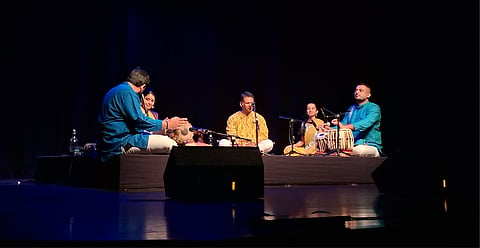
The concert was held on Wednesday, April 22 to a packed audience at the Bengaluru International Centre (BIC). It featured the Brindavani Raga, common to both schools of music and Ramapriya or Indira Kalyan Raga, as they are known in Carnatic music and Hindustani music. Vinod Anoor who played the mridangam, and Vignesh Kamath who played the tabla spoke to TNM after the concert.
Vinod revealed that only around 4 out of the 90 minutes of the program was rehearsed, everything else was guided by their love for the art and tala (rhythmic framework).
The concert was largely led by the veena and bansuri, but concluded with a charged exchange between the mridangam and the tabla. The ragas performed were described by BIC as having “the same soul unfolding differently in each.”
Resonance featured Shubha Santhosh on the veena, Sameer Rao on the bansuri, Vinod on the mridangam and Vignesh Kamath on the tabla. Speaking about this exchange between South Indian and North Indian music, Vinod noted that Hindustani and Carnatic music are only two of the many streams of music in India. “If you go into folk, there are so many, we cannot count them,” he said.
The audience saw these musicians collaborating without words, over unspoken cues. In a conversation with TNM, Anoor discussed the necessity of complimenting the musical style of their fellow musicians. “We had the mindset to collaborate. We were not trying to outshadow someone,” he said, criticising musicians who perform with the intent of “having to get claps” .
Vignesh Kamath further added how even one extra note could lead to disturbing the entire performance, especially when in the context of collaborative performance like in jugalbandi.
“Individual practice or solo playing is like bachelor life. On stage when you are doing jugalbandi or collaborating, it’s like living with a partner,” Vinod said recalling what his masters have taught him. He highlighted the need for coexistence and compromise. Vinod called this collaboration nothing short of telepathy, even going so far as to call it “parakaya pravesha” (entering another body).
Vignesh further discussed how this collaboration should go beyond the stage and how off-stage interactions can help musicians work together. He highlighted his own friendship with Vinod saying “I have a connection with Vinod off-stage…” and added that this helped decide a lot on stage.
Anoor noted how globally accessible Indian music has become through the internet. During his concerts in Europe he was met with audiences who were distinctly aware of Hindustani music and Carnatic music. Vinod believes that through social media people are able to learn and understand about the “who is who” of musical genres, even those which are foreign to you.
Vinod also noted other aspects of technology like AI and its impact on music. He pointed out the AI generated music he has come across, “it will not have the human touch that only we can have as artists, and the individuality we bring.”
Even amongst other students under his guru, he has noticed distinct individuality. “A same guru cannot produce products like 100 products. No, everyone is different,” he said. He called performing the process of innovating all the knowledge and lessons from one’s teacher, trying to assimilate and internalize it, and then putting their own identity to it.
Vignesh highlighted how in the world of music one always had the “same vocabulary, same repertoire, everything the same,” But what made it different was the identity of the performer. “If I play with a different mridangam player than Vinod, maybe he will come with his own palette of colors, you know, he will color it differently,” he added.
This was most particularly seen in the percussion solo bit, where both Vignesh and Vinod got to take center stage and improvise their acts while still complimenting each other. “He did his solo bit, I did my solo bit, trying to interact. I was trying to just reciprocate to what he was throwing across to me” said Vignesh.
This article was written by a student interning with TNM.
Follow TNM's WhatsApp channel for news updates and story links.
