
Subscribe
Karaga, one of Bengaluru’s most colourful festivals, was in the spotlight at the National Gallery of Modern Art (NGMA) on Sunday, June 28. Community organisation Heritage Beku and historian, researcher, and author Sunitha Srinivasan came together to talk about the 11-day festival of devotion, dance, and tradition.
Karaga is an age-old festival associated with the Thigala community in Bengaluru, centered on devotion to Draupadi, seen as Adi Shakti or the Divine Mother, and culminating in a nocturnal procession carrying the Karaga (decorated pot).
Priya Chetty-Rajagopal, founder of Heritage Beku, opened the evening by framing what was to come, before handing it over to Sunitha, who spent 3 years researching the Karaga festival and recently published a book on the subject, Eleven Days in Summer.
Using images from her book taken by photographer Hubert Reilard, Sunitha took the audience through the proceedings – the processions, the rituals, and the scale of participation that turns Bengaluru’s streets into a living shrine. She explained that the Karaga is an 11-day festival, not just the one-night procession most Bangaloreans believe it to be. The entire festival centres around the Shri Dharmaraya Swamy Temple in KR Market, which was built by the Thigalas themselves.
The priest who carries the karaga on his head begins his training 6 months before the festival and must take a vow of celibacy on Rama Navami. Over the 11 days, devotees too give up everything, they fast and lose out on sleep, all to show their unwavering faith to the goddess.
The festival starts with the hoisting of the flag, for which a sacred bamboo tree is used. A select group of men take a 30-foot tall bamboo post from the Bannerghatta forest and carry it themselves through the streets of Bengaluru to the Dharmaraya temple.
Next, a shuddhi karya ceremony is performed to ward off evil spirits. The Karaga priest then carries the goddess on his head in the form of a pot to a Dargah, where an interfaith ceremony brings together different communities. The 10th day is the Potharaja puja, which is performed by the Potharaja community alongside the Thigalas. The festival ends on the 11th day with the priest taking the karaga from the Sampangi tank to the Dharmaraya temple.
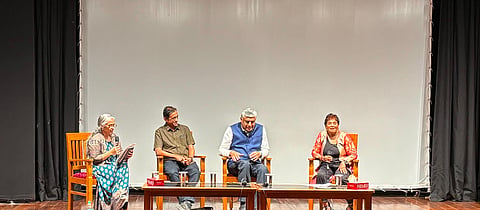
The evening at the NGMA then pivoted to dialogue. Wequity founder and motivational speaker Geetha Kannan moderated a panel featuring Sunitha Srinivasan, entrepreneur and tech leader MD Ramaswami, and chair of AICC Research and former Rajya Sabha member MV Rajeev Gowda. Their discussion grounded the festival’s significance in lived experience and the city’s hidden heritage.
The panelists discussed what drew them to the Karaga festival and shared personal memories of witnessing it. They spoke about how Bengaluru has hidden villages with ancient traditions that most residents don’t know about.
Sunitha pointed out that women play a central and powerful role in the Karaga festival. “There is huge empowerment for the women, and in fact, two days of this entire festival are completely run by the ladies,” she stated.
When asked about the need for books like Sunitha’s to document these traditions for future generations, Rajeev Gowda said, “One of the marvelous aspects of the community is that even in these modern, stressful times, they’ve managed to preserve these traditions across generations. But given the migration and nuclear families today, it’s becoming difficult to maintain connections and rootedness to the land and its traditions.”
Speakers further emphasised that Bengaluru has far more history and culture than just IT hubs and malls. They stressed that for the city to keep its identity, citizens must actively participate in and respect these traditions.
The programme also included a short performance by Kalaripayattu artist Prakash Kumar and his two students, followed by a martial art performance by Rekha, the only woman anchor of the art form from the Thigala community.
This article was written by students interning with TNM.
