
Subscribe
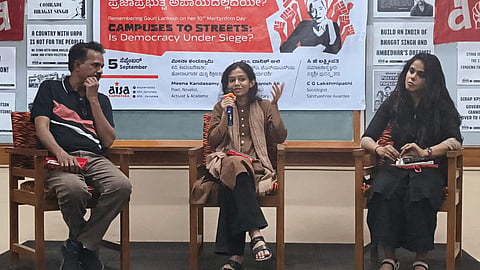
Nine years after an assassin tried to silence journalist Gauri Lankesh, the All India Students' Association (AISA), the student wing of the CPI(ML) Liberation, held a panel discussion titled ‘Campuses to Streets: Is Democracy Under Siege?’ in Bengaluru on September 5, marking the 9th anniversary of the journalist-activist’s assassination.
Nine years after her killing, the case continues at what critics have described as a painfully slow pace. The organisers opened the event with the call “Naanu Gauri”, meaning “I am Gauri”, urging people not simply to grieve her death but to carry forward the memories and ideas she stood for.
The panel featured Jawaharlal Nehru University Students' Union (JNUSU) Joint Secretary and AISA leader Danish Ali, who has been active in student politics since 2019 and was among the hunger strikers at Jantar Mantar; sociologist and author Lakshmipathi CG, who writes extensively on caste; and writer-activist Meena Kandasamy, known for her poetry on Dalit and feminist resistance.
The three speakers also released a booklet curated by AISA Karnataka on the state of public education in India, with a focus on schools and universities in Karnataka. The booklet describes the National Education Policy (NEP) as “a dangerous intersection of neoliberalism and saffronisation” that reshapes education in the interests of capital, caste and ideological control.
Danish recalled hearing about Gauri's murder as a school student in 2017. She said the killing made her question India's claim to being a democracy, questions that, she said, remain unanswered nine years later and ultimately pushed her towards student politics.
Danish said dissent on campuses across India continues to be met with rustication, fines and police cases. She was among the JNUSU members fined Rs 20,000 each after protesting a surveillance system that the university sought to introduce. The university also imposed a fine of Rs 19,000 on each student who was not directly involved in the protest. “The JNU administration shamelessly fined them for attending, clapping and sloganeering at the protest site,” she said.
She said this year's movement against the leak of NEET question papers began online, as people started “rejecting their whole politics of labelling”. She said the movement grew from social media into street protests at Jantar Mantar and in various parts of the country, which she claimed eventually forced the resignation of Union Education Minister Dharmendra Pradhan.
Danish said the resignation alone would not address the corruption behind the leaks and reiterated the movement's demand for the repeal of the NEP.
Danish also alleged that mainstream media had largely stopped holding the government to account, while independent journalists had instead faced the brunt of state action. “It is only doing the job of flattering the people sitting in the government,” she said.
She cited the case of Shaheen Khan and Nafisa Khan, two freelance journalists with the digital outlet 4PM News Network who were allegedly detained and beaten by Delhi Police at Saket police station on September 3, days after covering an event attended by Delhi Chief Minister Rekha Gupta and Union Home Minister Amit Shah.
The two journalists and press bodies, including the Press Club of India and the Delhi Union of Journalists, have alleged that police officers assaulted them further and used religious slurs after learning that they were Muslim. Delhi Police has denied the allegations, saying the journalists' scooter had obstructed a security route and that they lacked identity cards.
“If you tolerate injustice in one region, don't think that injustice will not be implemented where you stand now,” Danish said.
Danish also said pellet guns, previously used by security forces against protesters in Jammu and Kashmir, were used for the first time in Delhi against students demonstrating at Jantar Mantar. She said the police response to the NEET protests had also extended to her family: officers questioned her neighbours and called her father, warning him, according to Danish, to “tell your daughter to focus on her studies and not participate in any kind of politics.”
Lakshmipathi argued that caste hierarchies within families function as the earliest site of what he called fascism, before students encounter it on a larger scale on campuses. “Caste is fascism,” he said.
He pointed to Karnataka's higher education system, which he said comprises 43 government and 29 private universities, several of them run by dominant caste groups such as Lingayats and Vokkaligas, or by religious mathas and madrasas.
Lakshmipathi said students at colleges run by mathas and madrasas receive religious instruction instead of scientific or professional training. He also pointed to seers who continue to run such institutions despite facing scandals of their own. “They are not teachers. They never have a teacher in their class; they are preachers,” he said.
He said such institutions demand compliance rather than critical thought, describing the result as classrooms turning into “caste-rooms” that marginalise students from minority communities.
Lakshmipathi said this pattern extends beyond Karnataka and is replicated across India's education system.
Meena said the assassinations of Lankesh and other rationalist writers, along with continuing legal cases against activists, have encouraged self-censorship at two levels within India's literary community — among authors and publishers.
She referred to Penguin Random House's reported decision not to publish Sonia Gandhi's memoir, saying the episode demonstrated how even well-known voices can be drowned out.
Meena also criticised the NEP, arguing that it enables privatisation, bypasses reservation mandates in faculty recruitment and introduces multiple public examinations throughout students' school years. She said these measures were designed to push students out of the education system rather than retain them.
She also spoke about the rewriting of NCERT textbooks and what she described as the manipulation of history and culture. This rewriting of culture, she said, “started with the destruction of the Indian Knowledge system. Brahmanism could not tolerate the fact that traditions were thriving outside of the Vedic fold.”
Meena recalled her father telling her after Lankesh's assassination: “Even if people knock you down for being a writer, you can understand that at least you have meaning in your death.”
AISA closed the discussion by urging students to carry the conversation back to their campuses with the call: “Refuse to be reduced to marksheets. Refuse to be reduced to resumes.”
This story was written by a student interning with TNM.
Follow TNM's WhatsApp channel for news updates and story links.
