
Subscribe
The larger goal behind the recent meeting of Kannada and Marathi language groups in Bengaluru was to build a language equality movement, foster federalism, and advocate for the rights of states, Karnataka Rakshana Vedike (KRV) leader Arun Javgal said, while acknowledging that there are tensions between the two groups.
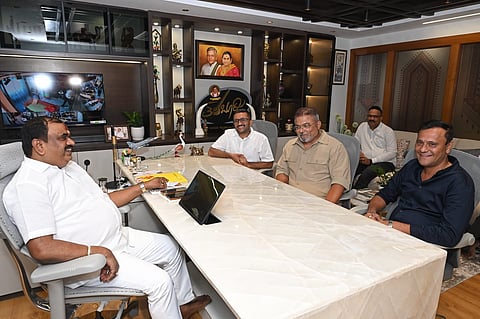
KRV’s meeting with members of the Maharashtra Navanirman Sena (MNS) had taken many by surprise and sparked interest on social media, as both groups have previously clashed over language-related issues along the Karnataka-Maharashtra border.
Arun Javgal and others of KRV met with Maharashtra Navanirman Sena general secretary Yogesh Parolekar and Mumbai president Sandeep Deshpande on August 29 and 30 in Bengaluru.
Calling it a “long-pending meeting”, Arun said, “For more than two decades, both KRV and MNS have been fighting against Hindi imposition and for the linguistic and employment rights of our respective people.” He added that “mutual support and understanding between the two organisations is not new” and that the two organisations have supported each other’s campaigns in the past.
Maintaining that KRV was committed to Kannada interests, Arun said that the two groups must fight for common issues. “The fight against Hindi imposition is not a Karnataka-versus-Maharashtra issue. It concerns linguistic equality, the rights of all Indian languages, and a genuinely federal India,” he said.
Language equality
Speaking to TNM, Arun pointed out that the idea for the meeting did not come out of the blue, nor was it the first time that KRV has collaborated with language rights groups. He said that a round table conference was held in 2017, involving language rights groups from West Bengal, Punjab, Tamil Nadu, and other states. For several years, he said, MNS and KRV supported each others’ campaigns, although it was mostly online.
The idea now, Arun said, was to build a national-level forum to fight for language equality. “There are issues, such as the Cauvery river water dispute and the border issue with Maharashtra. But despite the problems, we can fight along with other language groups for common issues. ”
He said that the two-day meeting involved discussions on setting up a national level forum, holding events in different cities, and initiating discussions with other language groups.
“We want to invite even Hindi groups to talk about language quality. More than 40 languages have been clubbed under Hindi, such as Awadhi, Bhojpuri, and Rajasthani. These languages have no official status. In some ways, their situation is worse, because at least languages such as Kannada have their own identity.”
Arun also said that Sitakant Mohapatra report of 2004 had recommended the inclusion of over 30 languages in the Eighth Schedule of the Constitution. “Several of these languages are grouped under Hindi. But the Union government won’t [include those languages in the Eighth Schedule] because it will reduce the number of Hindi speakers. Hindi is being imposed on them too.”
He said that the aim is to organise an event in Delhi on February 21, which is International Mother Language Day. At the proposed event, language equality, Hindi imposition, and federalism will be discussed by groups from across the country.
Language rights and federalism are closely related, Arun said, pointing out that the effects on people’s lives ranged from what languages banks printed forms in, to languages approved for exams and voting rights of states in the GST Council that impacted their access to funds and therefore how they spent the money for the development of their states.
Arun cited the example of policymaking. He said, “Article 343 says India’s official languages are English and Hindi. Any draft policy or law by the Union government is published only in these languages. We don’t have the right to participate in policymaking in our languages and we are a democracy.”
He said that efforts would be made to reach out to political parties and language rights groups in Kerala, Tamil Nadu, Punjab, Odisha, and Telangana, as well as organisations fighting for languages that have been clubbed under Hindi.
Follow TNM's WhatsApp channel for news updates and story links.
