
Subscribe
Discarded like curry leaves after a meal is how 51-year-old Mohandoss Ganesan describes the situation he and 83 others are in. Mohandoss is the secretary and treasurer of the Karnataka General Labour Union (KGLU) that took their employers—who are part of the Nirma Group—to court for fraudulently claiming that they were labourers hired for contractual work. The court agreed with them and ruled in their favour, ordering the company Nuvoco Vistas Corporation to pay arrears in lakhs of rupees to each of the 84 workers of the union. But when the 20-year battle—fought in the courts and on the streets—ended in victory for the union, the company challenged the ruling in the Karnataka High Court.
Mohandoss Ganesan joined a ready-mix concrete (RMC) manufacturing plant owned by Larsen and Toubro in 2002. At the time, L&T owned five RMC plants in Bengaluru and one in Mysuru, and paid the salaries directly to the workers along with contributions for Employees’ State Insurance (ESI) and Provident Fund (PF).
In the early 2000s, the company began listing some workers as subcontractors and made it look like the workers, including Mohandoss, received their salaries from these subcontractors. However, the work done by these workers was the same as that done by the rest.
By this time, many workers at L&T’s RMC plants had already put in several years of work. “You work hard for the whole year and wait for April. Imagine getting an increment of 15 paise per day on your wages. Between 1996 and 2004, our increments used to be something like 15 paise, 50 paise, 60 paise, 20 paise… We were angry. Someone we knew suggested we form a union, saying that it might give us some security. When we formed the union, we had absolutely no security.”
Initially, the union was affiliated with the Centre for Indian Trade Unions (CITU), which is the labour wing of the Communist Party of India (Marxist). In 2012, the union quit its association with CITU and became affiliated with the All India Central Council of Trade Unions (AICCTU), the labour wing of the Communist Party of India (Marxist-Leninist) Liberation.
Soon after they formed and registered the union in 2004, they began to demand the regularisation of their work. For about five-six months, they protested by slowing production. The plants ran around the clock, and the workers worked in shifts. So, each day, from the usual 80-90 vehicle loads of ready-mix concrete, they slowed production to about one load an hour, to about 17-18 vehicle loads per day, Mohandoss said.
The company retaliated by effecting salary cuts, withholding bonus and other measures. When the workers raised a dispute with the Labour Department under the Industrial Disputes Act 1947, the company finally had to pay the owed wages through the Department in 2005.
“Back then, our wages used to be about Rs 4,000 a month. During the settlement, they raised it to about Rs 8,000,” Mohandoss recalls. They also asked for their appointments to be made permanent, but the company simply refused.
Around this time, L&T roped in a company called Total Solution Support Services through which it routed the workers’ salaries.
In 2008, a company named Lafarge India Limited took over the RMC plants from L&T. The business transfer agreement dated June 24, 2008, stated that none of the workers would be removed.
In November 2010, Total Solution was replaced by a firm called Wize-Men HR Services, which retrenched all the workers. In protest, they struck work at all six units. “We put up tents outside the factory. We sat there without a rupee paid in wages, cooked and ate right there outside the factory, we even asked people for money to help us get by,” Mohandoss said.
Ten months after they launched their protest, the Labour Secretariat passed an order saying that the retrenchment was illegal and the workers could rejoin.
The fight for regularisation continued. Lafarge changed its name to Nuvoco Vistas Corporation in 2017, after it was acquired by the Nirma Group the previous year. Nirma Group is the fifth-largest cement group in India and the leading cement player in eastern India in terms of capacity, according to its website. Its business includes cement, ready-mix concrete (RMC), and modern building materials. Nuvoco has a presence in 85 locations across the country, including 13 cement manufacturing plants and 53 RMC plants across the country.
KGLU placed its charter of demands before Nuvoco on October 31, 2012. Again, the union demanded that all the workers be regularised.
When the company did not respond positively, the union raised a dispute with the Labour Department under the Industrial Disputes Act 1947 (ID Act). When conciliation failed, the Labour Department, on November 22, 2013, referred the matter to the Industrial Tribunal under Section 10(1)(d) of the ID Act.
Regularisation would mean a substantial financial gain for the workers—permanent workers are paid at least double what Mohandoss and others who are reflected as contract workmen get for doing the same job, Mohandoss explained.
For instance, Mohandoss is a loader and machine operator. He earns around Rs 45,000 a month, but his actual pay is only half that. “We have an unwritten agreement with the management of having a 12-hour shift for each worker—eight hours of regular duty and four hours of overtime. The money is for overtime duty. Without that, we would get only about half that amount,” Mohandoss said.
In comparison, a loader and machine operator who is a permanent employee makes Rs 75,000. “At least eight of our union members were made permanent staff by the management, to break the union. They created permanent posts of operators only in 2010, and now there are two each at every plant,” Mohandoss alleges.
Like machine operators, Mohandoss says that a handful of people doing other tasks, such as accounts and purchasing, have been made permanent, and their pay is substantially higher than that of those who are still contract workmen. “We should get the same amount as permanent employees.”
Nuvoco did not respond to this allegation when contacted.
The court battle
In the tribunal, the union accused Nuvoco of continuing L &T’s practice of fraudulently showing the workers as contract workers. They accused the two companies of deploying Total Solution and Wize-Men Services as “sham” contractors solely for the purpose of denying workers the financial and other benefits that would be due to permanent workers.
The case made out by the union gets its legal impetus from case law and the Fifth Schedule of the Industrial Disputes Act, which lists unfair labour practices that are punishable by a six-month prison sentence, a fine of Rs 1,000, or both.
Among the unfair labour practices listed in the Fifth Schedule is the employment of '‘badlis’, casuals or temporaries, and to continue them as such for years, with the object of depriving them of the status and privileges of permanent workmen”.
The idea outlined in this provision was at the heart of the union’s case against Nuvoco—workers had toiled day after day for over two decades in the same manufacturing units despite the change in ownership, and so, must be treated as regular workers.
Nuvoco argued that it had separate staff for contract work and that its regular workforce was different. It claimed that it had no say in any matter regarding the workers, including in hiring, payment of wages, ESI and PF, maintenance of attendance, or disciplinary action. All control and supervision of the workers lay with the contractors, first Total Solution, and then Wize-Men.
Nuvoco claimed that what the workers were asking for required a prior abolition of contract labour and then adjudication regarding regularisation, which it claimed was beyond the scope of the tribunal.
What Nuvoco was referring to was Section 10 in the Contract Labour (Regulation and Abolition) Act 1970 (CLRA Act), which allowed the government to prohibit the use of contract labour in an establishment.
Nuvoco cited several court rulings to support its case, but the tribunal rejected those citations by relying on the 2001 Supreme Court judgment in International Airport Authority of India vs International Air Cargo Workers’ Union. Justice P Sathasivam held that the industrial tribunal has the power to go into the question of whether a contract system is sham and bogus even without a notification under Section 10 of the CLRA Act.
Evidence
In the tribunal, the union had to establish that the nature of the work they did was permanent, and because they had done that work for over two decades, they must be treated as permanent workers. They also argued that “sham” contractors were introduced with the sole intention of denying them the benefits they were entitled to.
The union established in court that the work done by the workers at the RMC plants was crucial to Nuvoco’s RMC business, without which the plants could not function. The workers carried out every task of the production process, such as conveyor operator, cube casting, wheel loader operator, welding, electrical, lab technician work, and so on. The tribunal noted that the workmen had signed invoices, technical reports as lab technicians, and that workers had even been transferred from one unit to another.
The union presented documentary evidence that showed that the workers had all joined between 1996 and 2004, well before Total Solution came into the picture. Indeed, Total Solutions came into existence only in 2005 and did not appear before the tribunal at all.
Until 2002-03, L&T directly paid the workers. But in 2002, they began to project some of the workers as subcontractors through whom Mohandoss and others were paid, even though the so-called subcontractors did the same work as Mohandoss and others.

Advocate Avani Chokshi and Shilpa Prasad, who represented the union in the tribunal, told the court that neither Nuvoco nor its contractors had the licences or registration certificates mandated by the CLRA Act.
For instance, contractors are supposed to apply for a licence under Section 12(1) of the CLRA Act, which prohibits contractors from carrying out any work without a licence. Avani pointed out that Total Solution did not have the licence at all, while Wize-Men first obtained a licence under Section 12(1) only in 2010, two years after it took over from Total Solution. It later obtained licences for each plant in 2011, 2017, and 2019, but for only a few workers.
Nuvoco, as the principal employer, was supposed to obtain a registration certificate under Section 7(2) of the CLRA Act, but it did not do so until 2015—two years after the matter reached the Industrial Tribunal.
Nuvoco claimed before the Tribunal that it had no control over the workers, but neither Nuvoco nor Wize-Men presented “reliable materials” to show that after taking over the business in 2008, Nuvoco appointed “permanent workmen to attend the permanent nature of manufacture of ready-mix concrete in all the plants situated at different places and to transport it to the end point of customers”.
The Tribunal noted that the charter of demands was first raised on July 3, 2005, well before Wize-Men came into the picture. All the records produced by Wize-Men pertaining to disciplinary action or dismissal order of employees, muster rolls, pay slips, PF challans, etc., were from the period after the dispute was referred to the Industrial Tribunal.
Avani also pointed out in court that entry and exit to the RMC plants owned by Nuvoco were controlled by a biometric system maintained by Nuvoco, and leave applications were submitted to L&T and subsequently to Nuvoco.
It also noted that the cheques given to two retired employees show that their service period was calculated from 2002, before the introduction of the contractors.
Similarly, concerning supervision, Nuvoco claimed that Wize-Men’s staff supervised the workers at the RMC plants. Wize-Men presented a witness who it claimed was a supervisor. However, the person in question told the Tribunal that he was a BCom graduate who worked in the accounts department of Wize-Men.
The Tribunal said that it was “very difficult to believe” that a person with no technical knowledge of RMC plants was a supervisor, and that, too, the sole supervisor of six plants located across Bengaluru and Mysuru.
All this evidence, Presiding Officer of the Industrial Tribunal at Bangalore M Jagadeeswara, noted, further negated the company’s claims that it had no control over the workers.
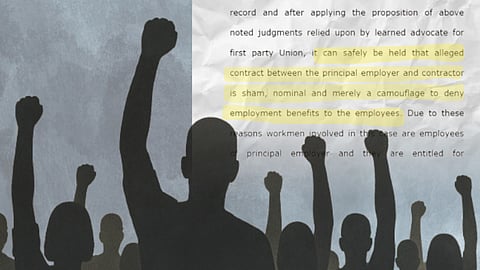
After going through the records put forward by both parties, Jagadeeswara noted, “All those contract agreements… are sham, bogus and merely a camouflage to deprive the benefit to the workmen…”
Although the Tribunal’s order is dated September 1, it was only made public on November 12 after it was published in the Gazette by the Labour Department as mandated by the ID Act.
It ruled that the workers were entitled to regularisation and all the benefits that came with it, effective from 2013, the year that the dispute was raised. It ordered Nuvoco to pay arrears and other benefits within three months of the publication of the order in the Gazette. This means that each worker is entitled to receive 12 years’ worth of arrears, which is lakhs of rupees for each of the 84 workers.
“I am very happy about the verdict. Because I was a witness in the case,” Mohandoss said. He was the sole witness put forth by the union.
But this happiness was short-lived.
Closure of plants
Nuvoco Vistas Corp Ltd wrote to the Labour Secretary on September 26, 2025, under Section 25-FFA of the Industrial Disputes Act, stating that it was closing six factories in Karnataka—five in Bengaluru, and one in Mysuru—on or after 60 days from the date of the notice.
The company said that the reason for the closure was losses which ran into crores of rupees due to “intense market competition” in Bengaluru. The company claimed that it was facing “pricing pressure” not only from large industry players but also from an increasing number of small-scale operators. It provided a detailed breakdown of the losses at each plant.
Two months later, 26 workers received cheques ranging between Rs 6-9 lakh along with termination letters dated November 22 from Wize-Men. The firm said that the termination letters were “in continuation” of its notice dated October 7 and that the workers would be relieved after closing hours on November 25. The compensation in the cheques comprised compensation under the Industrial Disputes Act, gratuity, leave encashment and bonus.
“How do we accept that pittance of Rs 6 lakh and continue our lives? We told them that whatever money is to be given to us, should be given by the company according to the court order,” Mohandoss said.
Their advocate Avani submitted these cheques to the City Civil and Sessions Judge and obtained an ex parte temporary injunction prohibiting Wize-Men from acting against the workers, as the Industrial Tribunal ruled that Wize-Men was a sham company and the workers were employed by Novoco.
“I’ve been working here since 2002. At the time, wages were Rs 25-30 per day. All these years, I have lived with this fight. We can go ahead fearlessly because of our lawyers. They stood by us. Even now, they told us to go ahead and protest and that they would take care of the rest. The company has shut the plants, but we’ve been sitting inside the plant premises, just inside the gate. It’s just the security guards and us,” Mohandoss said.
Since November 26, the workers have turned up each day at the four plants in Bengaluru and one in Mysuru, in protest against the closure order. “People from the company turn up with the police to drive us away. So we wrote to the DCPs asking for protection,” Mohandoss said.
On December 12, Nuvoco filed a writ petition in the Karnataka High Court seeking the quashing of the order passed by the Industrial Tribunal. But in the interim, it sought a stay on the Tribunal’s order, which the HC granted on December 15, after noting that there was a dispute regarding whether Nuvoco or Wize-Men was supposed to pay the workers. The High Court said that the “issue regarding payment of the amount requires hearing on the merits of the case”. The case will now only be listed after the winter vacation.
“Our struggle is not small. Working in the cement industry with its dust and fly ash is not easy. For more than 30 years, we’ve worked in that dust. Many of us, including me, have dust allergies. We worked like this and got profits for the company. Now that it’s time for them to do something good for us, they’re throwing us out like curry leaves from the plate. They’re thinking of getting new curry leaves. Can we let this go? I am very disappointed in the company, and also very angry. So we’re continuing to fight,” Mohandoss said.
The union has challenged the termination of the workers by raising a dispute with the Assistant Labour Commissioner at Bengaluru. The union has accused Nuvoco of retaliating against the unionised workers by illegally retrenching them to avoid giving them the financial arrears as ordered by the Industrial Tribunal.
The process started on June 12, when workers found a notice put up at the Sarjapur plant stating that workers would be terminated from August 1, as the lease agreement for the plant had expired and could not be renewed. The management refused to engage with the workers. Despite the workers repeatedly expressing their willingness to work, the management put up another notice the next day, accusing the workers of “unauthorised and abrupt stoppage of work”. The union raised the matter with the Industrial Tribunal, which ordered in July that the status quo be maintained.
On October 7, Wise-Men put up a notice saying that it was terminating the services of all the workers as Nuvoco had intimated to them about the closure of the plants in Bengaluru and Mysuru with effect from November 26.
By this time, the Industrial Tribunal actually ruled in favour of the workers, even though the gazette notification was issued only on November 12.
“The (union) workers were shocked to see such a notice, as it was merely an attempt to evade the implementation of the Award by removing all the workers through the sham-contractor before the Award came into effect,” according to the dispute filed with the Assistant Labour Commissioner.
Amid this, Nuvoco went ahead with the closure of the plants and outsourced production to other local manufacturers, the dispute said. “This was because Nuvoco is highly profitable and continues to receive orders to date, and hence to fulfil its obligations, has continued production through third-party RMC plants. Invoices as late as Nov 2025 have been issued by (Nuvoco),” the dispute said.
The union claimed that in the financial year ended March 2024, Nuvoco had a profit of Rs 207 crore before tax. “Thus, without any rhyme or reason, the Second Party is attempting to retrench the workers… The union also apprehends that Nuvoco will remove all the union workers and show name-sake that it has stopped in Karnataka, only to subsequently re-start production through outsourced agencies, third-party RMCs, or through franchisees, to avoid having to employ the first-party workers,” the dispute said.
In an emailed response, Nuvoco said that the company’s decision to close the plants was “driven by the region’s ongoing operational challenges and long-term lack of viable profitability, despite continued efforts to revive the business. This decision is independent of and unrelated to the Industrial Tribunal’s award.”
Stating that the matter was sub-judice, Nuvoco claimed that the retrenchment and closure were carried out “in compliance with applicable legal requirements, including the issuance of statutory notices under the Industrial Disputes Act. The Company is not operating through toll manufacturing or third-party arrangements.”
Mohandoss’s biggest fear is the permanent closure of the company. The men who fought unitedly for so long may just be defeated by time. “We’re all over 50 now. If the companies close permanently, how will we find work at this age?”