
Subscribe
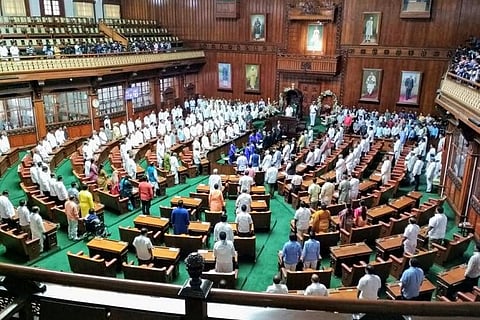
The Karnataka Assembly passed a bill against honour killing on Monday, March 24, despite opposition from members of the BJP who argued that there was no need for such a law.
Law Minister HK Patil tabled the Karnataka Freedom of Choice in Marriage and Prevention and Prohibition of Crimes in the Name of Honour and Tradition (Eva Nammava Eva Nammava) Bill 2026, in the Assembly.
The inclusion of the phrase “Iva Nammava, Iva Nammava” in the Bill is a reference to a 12th-century Kannada Vachana by Basavanna, meaning “He is ours, He is ours.”
“We hear about honour killings. This law paves the way for social transformation or even revolution as it gives legal safeguards to prevent crimes committed against persons choosing inter-caste marriages,” Patil said while tabling the bill.
The bill was introduced after a man killed his 20-year-old pregnant daughter and her unborn child for marrying a Dalit man in Hubballi taluk. In a 2024 report titled ‘In the Name of Honour’, the People’s Union for Civil Liberties-Karnataka documented 13 honour-related attacks between January 2022 and December 2023, resulting in the deaths of 12 individuals.
Home Minister G Parameshwara had said in the Legislative Council on March 12 that there had been 15 honour killings in the past five years in response to a question by MLC Kishore Kumar Puttur.
The bill recognises that consenting adults have the freedom and the right to choose their life partners and that no one has the right to interfere with that choice.
Recognising that inter-caste couples need the protection of the police and support from the local administration, the bill creates a comprehensive support system which includes preventive measures, awareness raising, and detailed procedures on what the local administration must do when couples reach to seek protection.
The local police and district administration must provide protection, including shelter, to couples who fear that they may be attacked or threatened within six hours of receiving such intimation.
The state government must set up safe houses in each district for such couples with adequate security and due regard for their privacy. Such a place must also have access to facilities to meet lawyers or other supporters such as NGOs.
A crucial aspect of the law is that it directs officials found to have wilfully neglected their duties under the law be faced with departmental proceedings, and punished with up to two years’ imprisonment and fines.
It directs the officials concerned to record complaints of any person, witness or informant with regard to an offence under the act, register an FIR when necessary, and file a chargesheet with the special court within 60 days.
The Bill also gives the police and the district magistrate the power to prohibit unlawful assemblies and provide logistical support to couples seeking to marry, and arrange for a safe house on payment of nominal fees up to a year after the marriage based on threat assessment.
The law also directs the state government to identify districts where honour killings have been known to occur in the past five years and take measures to sensitise the public as well as government officials. It also envisages the creation of a special cell in every district to prevent crimes carried out in the name of “tradition” and establish dedicated helplines.
Each district would have an ‘Eva Nammava Vedike’, a committee with a retired judge, police officer, revenue officer, sub-registrar and others to facilitate solemnisation of marriages and provide counselling.
The government “may” designate certain courts as track courts to try cases for offences committed under the law.
Opposition
Several MLAs from the Opposition BJP objected to the bill. While former law minister S Suresh Kumar objected to the provision of the bill on couples declaring their intent to live together.
Karkala MLA V Sunil Kumar asked how the law was better than the provisions in the Bharatiya Nyaya Sanhita (BNS).
Leader of the Opposition in the Assembly R Ashoka however, pointed out that the government had not addressed the issues of the witnesses turning hostile, leading to poor conviction rates in cases of such killings.
Law Minister HK Patil assured the Opposition that their concerns would be addressed while framing the rules.
Follow TNM's WhatsApp channel for news updates and story links.
