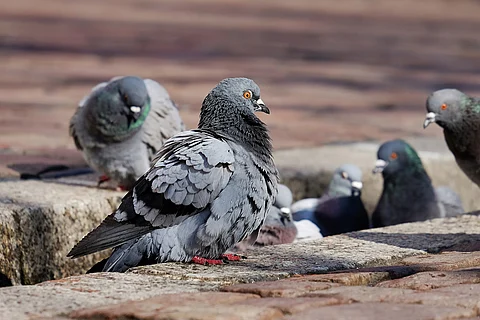

The Karnataka government has initiated steps to regulate and, where necessary, prohibit the feeding of pigeons in public spaces across the state, citing growing public health risks. The move follows concerns raised by health authorities about respiratory illnesses associated with prolonged exposure to pigeon droppings and feathers.
In a letter dated December 16, the Health and Family Welfare Department asked the Urban Development Department to issue directions to the Greater Bengaluru Authority (GBA) and all municipal corporations to immediately implement regulatory measures. The department noted that unregulated pigeon feeding has led to excessive bird populations in densely populated areas, resulting in sanitation issues and increased health hazards, particularly for people vulnerable to lung-related illnesses.
Health officials warned that medical evidence links exposure to pigeon droppings and feathers to conditions such as hypersensitivity pneumonitis and other chronic respiratory diseases, which can cause serious and, in some cases, irreversible lung damage. The department said municipal authorities must act to mitigate the risk of disease spread arising from such practices.
Under the proposed framework, feeding pigeons will be prohibited in locations where it causes a public nuisance or poses a health risk. Feeding may be permitted only in designated zones, which must operate under controlled conditions and limited hours. These areas are to be identified in consultation with stakeholders, with responsibility for their upkeep and compliance placed on recognised charitable organisations or non-governmental organisations.
The government has authorised local body officials to strictly enforce the guidelines. Officers may issue on-the-spot warnings, impose fines, or initiate prosecution against violators. Legal action can be taken under provisions of the Bharatiya Nyaya Sanhita, including Sections 271 and 272, which deal with negligent and malicious acts likely to spread infectious diseases dangerous to life, carrying penalties ranging from fines to imprisonment.
The department also directed municipal corporations to undertake public awareness campaigns to inform citizens about the health risks associated with pigeon feeding, the regulatory framework being introduced, and the penalties for non-compliance. Authorities have been asked to use signboards, banners, and digital messaging, while also promoting alternative and humane methods of bird conservation that do not compromise public health.
In its note, the government referred to similar action taken in Mumbai, where the Brihanmumbai Municipal Corporation sealed pigeon-feeding enclosures following directions from the Bombay High Court to address public nuisance and health concerns. Officials said civic bodies in Karnataka already possess sufficient statutory powers under existing laws to take preventive action.
These powers include provisions under the Greater Bengaluru Authority Act, 2025, and the Karnataka Municipal Corporations Act, 1976, which enable local authorities to enforce public sanitation standards and prevent the spread of diseases. The Health Department emphasised that the objective of the move is not to target animal welfare practices but to strike a balance between humane treatment of birds and the protection of public health in increasingly crowded urban environments.