
Subscribe
Follow TNM's WhatsApp channel for news updates and story links.
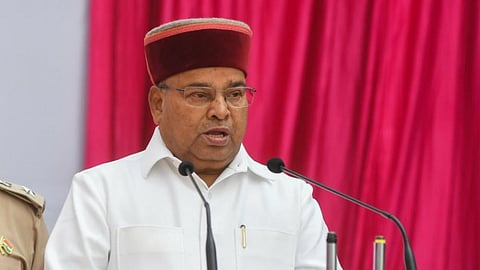
Karnataka Governor Thaawarchand Gehlot has reserved the Karnataka Hate Speech and Hate Crimes (Prevention) Bill, 2025 for the consideration and assent of the President. In a communication sent to the state government, the Governor said he was exercising his powers under Articles 200, 201 and 254 of the Constitution to reserve Bill LA No. 79/2025 for Presidential consideration, noting that the proposed law required closer scrutiny to assess its constitutional validity.
While acknowledging that hate speech poses real harm to society, the Governor cautioned against curbing fundamental freedoms in the process. “There is no doubt that hate speech is harmful to society. But killing freedom in the name of preventing hatred is not the solution. In a free society, the answer to hatred should be ‘free speech,’ not ‘dictatorial laws,’” he said, adding that education, culture and awareness were more sustainable tools to address hatred.
The Bill, which was passed during the winter session of the Karnataka legislature in Belagavi in December 2025, seeks to prevent hate speech and hate crimes in the state. It defines hate speech as any spoken, written, visual or electronic expression that causes injury, disharmony, hostility or hatred against an individual or group based on religion, race, caste, gender, sexual orientation, place of birth or disability.
One of the Governor’s key objections relates to the breadth and vagueness of this definition. Referring to Section 2(1) of the Bill, he warned that the provision could potentially criminalise ordinary speech, intellectual criticism or academic discussion, and could lead to subjective and arbitrary enforcement. The note flags the risk of a “chilling effect” on free expression under Article 19(1)(a) of the Constitution.
The Governor also raised concerns about the enhanced punishments proposed under the Bill. Under provisions corresponding to Sections 196(1) and 196(2) of the Bharatiya Nyaya Sanhita, imprisonment can extend up to seven years even for first-time offences, with fines starting at Rs 50,000 and rising to Rs 1 lakh for repeat offences. Several offences have been reclassified from bailable to non-bailable, and from non-cognisable to cognisable.
Calling the punishment framework “shocking” and “repressive”, the Governor pointed out that non-bailable detention combined with severe prison terms raised questions of proportionality and procedural safeguards under Articles 19 and 21 of the Constitution.
Another major concern highlighted is the introduction of collective and organisational liability. The Bill makes leaders and office-bearers of both registered and unregistered organisations criminally liable for hate speech allegedly committed during meetings, rallies or events conducted under their banner. The Governor noted that this could result in punishment without direct individual culpability.
The Bill also empowers the state government to block or remove online content deemed hateful, significantly expanding executive authority over digital platforms. The Governor cautioned that such powers, if exercised without adequate safeguards, could disturb the federal balance and overlap with existing Union government laws, raising the possibility of repugnancy under Article 254.
Procedural lapses in the passage of the Bill were also flagged. The Governor noted the absence of meaningful public consultation and said the legislation was passed without adequate deliberation with civil society organisations, media bodies, digital rights groups, constitutional experts or even elected representatives across parties.
Lok Bhavan, the Governor’s office, received around 40 representations opposing the Bill, many of which warned of misuse and unintended consequences. These representations, the Governor said, reinforced the need for wider debate before enacting such far-reaching criminal legislation.
Emphasising Karnataka’s long intellectual and reformist traditions, the Governor warned that the Bill could stifle dissent and critical thought. “Democracy is not just about voting; it is about respecting differences of opinion, questioning authority, and having free dialogue,” he said, cautioning that laws enacted in the name of social harmony have, in history, often curtailed fundamental rights.
Follow TNM's WhatsApp channel for news updates and story links.
