
Subscribe
Follow TNM's WhatsApp channel for news updates and story links.
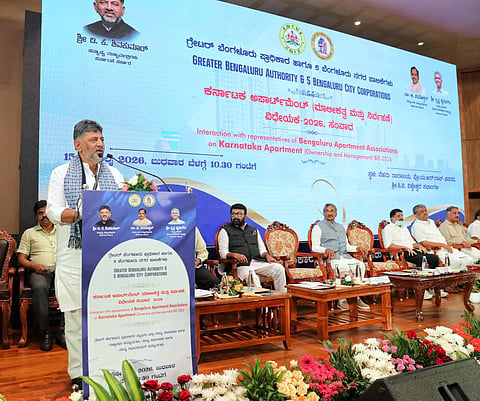
The Karnataka government held a public interaction to discuss the draft of a new apartment law with representatives of Bengaluru apartment owners' associations on Wednesday, July 15.
The proposed Karnataka Apartment (Ownership and Management) Bill is intended to replace two laws that have governed apartment ownership and management in the state for more than five decades — the Karnataka Apartment Ownership Act, 1972, and the Karnataka Ownership Flats (Regulation of the Promotion of Construction, Sale, Management and Transfer) Act, 1972.
The government has also hosted a copy of the draft bill at https://udd.karnataka.gov.in and stakeholders have been requested to send in comments and suggestions to kaomablr@gmail.com before August 6.
Once the proposed bill becomes an Act, existing owners will not need to register with the new body but will be automatically transferred. Some of the major proposals in the bill are calculation of undivided area share, standard definition of what constitutes a super built area; redevelopment scheme needing the written consent of at least 75% of a building's owners; forming of owners’ association within three months of a majority of apartments being allotted and ‘deemed conveyance’ for owners of older complexes where common-area land was never formally transferred.
The event was hosted by Bengaluru Development Minister Krishna Byre Gowda and attended by Chief Minister DK Shivakumar, Ministers KJ George and Byrathi Suresh and several MLAs including NA Harris, SR Vishwanath, MLC TA Saravanan as well as Karnataka Pradesh Congress Committee president BK Hariprasad.
Chief Minister DK Shivakumar said that the government hoped to combat some of the recurrent problems faced by apartment owners.
“We are aware of the problems faced by property owners, and they should have complete ownership rights. Our objective is to help people. Citizens have worked hard to build a roof over their heads. That is not an easy task,” he said.
He also said that the objective of the government is decentralisation of powers. Emphasis is being placed on resolving disputes without resorting to litigation, he said.
Several representatives of the owners’ associations said the draft bill should have provisions to prevent people from approaching civil courts for minor reasons and ending up in extended litigation. Others requested frameworks to make annual audits mandatory, a single nodal point to submit documents to get annual No Objection Certificates from various authorities, and ensuring builders collect maintenance amounts before handover in escrow accounts.
Why a new law
Additional Chief Secretary of Urban Development Department Tushar Giri Nath said the existing framework had left apartment owners without compulsory registration requirements, clarity on who approves building by-laws, or a defined mechanism to resolve disputes and hear appeals.
Several provisions of the current laws also overlap with, and are not aligned to, the central Real Estate (Regulation and Development) Act (RERA), and there has been no clear process for transferring land under common facilities from developers to owners, for acting against owners who withhold maintenance dues, or for redeveloping ageing complexes. He said the resulting gaps have driven prolonged litigation and disputes between developers and apartment owners.
The bill will apply to any project of more than eight apartments, including villas within approved layouts, but exempts government buildings, single-owner properties not divided for separate ownership, and plotted or villa developments where land is individually conveyed and civic amenities have been handed to the local authority.
Some key features in the draft bill
Formally recognises an apartment, with its share of project land and common areas, as heritable and transferable immovable property, on par with any other real estate.
Owners can sell, mortgage, lease, gift, or bequeath their apartment; subdividing the land share requires the competent authority's approval.
Introduces a standard "super built-up area" formula: carpet area + external walls/balconies + a capped share of terraces or open spaces (up to one-third, unless the title deed says otherwise) + a proportionate share of built-up common areas.
Any future increase in development rights (e.g., from a zoning or Floor-Area-Ratio change) belongs collectively to apartment owners, not the developer.
Draws a firm line between common parking (part of shared common areas, can never be sold or transferred as private property) and private parking (must be separately built, approved as an independent unit in the sanctioned plan, and conveyed by registered deed; simply allotting a stilt/basement/podium spot doesn't make it private).
Promoters must file a declaration with the competent authority within 60 days of the occupancy certificate being issued.
Within the same window, they must hand over all original project documents (titles, sanctioned plans, warranties, maintenance contracts, tax receipts, etc.) and any maintenance deposits/corpus funds, backed by an audited statement of accounts.
An owners' association must be formed within three months of a majority of apartments being allotted. This will be a joint responsibility of promoter and allottees.
The promoter must formally transfer management, maintenance, and administration (not ownership) of common areas to the association.
Promoters remain liable for RERA defect-rectification obligations even after handover.
Associations already registered under the old laws are deemed valid, provided they update their bye-laws within six months.
A redevelopment scheme needs the written consent of at least 75% of a building's owners; the resulting resolution binds everyone.
Dissenting or non-voting owners can take a monetary settlement no less than twice the market value of their apartment and land share (less depreciation), set by a government-recognised valuer, paid in full before the proposal goes to the planning authority.
Settlement disputes go to the competent authority, then to an Appellate Authority or a redevelopment Tribunal with civil court powers.
If a project stalls, the association can invoke the developer's bank guarantee and bring in a replacement.
If redevelopment collapses entirely, a 75% owner majority can instead sell the land outright and split proceeds by ownership share.
For older complexes where common-area land was never formally transferred, the bill introduces "deemed conveyance," automatically vesting it in the owners.
Buildings over 30 years old need a structural stability assessment by a certified engineer, repeated every five years thereafter.
A building rated unsafe triggers mandatory notice to the competent and local authorities; associations can appeal an adverse finding to an Expert Committee.
Associations must insure common property (fire, flood, public liability), keep audited annual accounts through a scheduled bank, and may raise a dedicated "Common Capital" fund for renovation/redevelopment.
Unpaid maintenance dues become a legal charge on the apartment, enforceable against future buyers, subordinate to government taxes and pre-existing mortgages.
Associations can restrict non-essential amenities over persistent non-payment, but essential services like water, power, sanitation, or lifts can never be cut off.
Enforcement moves to the Urban Development Department; a UDD officer of at least Group-B rank becomes the "competent authority" for a jurisdiction.
Powers include summoning witnesses, demanding documents, issuing binding directions, imposing penalties, and taking over an association's affairs directly if two-thirds of owners request it.
A two-stage appeal process — First and Second Appellate Authorities, both with civil court powers — and then High Court.
Civil courts are barred from hearing any matter the competent/appellate authorities are empowered to decide.
Penalties up to Rs 1 lakh against promoters for failing to file a declaration, form an association, or execute transfer deeds (plus daily fines for continuing violations); up to Rs 20,000 for other contraventions.
A state-level Consultation and Advisory Committee (owners' association reps + government officials, government-appointed chair) is proposed to advise on broader policy concerns.
The government must launch a public online portal for applications, association registrations, and project records within two years of the law taking effect.
Follow TNM's WhatsApp channel for news updates and story links.
