
Subscribe
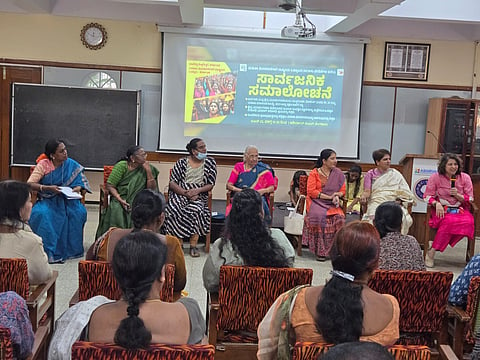
Activists and academics in Karnataka on Wednesday, June 25, launched a campaign demanding the immediate implementation of the Women’s Reservation Act. They argued that linking it to a future Census and delimitation exercise has delayed women's political representation.
At a public consultation held in Bengaluru, organisations under the banner of the National Coalition for Women’s Reservation (NCWR)-Karnataka and Naveddu Nilladiddare – a collective comprising of several organisations and individuals in the gender justice movement – expressed concerns over what they described as the "weaponisation" of the Nari Shakti Vandan Adhiniyam, enacted through the 106th Constitutional Amendment in 2023.
In a statement issued after the meeting, the coalition said the demand for 33% reservation for women in Parliament and State Assemblies has been pending for nearly three decades. However, it argued that the current law does not provide immediate political representation because its implementation has been tied to the completion of a future Census and the subsequent delimitation process.
The coalition also referred to developments in April 2026, when the Union government attempted to issue a gazette notification linking the implementation of the Women's Reservation Act to a set of constitutional and legislative changes, including the proposed Constitution (131st Amendment) Bill.
“We stand with the democratic forces that successfully resisted this motion, recognizing that tying women's rights to seat expansion threatens the very fabric of Indian federalism and creates severe North-South representation imbalances,” the statement said.
With the Monsoon Session of Parliament approaching, NCWR-Karnataka announced a statewide public consultation programme and signature campaign. The coalition said it would reach out to Members of Parliament and Members of the Legislative Assembly from Karnataka, urging them to seek amendments to the law and press for its immediate implementation.
As part of the campaign, a delegation plans to meet Chief Minister D K Shivakumar and other government representatives, seeking a resolution in the Karnataka Assembly calling for the implementation of women's reservation without any preconditions.
The coalition's primary demand is the immediate enforcement of the 33% reservation law. It also called for the removal of provisions linking the legislation to Census and delimitation exercises.
The organisations further argued that any future delimitation or expansion of parliamentary seats should be undertaken through a transparent and consultative process involving states and other stakeholders, rather than being tied to women's political representation.
The statement also stressed the need to safeguard parliamentary democracy and federalism, asserting that the long-standing demand for women's reservation should not be used to justify measures that could centralise power or alter the balance of representation between states.
Another key demand relates to the identification of seats that would be reserved for women. The coalition said this process should not be centralised and must involve state governments, communities and women's organisations. It also called for safeguards to ensure representation for women from marginalised communities, including Dalits, Adivasis, OBCs, religious minorities, transgender persons and other gender minorities.
Without such safeguards, the coalition argued, the benefits of reservation could disproportionately accrue to women already privileged by caste, class and political networks, leaving existing inequalities intact.
The organisations also pointed to the framework established under the 73rd and 74th Constitutional Amendments governing Panchayati Raj institutions as a possible model for designing women's representation. They said the framework could be expanded and reformed to accommodate broader social inclusion.
Calling for wider support, the coalition urged citizens, civil society groups and political leaders to join the campaign, stating that gender justice should not be contingent on political calculations or procedural delays.
