
Subscribe
For days, families living on a quiet stretch of 3rd ‘B’ Main in Bengaluru’s KSFC Layout in Lingarajpuram dismissed recurring gut issues as seasonal illness or food poisoning. It was only when residents began finding foul-smelling, frothy water in their taps and thick, dark silt coating their underground sumps, that the problem became clear – sewage had mixed with their drinking water.
The contamination, detected in parts of Lingarajapuram under the North City Corporation limits, has affected between 30 and 40 households along a single lane of the KSFC Layout. After complaints escalated, the Bangalore Water Supply and Sewerage Board (BWSSB) halted piped water supply to the area as a precautionary measure, leaving families dependent on private tankers.
Residents told TNM that illness had been reported across households, with symptoms ranging from vomiting and diarrhoea to stomach and intestinal infections. In some cases, residents required hospitalisation. Many of the affected homes include elderly residents, young children, and pregnant women.
Brinda Xavier, a resident of the layout, said the problem had been unfolding quietly for nearly two weeks before the source was identified. “This issue has been affecting us for about 15 days, maybe even longer. People started falling sick one after another. In my house, my daughter-in-law had a stomach upset first, then my mother, and later my daughter,” she said.
Initially, Brinda said they suspected problems in their kitchen or with food preparation. “We have small kids and a pregnant woman at home, so we thought it could be something else. Finally, we realised it was because of the water.”
Like several others, Brinda had to spend money to clean her sump and arrange alternate water. “I got my tank cleaned for Rs 2,200, and we also filled water yesterday because we needed it in the morning. Later, the Cauvery water supply started. There has been no compensation,” she added.
Another resident, Sanjeev, said the contamination became visibly alarming only in the past week. “We’ve been facing this for two to three weeks, but in the last week it got really serious. The water coming from the tap was extremely dirty and smelly,” he said.
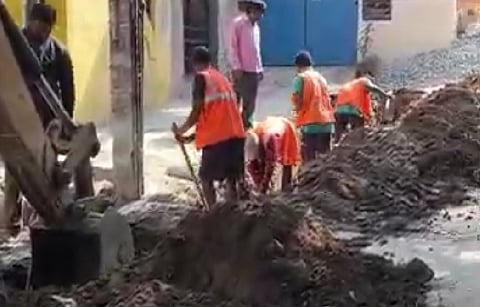
After comparing notes with neighbours and checking their tanks, residents alerted the BWSSB. “They dug up a few places and used a camera. I think they realised the existing pipe is very rusty and damaged, so they are planning to lay a new one,” Sanjeev said.
He described the discovery as frightening, particularly for families with children. “This was the first time we saw water like this. Even if you have a basic filter, this kind of contamination is not something it can handle. I have a two-year-old child, and that is what scared us.”
According to Sanjeev, the contamination was not always immediately visible. “At the start of the supply, the water would be dirty, then it would turn clear. It gets diluted in the sump, so you don’t realise immediately. When we cleaned the tank, the water was grey-green and foul-smelling. That’s when we knew the contamination was coming from the pipeline.”
Jayaseelan, president of the KSFC Layout Residents’ Welfare Association, said complaints had been limited to 3rd ‘B’ Main so far. “For the last 10 days, residents on this road have been reporting a foul smell and dirty water in their sumps. We found that the Cauvery water line and the sanitary line are mixing somewhere,” he said.
Jayaseelan said senior officials intervened only after the issue reached the media and the water samples were shown to BWSSB officials. “The BWSSB chairman, Ram Prasath Manohar V, gave clear instructions to use robotic cameras and identify the source.”
He attributed the problem to ageing infrastructure. “The sanitary line here is more than 40 years old. That’s why we are asking for both the water line and the sanitary line to be changed. It is better to be cautious now and do the needful, than wait for the next incident. They are replacing the water line now, and we have requested that the entire layout’s sanitary lines be taken up,” Jayaseelan said.
Another resident also pointed to decades-old infrastructure as the cause of the problem, arguing that the contamination was an outcome of long-neglected maintenance. “The ones here are GI pipes, which have been phased out elsewhere. But this layout never got a facelift,” the resident said.
“They should have replaced these pipes years ago. The same applies to the sanitation lines. This is basic science and engineering, pipes corrode over time. The authorities should have addressed this 10 or 20 years ago, not now. The system has crossed its threshold. That’s why the pipes are breaking and contamination has occurred. The pipes simply needed replacement, and that’s what they are doing now,” he said.
BWSSB officials said they launched an intensive investigation using robotic technology and ground staff to pinpoint the exact source of contamination. The board confirmed that sewage had mixed with the drinking water pipeline, though no specific infectious disease outbreak has been detected so far. Local health officials reported cases of fever and food poisoning-like symptoms and conducted a health survey in the area on Monday, January 5.
To prevent water scarcity during repairs, BWSSB deployed Sanchari Kaveri mobile tankers to supply free potable water to affected households. The BWSSB chairman has termed the issue a top priority and issued a deadline to engineering teams to identify the fault, fix the pipeline, and restore safe water supply.
