
Subscribe
Follow TNM's WhatsApp channel for news updates and story links.
In a village in Karnataka's Uttara Kannada district, children are growing as well as those in India's wealthiest households, according to a study that suggests the community's traditional diet could offer lessons for child nutrition.
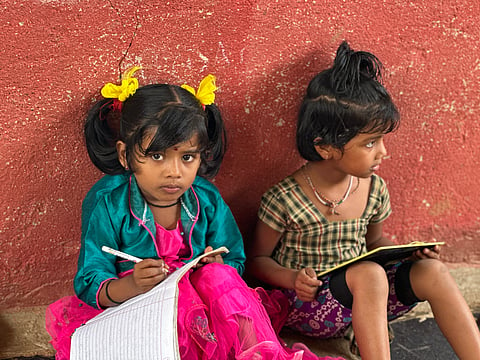
Children from Baddigere village of the pastoral Gowli community in Mundgod of Uttara Kannada district have heights and weights comparable to those of children in the wealthiest quintile of the National Family Health Survey (NFHS)-5, according to a study conducted by the Loyola Vikasa Kendra (LVK).
The study examined the relationship between the community's dietary practices and the oral and general health of children. Researchers collected anthropometric data and conducted oral and physical examinations of 49 children after obtaining parental consent. The study also included focus group discussions, key informant interviews and collection of household dietary data. Permission for the examinations was obtained from the Department of Women and Child Development.
LVK, which has been working with vulnerable communities in Karnataka since 1986, said it had observed during routine checks at anganwadi centres that Gowli children appeared to have lower levels of stunting and underweight, along with better general and oral health than expected.
The findings documented the children in a single Gowli village with 150 households, whose diets rely largely on milk, fermented foods, indigenous livestock and minimally processed ingredients. The study found that 73% of the children had normal height for their age, 88% had normal weight, and were free of infections or illnesses. The report calls for a detailed government study, suggesting that the village's dietary practices merit closer examination.
Who are Gowlis?
The Dhangar Gowli or Dhanagala Gowli community migrated from Maharashtra around 75 years ago following a drought and has traditionally depended on cattle rearing. They are originally the Yadavs of Maharashtra. In Karnataka, their population numbers around 19,000 across a few districts, and they are categorised as Other Backward Class.
The community owns indigenous Pandharpuri and Dharwadi buffalo breeds, which they consider hardy and better suited to forest grazing than imported Jersey cattle. Milk and fermented dairy products form an important part of the community's diet. The reduced access to forests has led to a decline in livestock numbers, which community members said could affect children's nutrition in the future.
Dietary practices by the community
According to the study, milk forms the cornerstone of the Gowli community's diet. Children begin their day with a glass of milk soon after waking up and continue to drink milk throughout the day, sometimes consuming it raw. Adults also reportedly prefer drinking milk over tea or coffee.
Children are generally given milk three times a day—in the morning, afternoon and evening, going up to five times. The study notes that milk from indigenous Pandharpuri and Dharwadi buffaloes are considered particularly tasty by the community, and milk and fermented dairy products are integral to their daily diet.
A staple food is amblee, prepared by fermenting cooked rice, and sometimes ragi, in curd for two to three days. The community also consumes butter, ghee and majjige saaru, a curry made with buttermilk. Fish, chicken and mutton are commonly eaten, including blood, organ meat and other offal.
Honey, medicinal plants, green leafy vegetables, roots, tubers and berries have traditionally formed part of the community's diet. However, the study notes that access to these foods has become increasingly difficult.
Children commonly eat milk and milk products, fermented rice, rice with sambar and eggs provided at anganwadis three days a week. Children up to three years receive take-home rations consisting of rice, milk powder and occasionally dal, while those aged three to six years are served milk, sometimes chikkis and broken wheat upma at anganwadis.

According to the report, community members expressed dissatisfaction with the quality of food served at anganwadis and government schools, stating that they preferred fresh milk over reconstituted milk supplied under the state's Ksheera Bhagya scheme. The children also disliked the upma, and reduced quantities of oil had made it less palatable.
Women are given a preparation made with animal blood, known as sooka, after childbirth, along with dishes containing mutton, copra, ghee, coconut oil, pepper and broken wheat. Researchers reported that there are few dietary restrictions imposed on women after delivery. Children are breastfed for up to five years, depending on when mothers return to work.
The community also grows vegetables in kitchen gardens, including brinjal, okra, cluster beans, radish and beans. Commonly consumed green leafy vegetables include amaranth leaves, drumstick leaves and malabar spinach. The report notes that the community earlier also used the leaves of yams.
Rice consumption has increased over time, although the community reportedly prefers unpolished rice and sometimes cultivates red rice. The polished rice supplied through the Public Distribution System (PDS) is generally not preferred, and some households mix it with unpolished rice when alternatives are unavailable. The community usually consumes naati koli (country chicken), while eggs are generally reserved for children considered weak.
Researchers found little exposure to refined foods, sweets, chocolates, junk food or packaged foods, although a recently opened shop has led to occasional consumption of chocolates by children. Community members also told the authors that they consider it a sin to let any child go hungry, and children are fed up to five times a day. Sweet foods are reportedly not preferred.
The study found that 73% of the children examined had normal height for their age and 88% had normal weight. It also reported that 98% had clear eyes and skin, good dentition and facial structure and were free of gastrointestinal, respiratory, skin and other infections or illnesses. Researchers said the findings suggested an association between higher milk consumption and lower incidence of dental caries, noting that children with caries consumed less milk because of poverty or parental migration. They added that a more detailed study, preferably conducted by the government, would be required to examine this association further.
The oral health assessment found that 92% of the children had no malalignment of teeth, while one child had diastema and two had an open bite. All children had normal palates with no cleft palate. None had overcrowding of teeth, while 96% had a normal bite and 4% had an overbite. The study found that 90% had no fractured teeth, while 10% had a fracture of the incisal edge of a single tooth. Plaque was present in 51% of the children, and 8% had a narrow facial structure. Overall, 68% of the children had no cavities, and 63% had neither caries nor cavities.
(With acknowledgements to Dr Sylvia Karpagam, Dr Svarooparani Patel, Loyola Vikasa Kendra, Mundgod, and Kavin Selvaraj.)
Jerald Dsouza SJ is the Secretary of Social Justice and Ecology Secretariat in Delhi. Anil Dsouza SJ is the Director at Loyola Vikas Kendra in Mundgod. Views expressed here are the authors’ own.