
Subscribe
Historically, Indian mainstream theatre has exclusively been a ‘gated community’ where dominant caste perspectives dictate narratives. These stages frequently romanticise and objectify specific bodies, languages, and communities. The brutal realities of caste are consistently misrepresented, while the very cultures deemed unworthy of theatrical depiction are appropriated.
Their narratives often portray Dalits as merely poor and uneducated. Consequently, artists from Dalit and marginalised communities rarely have the opportunity to lead the stage or secure central roles.
The Kannada language play Bob Marley from Kodihalli breaks this. It boldly confronts the savarna gaze and refuses to remain silent.
Drawing inspiration from Rohith Vemula’s final letter before his institutional murder and Babasaheb Ambedkar’s Waiting for a Visa, the performance transforms the stage into a critical space.
The title Bob Marley from Kodihalli is inspired by the spirit of Bob Marley, who is seen as a symbol of Jamaican music, culture, and identity. The play explores questions of caste identity and concealment that closely resonate with the experiences of Black communities.
Through the poems of NK Hanumantayya, such as ‘Himada Hijje’ (Snow Steps), the play acknowledges the past and present of caste, indicating its persistence.
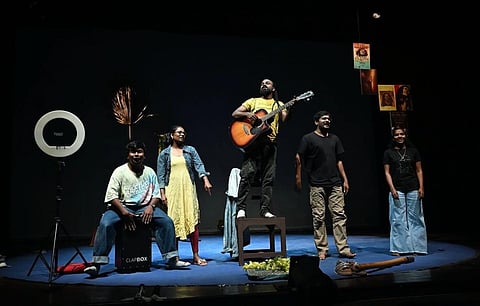
Directed by Lakshman KP, the play stands out for its powerful performances. Shwetha HK brings raw intensity to Nadi, a schoolteacher. Chandrashekhar Kodihalli adds depth to the title character, an aspiring singer. Bharath Dingri gives a thoughtful portrayal of Shakya (also called Bro), a struggling artist finding his way in the city. Mariyamma Chudi completes the group with her striking voice and musical talent.
All three characters are deeply shaped by questions of migration, identity, housing, and urban survival. The city’s false promise of liberation from caste instead forces them to confront caste identity while seeking ways to conceal it.
VL Narasimhamurthy, who has closely followed the Dalit Sangharsh Samiti and explored the Dalit movement in Karnataka, as well as Ambedkar's writings, shaped the play’s vision. This collective of Dalit artists and scholars captured the heart of the theme with striking clarity.
Caste in the city
Finding a home in the city is a paradox: Without facing a caste identity question, it is impossible to find a house — although the city denies this reality.
In contrast to more symbolic or historical representations found in many contemporary productions, Bob Marley from Kodihalli distinguishes itself by foregrounding the lived realities of urban housing, migration, and the persistent negotiation with caste identity in everyday city life.
Cities are often imagined as diverse social spaces shaped by migration and economic mobility, giving rise to the belief that caste is a predominantly rural phenomenon that fades in urban settings. While many migrate to cities in search of livelihoods and careers, for Dalits, the city frequently becomes another site of exclusion.
In the high-rise neighbourhoods of Bengaluru or Mumbai, this exclusion is felt the moment a landlord hesitates after hearing a full name. The ‘No Vacancy’ or 'To Let' signs encountered by Dalit and Muslim families stand as everyday reminders that urban infrastructures still sustain institutionalised caste divisions and practices of untouchability.
Bob Marley from Kodihalli stages a crucial urban contradiction. It visualises how caste persists and assumes new forms within the city.
In one scene, the three characters quietly discuss their concerns and restrain their desire to eat meat to avoid revealing their Dalit identity. The tension is evident, highlighting how this is a constant fear. This moment resonates strongly with Dalit audiences as it reflects a brutal yet familiar reality.
This approach places the play in conversation with a growing body of recent Dalit and anti-caste theatre, such as Jayant Pawar’s Marathi play Adhantar, which confronts the migration and mill workers issues in Mumbai city and Abhishek Majumdar’s work Pah-La, which examines both marginalisation and resistance.
Ambedkar warned against romanticising Indian social life. In Waiting for a Visa, he records the humiliations he faced in then-Baroda while serving as a secretary in Maharaja Gaekwad’s office. Despite his education and international degrees, he was denied housing.
Almost a century later, the nation has changed on paper through policies and schemes, yet the core structure of caste remains intact.
Rohith Vemula’s life and death captured this continuity. His scholarship was systematically withheld, and his final letter named his birth a “fatal accident”, exposing the cruelty of institutions that still punish caste location.
Director Lakshman KP notes, “The play emerged through a collaborative process grounded in shared experiences of village life and urban housing. Our Ambedkarite voices challenge the persistent romanticisation of the village in Indian cinema and theatre.”
The performance demonstrates how caste endures, manifesting in subtle forms of surveillance and affecting access to resources such as housing. The play highlights the daily survival strategies adopted by many Dalits, who often feel compelled to hide their caste identity. Sometimes, they pretend to be vegetarians or abandon their hometowns and surnames to secure housing.
This act of concealment is driven by fear, a constant dread of being exposed and subsequently subjected to harm or insult. The play powerfully captures this everyday dilemma, the difficult choice between confronting caste directly or concealing one’s identity to avoid mental discomfort and injury.
Labour, culture, and caste
The play sheds light on past memories of caste by foregrounding a brutal cultural labour — ‘Kulvadi Chaakri’. This is an age-old caste-based ritual imposed on Dalits in many rural regions. It is performed during the death rituals of dominant caste families in the village.
During this act, a Dalit person is made to hold and drag the Utrani Gida (prickly chaff flower or devil’s horsewhip plant) for several minutes. The thorns cut into the skin, severely injuring the hands. What is presented as ritual is, in fact, a form of caste violence enforced as labour, dehumanising Dalits under the guise of tradition.
This part of the story draws on Chandrashekhar Kodihalli’s lived experience, as his family endured caste-based violence and humiliation through the kulvadi chakri practice. He brings these realities to the stage through his performance as Bob.
The play highlights a stark contrast: while dominant communities may find pride and identity in their rituals, for Dalits, caste-based performances are not about culture. They show the enforced endurance of stigmatised occupations and the public display of fear, shame, and institutionalised humiliation.
Chandrashekhar Kodihalli says he chose to share his family’s history despite the shame and difficult memories associated with this Hindu traditional practice. This powerful theme of caste memory and survival is also central to his previous work, Tyape.
Alongside cultural caste labour, the play moves into the vulgarity of caste through the Devadasi system and the brutal exploitation of Dalit women. The play traces how trauma becomes generational and how women’s bodies become the sites where caste and patriarchy operate together.
Swetha HK plays Nadi, an educated and independent woman who confronts this inherited violence with courage. Through her character, the play reveals how Dalit women are doubly marginalised and made to carry the burden and stigma of both caste oppression and patriarchal control.
Nadi’s role shows how Dalit women confront caste issues directly rather than avoid them. By confronting these challenges, she breaks the cycle of fear, while the other two characters initially withdraw from confronting caste and its anxieties. Nadi symbolises political awakening and is connected to the fireflies in the performance. Their light in the darkness represents both resistance and hope.
Swetha H K, the 2025 Shankar Nag Theatre Award winner, says her constant confrontation with caste and gender norms that limit her to an imposed identity helped her do justice to the character, as Nadi carries a deep scar and the stigma of caste and patriarchy. She emphasises her outrage at the continued commodification of Dalit women's bodies even on stage. She also highlights how the duties of Dalit women are often described from an upper caste perspective that romanticises suffering rather than confronting injustice.
Modern untouchability in the city
Bob Marley from Kodihalli highlights the persistent reality of caste in the urban and digital age. It challenges the pervasive myth of meritocracy and the claim of a “casteless” urban society.
Access to opportunity remains governed by what diversity advocate Marilyn Loden conceptualises as an invisible glass ceiling, which determines who gains visibility, who is allowed to occupy central positions, and ultimately, who is recognised as an artist.
Bharat Dingri’s portrayal of Sakya, also called Bro, encapsulates a central contradiction within the play. While he aspires to professional success and a life beyond mere survival, each attempt to access the mainstream is constrained by caste-based conditions. The play demonstrates that discrimination extends beyond housing and notions of “purity” into auditions, performance spaces, and cultural institutions that present themselves as modern yet continue to reproduce entrenched hierarchies.
Even when Dalit artists manage to enter these spaces, they are often pushed to the margins, confined to supporting roles, backstage labour, or behind-the-scenes work, while the industry's centre remains closely guarded.
This form of gatekeeping is also visible in public cultural life, particularly in controversies surrounding the appointment of chairpersons or directors within cultural bodies, revealing how power and networks, rather than transparent criteria of merit, shape these institutions.
Such patterns of exclusion are further illustrated by instances such as filmmaker Adoor Gopalakrishnan’s opposition to state support for women and Scheduled Caste and Scheduled Tribe filmmakers in Kerala, where words like “training” and “talent” are mobilised to regulate the entry of marginalised communities.
A similar logic operates within classical arts, as reflected in Kalamandalam Sathyabhama’s remarks targeting Dalit artist RLV Ramakrishnan, which exposed how caste-based exclusion is enforced through aesthetics and bodily norms in the name of culture.
Why this play must be remembered
Dalit movements have long used art as a crucial frontline for resistance, memory, and survival across generations. However, increasing commercialisation often leads to the erasure, sidelining, or reduction of Dalit artists and their contributions, reducing them to mere spectacle.
The current necessity is not to just ‘include’ marginalised voices in the mainstream but rather to fundamentally shift the centre of discourse. More stories must emerge from the margins, narrated by those who live them.
Bob Marley from Kodihalli also reminds us that the casteist remarks have become distressingly common microaggressions packaged as compliments.
These aggressions are reminders that certain people are only permitted visibility as stereotypes, while full human recognition is reserved for those who conform to dominant caste comfort.
The fact that the entire production team was composed of artists from the Dalit community underscores a vital point: representation is not charity — it’s power. The fight for this power will persist until the structure of caste is fully confronted, dismantled, and ultimately defeated.
Inspired by the rhythm of global resistance and identity, the play ends with a powerful anthem. The song, ‘Elliganta obba Shrestha', inspired people to hope and continue the fight for dignity.
The cast and director Lakshman KP gather at the edge of the stage to deliver an anthem that strikes at the heart of the “Superiority” complex:
“Elliganta obba Shrestha, innobba kanishta anta irtato... alliganta horata irtade.” (As long as one is considered superior and another inferior... the struggle will continue.)
This is the Bob Marley spirit of Kodihalli. It rejects the systems that took Rohith Vemula’s life.
The play addresses the crucial need for constructive space and identity, illustrating how true caste healing commences only with direct confrontation. As the performance concluded, the audience began to share their personal experiences of caste, drawing a direct link between the narrative on stage and their own realities. In this moment, theatre was more than just fiction or a performance; it was a powerful shared testimony.
Ektha Harthi Hiriyur is a research officer at the Tata Institute of Social Sciences (TISS), Mumbai. Her research focuses on the intersections of caste and gender studies, digital labour, platforms and culture.
Views expressed are the author’s own.
