
Subscribe
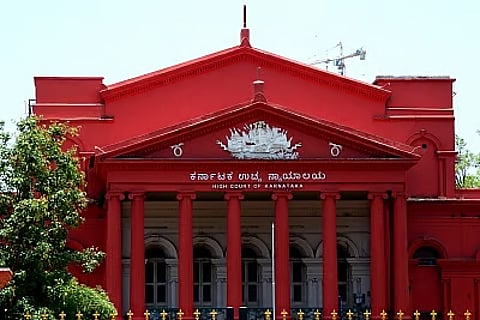
The Karnataka High Court on Friday, November 6, held that the Enforcement Directorate (ED) cannot act as a 'super cop' by independently investigating scheduled offences or filing private complaints when the competent investigating agencies decline to initiate criminal proceedings based on information shared by the agency under the Prevention of Money Laundering Act (PMLA).
Justice MI Arun, allowing a batch of writ petitions filed by Congress leader KY Nanje Gowda and others, held that the ED's powers under the PMLA are "derivative and not original". Money laundering proceedings cannot continue once the underlying scheduled offence, which forms the basis of the investigation, has been closed, it said.
The High Court observed that the PMLA does not expressly empower the ED to file a private complaint in respect of a scheduled offence and subsequently initiate an investigation against the accused under the provisions of the Act. "The ED is not a super cop to investigate anything and everything which comes into its notice," the Court observed.
It also held that the ED cannot file a private complaint under Section 200 of the Code of Criminal Procedure (CrPC) or Section 223 of the Bharatiya Nagarik Suraksha Sanhita (BNSS) to compel an investigation into an alleged scheduled offence when the competent authorities have chosen not to initiate proceedings.
The case originated from allegations of irregularities in the grant of approximately 80 acres of land to 38 persons by the Malur Land Grant Committee in Kolar district. Nanje Gowda, who was then the chairman of the committee, was accused of colluding with other members and abusing their official positions to facilitate the allegedly illegal land grants.
Based on a private complaint filed by social activist KC Rajanna before the Chief Metropolitan Magistrate, Bengaluru, in 2022, a criminal case was registered. The ED subsequently treated the land scam allegations as a predicate offence and registered an Enforcement Case Information Report (ECIR) in November 2023. During its investigation, the agency allegedly discovered materials indicating irregularities in the recruitment of employees to the Kolar and Chikkaballapur Milk Union Ltd. (KOMUL), which it named the 'Job Scam Case'.
The ED shared the information concerning the alleged recruitment irregularities with the jurisdictional police and authorities under Section 66(2) of the PMLA. However, the jurisdictional police did not initiate proceedings based on the information shared by the ED.
Meanwhile, a closure report was filed in the land scam case. Although the complainant filed a protest petition, the trial court dismissed the proceedings for want of the requisite government sanction to prosecute the public servant. Despite the closure of the predicate offence, the ED continued its proceedings under the PMLA.
Further, after the jurisdictional authorities did not act on the information shared regarding the alleged job scam, the ED filed a private complaint before the trial court on September 11, 2024, seeking to have the matter referred to the Lokayukta Police for investigation. Aggrieved by the ED's actions, Nanje Gowda and others approached the High Court challenging the continuation of the money laundering proceedings, the seizure of articles and the agency's decision to file a private complaint.
The High Court first examined whether the ED could continue its investigation into alleged proceeds of crime under the PMLA after the predicate offence had been closed on technical grounds, including the absence of the requisite sanction to prosecute.
"The action of the ED continuing the investigation or inquiry into the existence of proceeds of crime derived from the scheduled offences alleged in the Land Scam Case cannot be sustained," the court held.
The court then examined whether the ED could independently file a private complaint under Section 200 CrPC or Section 223 BNSS when the competent authorities did not initiate proceedings based on information forwarded under Section 66(2) of the PMLA.
Rejecting the ED's contention, the court held that Section 66(2) requires the agency to forward information regarding violations of other laws to the concerned authorities rather than take up the investigation itself.
The court emphasised the constitutional principle of separation of powers and the need for checks and balances between different institutions. It observed, "Our Constitution envisages separation of powers between different organs of government. The reason being that one institution in the country does not become supreme so that it is in a position to abuse the powers conferred on it. Law recognizes the requirements of checks and balances."
The Court further clarified that Section 66(2) of the PMLA obligates the ED to forward information regarding a scheduled offence to the competent agency. "The Act does not expressly empower the ED or the authorities under the PMLA to prefer a private complaint in respect of a scheduled offence and on the strength of it, thereafter, take up investigation against the accused therein under the provisions of PMLA," it said.
The court also pointed out that maintaining law and order is the responsibility of the state and not the Union government.
“It is the duty of the concerned agency to examine the same and to take a decision whether to prosecute the matter further or not," the court observed.
It also held that only those powers expressly conferred on it by the PMLA are to be exercised. “Filing of a private complaint by the ED is not contemplated under the PMLA," the court said
Emphasising the consequences of permitting such a practice, the court observed, "Allowing the ED to prefer a private complaint, when the other government authorities deem it inappropriate to initiate any proceedings against anybody, will amount to permitting the ED to act as a super cop and it goes against the philosophy of the Act which requires a predicate offence to be in existence for the ED to initiate proceedings as contemplated under the PMLA," the court said.
Allowing the ED to file private complaints would effectively enable the agency to initiate criminal proceedings against any person and subsequently investigate them, a power not contemplated under the PMLA, it noted.
Accordingly, the High Court quashed the Adjudicating Authority's order dated June 6, 2024, confirming the seizure of articles in proceedings under the PMLA and directed the respondents to return the articles seized from him, if any.
The court also quashed the ECIR dated November 30, 2023, the summons issued pursuant to it and the consequential proceedings, including the show-cause notice dated February 16, 2024, insofar as they concerned the petitioners in the relevant writ petitions.
Follow TNM's WhatsApp channel for news updates and story links.
