
Today’s generation might not be able to imagine a time when radio sets ruled lives. When National Panasonic’s 543 and small transistors hung from branches and windows, adding music to the humdrum of everyday life. The best part? No one knew what would play next. Life was about living in the moment.
And then came television, the game changer. For those of us living in Tier-2 and Tier-3 cities, the television was an object of charm that only those in the metros got to enjoy. The rest could only imagine what it looked like. I remember my aunt leaving her television set with us when she got transferred from Madras to Coimbatore in Tamil Nadu. We kids would turn on the television, watch the black and white dots swarming on the screen (there was no signal in non-metro cities then), and pretend to see shapes and images.
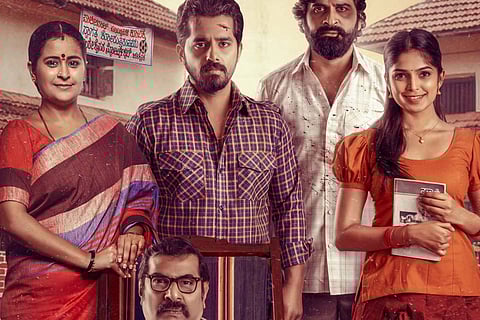
This is the world Sukesh Shetty sets his debut film Doordarshana in — a village that’s green with life, and also with envy. Envy for the one rich man, Ramachandra Bhat (an effective Sundar makes it very easy to hate this character), whose only expression is grumpiness and whose words are sprinkled with anger and irritation. His long suffering wife and son Manu (Pruthvi Ambaar) tolerate him, but why would the rest? He is not on talking terms with his brother Sreenivasa (Raaghu Ramanakoppa). He throws a stone at a young boy who steals a cashew fruit from his tree, and is generally a dark character. No one likes him, but everyone puts up with him.
At the other end of the spectrum is Kitty (Ugramm Manju), once Manu’s best friend, and now someone whose heart is filled with hate for the family. Manu likes Mythri (Ayaana), whose brother is the one who got hit by the stone.
Sreenivasa leaves a television his brother-in-law has bought from Dubai in Ramachandra’s house. Before you know it, the entire village is busy watching Ramanand Sagar’s Ramayana on it. And then, it goes missing, throwing everyone’s life asunder.
Amid all this, there’s talk of a school play by those who’ve passed out, among other things. But many of those subplots don’t hit home, because you don't engage with the lives of these boys. What does Manu do other than being a good son? Kitty wants to restart his grandfather’s hotel, but is he working towards it? What work does Manu’s friend ‘Bombay’ do? The only one shown working is the friend who runs an eatery. Everyone else is just there, and you’re expected to care for them and be invested in what happens to them.
All credit to Sukesh for getting the aesthetics right. You can almost imagine a world where the rotary phone was the only mode of communication available, and that too only in some homes. The scooter, the television antenna that most of us in our 40s would remember tuning and tuning until some hazy image appeared on screen, and people walking from their home to the one with a television to watch Ramanyana — all of these images are spot on.
Full marks to the scene in which the child imagines his teacher wearing a crown in class, and himself wielding the bow and arrow with an astra to boot. He sees the television almost as a god!
I’d have loved to see a little more about how Ramachandra had a change of heart. I’d have also liked to know why he’s so angry all the time. On the other hand, Kitty (Manju is persuasive in some scenes) has a reason for his hate — he lost a dear one to what his father said was Ramachandra’s family’s greed.
Pruthvi is usually a very casual performer on screen, and hence effective. But I missed that in this film, which does not offer Manu any defining feature that sets him apart. So, his lines remain mere lines, not emotions. He loves Mythri, but there’s no backstory there either. And before you know it, everyone is best pals like they were never angry with each other in the first place, and the end credits roll. This film has its intentions right, but needed some more heft in writing.
Music by Vasuki Vaibhav suits the mood, and cinematographer Arun Suresh captures the lovely locales of this rain-soaked land beautifully. You see the gorgeous exteriors, but you also see the dark interiors — both at home and inside hearts.
Doordarshana is not a perfect film, but it’s lovely to see slice-of-life films with not too many characters, and where the reason for angst is not something Baahubali-esque, but just a lost television set.
Subha J Rao is an entertainment journalist covering Tamil and Kannada cinema and is based out of Mangaluru, Karnataka.
Disclaimer: This review was not paid for or commissioned by anyone associated with the film. Neither TNM nor any of its reviewers have any sort of business relationship with the film’s producers or any other members of its cast and crew.