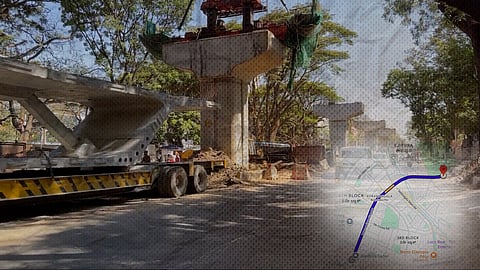
How many years’ delay is expected, and how many is just too much, when it comes to a public infrastructure project? How many hurdles are routine, and how many rather strange, for a public used to deadlines being pushed, and pushed again? Most Indian cities may have an example or two to say that no roadblock is too surprising when it comes to the construction of roads, flyovers, or public buildings. But Bengaluru’s Ejipura flyover project, now in its tenth year of construction, somehow seems to one-up every other delayed infrastructure project.
In fact, there is something about Bengaluru and its flyovers and how many of them have been a talking point. Remember that lone traffic police box atop the Richmond Road flyover? Or the Tagore circle underpass or the adjacent National College flyover that no one uses. The constant tinkering of the ill-designed Hebbal flyover, adding additional lanes, or the city’s unidirectional flyovers to ease traffic strangely only on one side of the road. And the less said the better about the state’s adamance in proceeding with the construction of the Shivananda steel flyover even in the face of massive public protests.
All those have been set aside for a 10-year-old project that Bengaluru returns to frequently for comic relief. A 2.38 km stretch of flyover construction starting from Kendriya Sadan in Koramangala and stretching just past the Sony World junction, merging onto the Intermediate Ring Road towards Domlur and Indiranagar. That is the Ejipura flyover, the subject of never-ending memes, mockingly referred to as a ‘heritage site’, a ‘monument’ or even the ‘Stonehenge’ due to the inordinate delay in its construction. So heavy is the attention on this project that a first information report was filed in January 2026 after a social media page falsely claimed that “cracks” had developed on the under-construction flyover.
The project, which began in 2017, is finally looking at completion before the end of October. Work has been proceeding at a brisk pace.
In mid-February, Maheshwar Rao, Chief Commissioner of the Bruhat Bengaluru Mahanagara Palike’s (BBMP) new avatar, the Greater Bengaluru Authority (GBA), announced that the flyover construction must be completed by July, reigniting public interest in the project. This was followed by an announcement in the Bengaluru South City Corporation budget that it would be completed by September. Since then, the completion date has hovered around October.
There was nothing uncommon about the flyover project, be it the intent, design, length, or the area it sought to cover. Despite having a determined MLA and some of the most tenacious groups of Residential Welfare Associations who constantly sought to push the project ahead, a series of disparate reasons – some bureaucratic hurdles, some unexpected setbacks – turned into a protracted nightmare for residents and commuters.
The story of the Ejipura flyover also reflects the real, everyday challenges of executing an infrastructure project. From contractor issues and delays in land acquisition to repeated tender cancellations, environmental concerns, disputes over debris clearance, and even the Union government scrapping an infrastructure fund, much has gone wrong with the flyover. In this story, TNM puts together a timeline of the project after speaking to multiple stakeholders and government officials.
The 2011 proposal
Contrary to popular thinking, this flyover project was not foisted on an unhappy populace of Koramangala. As early as 2005, the traffic on the stretch, especially at the Sony World junction, had already been piling up. By 2011, the stretch between Indiranagar and Koramangala had become notorious for long waits at traffic junctions.
Even then, the civic body BBMP had only intended to construct a flyover at the Sony World junction to ease the traffic. It was the representation by citizens and their demand for a flyover spanning five junctions between Hosur road and Ejipura junction that was finally decided upon. The proposal had the support of BTM Layout’s Congress MLA Ramalinga Reddy, who would go on to become a minister in both Siddaramaiah governments.
“All those people who say there was public opposition are sitting thousands of miles away. It has been on paper for at least 20 years. Everything was out there in the public domain. It is absolute nonsense to say there was no public consultation,” said Vijayan Menon, president of Citizen Action Forum and a resident of Koramangala.