
Subscribe
Various government agencies together spent around Rs 100 crore per day on Bengaluru in the 2021–2022 fiscal year, according to an analysis by Janaagraha, a city-based non-profit that works on urban governance and civic participation.
Janaagraha released the figures on Saturday, April 11, during the third edition of The Bengaluru Debates.
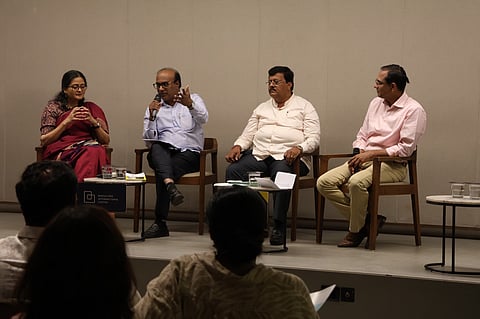
Several speakers at the event underscored the importance of access to financial data, without which the public would not be able to hold the government accountable. Over the course of the discussion, there was a general consensus that data transparency should be treated as a priority and should be central to planning, expenditure and reporting.
During a session titled "Can Radical Transparency Deliver Better Outcomes for the City?" Janaagraha said that based on data from 70 financial documents from 11 authorities, it is estimated that around Rs 38, 455 crore of public money was spent on Bengaluru in the 2021-2022 fiscal year. This works out to around Rs 100 crore a day.
The session started with a detailed presentation on expenditure for Bengaluru by Merin Sunny, Senior Associate, Public Finance Management at Janaagraha.
While the Greater Bengaluru Authority (formerly Bruhat Bengaluru Mahanagara Palike) is the visible governing body, it only accounts for 20% of the money spent on the city. The rest are accounted for by parastatal agencies such as Bengaluru Electric Supply Company (BESCOM) , Bengaluru Development Authority (BDA) , and Bengaluru Metropolitan Region Development Authority (BMRDA) and state government departments. BESCOM accounts for 47.30% of the total share.
Merin Sunny said that citizens have almost no idea how public money is spent because little information is available in the public domain. While the GBA Act 2024 mandates that the municipal corporation publish budgets, annual accounts, and key performance indicators, the parastatals have no such mandates.
Parastatals average around 34% transparency on financial disclosure. Out of the 12 parastatals only three entities - BDA, BMRDA and Bengaluru Water Supply and Sewerage Board (BWSSB) - are legally mandated to publish financial statements.
"You can see the lack of accountability of parastatals through the lack of poor transparency,” Merin Sunny said.
Padmanabha Reddy, former Leader of Opposition and former Councillor, said while radical transparency is essential, it must go hand-in-hand with strengthening local self-governance and ensuring citizens have both the information and the voice to hold institutions accountable.
The discussion also brought out the fact that transparency on its own is not enough. Active participation from the citizens, which begin at the local levels must be ensured which would strengthen the ward committees, build the awareness among the civic communities and so on.
Abdul Wajid, President, District Congress Committee (DCC), Bengaluru North and former Councillor, said strengthening transparency mechanisms, while ensuring that citizens have a meaningful voice, is key to restoring confidence in urban governance.
Anuja Mangalagiri, a resident of Bengaluru, said that the data being presented is often not accessible to the citizen. There would be gaps in the information provided because of lack of updates. She alleged that this is done intentionally and to avoid accountability and deflect scrutiny of their governance.
Highlighting the stark difference between the BBMP and the parastatals, Janaagraha has proposed three fixes for improving data transparency: First, every public authority must disclose budgets and audited accounts within set timelines. Second, citizens should be able to access a single dashboard for public expenditure. Third, data on street and neighborhood-level projects from tendering to certification should be made available to the public.
This article was written by student interns working with TNM.
Follow TNM's WhatsApp channel for news updates and story links.
