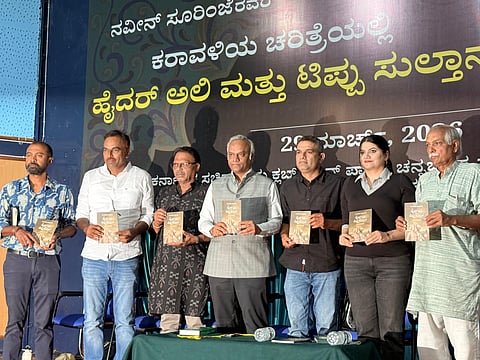

“The people who benefitted the most from Tipu Sultan’s largesse are today among those who villainise him in the strongest terms. And those who never benefitted from him in any manner are being forced to take to the streets to defend his name,” said Muneer Katipalla, an activist from coastal Karnataka, in Bengaluru on Sunday, March 29.
Muneer was speaking at the launch of a new book on Tipu Sultan, the former Mysuru ruler who continues to be demonised by the Sangh Parivar and other Hindutva outfits.
The book, Karavaliya Charithreyalli Haidar Ali Mathu Tipu Sultan (Haidar Ali and Tipu Sultan in Karavali’s History), written by journalist Naveen Soorinje, chronicles the policies of Haidar Ali and Tipu on land, economy, religion, and warfare, alongside key events of their time, with a focus on caste and community dynamics in coastal Karnataka.
In some ways, the extensively researched book seeks to address the accusations levelled by Hindutva groups against Tipu and Haidar, including claims of forced conversions, temple destruction, and the persecution of Christians and Kodavas.
Speakers at the event highlighted aspects of Tipu’s rule, touched on how history must be understood in the context of the time, and criticised what they described as the double standards of those who attempt to erase some of Tipu’s policies. Muneer even ventured into the hypothetical question of how Tipu’s legacy might have been perceived if he hadn’t been a Muslim.
“If Tipu hadn’t been Muslim, streets, airports, and whatnot would have been named after him,” Muneer said. He also pointed out that even in coastal Karnataka, structures such as the Jamalabad fort in Belthangady, Dakshina Kannada, are not adequately credited to Tipu Sultan, who built it.
He then raised a broader question: if Tipu is portrayed as a bigoted and intolerant Muslim ruler who persecuted Christians and Hindus, what tangible benefits did Muslims themselves receive under his rule?
“The only mosque that Tipu built in coastal Karnataka was the Eidgah mosque on Lighthouse Hill, and that too, barely has enough space. Similarly, the Zeenath Baksh mosque in Bunder, which he is believed to have renovated, is also tiny. Show me a mosque in coastal Karnataka that has 10-20 acres of land,” Muneer said.
In contrast, he noted, Tipu is documented to have granted land and patronage to several Mutts in the region, including the Swarnavalli Mutt.
“There were a handful of rich Bunts and Jains who may have converted to Islam, perhaps during Tipu’s time. But they did it to maintain their power and status. Other than that, where are the Muslims whom Tipu supported?” Muneer asked.
Citing the example of the Aikala church, Muneer said Tipu was believed to have held back from attacking it after petitions from local Bunts. “There are dozens of records to show that Tipu favoured Bunts and Jains, but none to show that he ever favoured local Beary Muslims. So who gained the most from Tipu’s rule? These very same communities are today calling him a traitor,” he said.
Referring to conflicts with Kodavas, Muneer argued that Tipu’s actions must be seen in the context of the time. “Kodavas continually attacked Gowda Saraswat Brahmin (GSB) temples, and Tipu attacked the Kodavas for that reason. Today, all of them are calling Tipu a traitor, Islamist, and intolerant. Let there be a discussion on all this,” he added.
“I am not a representative of Muslims or Islam, but someone working to represent working-class people, Dalits, and Adivasis of coastal Karnataka. Just like these communities, Muslims today are also an oppressed community, and that is why I am speaking on behalf of them, just like others (on the dias) are speaking about them,” Muneer said.
Sudipto Mondal, executive editor of The News Minute, also made similar observations. He pointed to the irony of Tipu having patronised Brahmin sects across the region, from Madhwas to Havyakas, and how the Shaivite Sringeri Mutt is now a centre of spreading vitriol against Tipu Sultan.
Minister for Rural Development and Panchayati Raj Priyank Kharge, meanwhile, spoke about present-day SP Road in Bengaluru, which was once known as Taramandalapet due to Tipu Sultan’s rocket foundry being located there. “It was called Taramandalapet because the rockets they tested there looked like stars in the sky,” Kharge said.
He also spoke about the futility of attempts to erase someone or something out of history. Chapters on Tipu Sultan in school textbooks have been the subject of controversy in the past, with BJP leaders calling for their removal.
Pointing to Lalbagh, one of Bengaluru’s two largest lung spaces, Kharge noted that Karnataka’s horticulture department itself credits Haidar Ali as the father of horticulture in its books and its website.
“Lalbagh is one of the best lung spaces in the country. We owe it to Tipu and Haidar Ali. The MP there (Bengaluru South MP Tejaswi Surya) is against Tipu Sultan. Once I asked him: ‘You want to wipe out Tipu and Haidar Ali from the pages of history? Come, let’s burn down Lalbagh. Can that be done?’ It’s difficult to take things out of history,” Kharge said.
Drawing another example, he referred to coffee, which originated in Yemen and is believed to have been brought to the region by Bababudangiri. “Who was Bababudangiri? What community did he belong to? And who owns coffee estates now? People like CT Ravi,” Kharge said, referring to the BJP leader who spearheaded a movement against the Bababudangiri shrine.
“But let’s come to the present. Where does LPG come from? Eighty percent of our chemicals, fertilisers, gases, the urea that our farmers use, where does it come from?”
He added that up to 90% of kesar, which is used to make tilak, is sourced from Islamic countries. “Will they stop putting tilak? If you raise these questions, they will say it comes from Akhand Bharat. I’m bringing up all this because our youth need to know,” he said.
Writers Banjagere Jayaprakash, Siddanagouda Patil, and historian Ruchika Sharma also spoke at the event.
