
Subscribe
Follow TNM's WhatsApp channel for news updates and story links.
The last few days of clearing pavements as part of Bengaluru’s Safe Footpath Campaign have wreaked havoc on the lives of street vendors. The campaign launched by the Greater Bengaluru Authority (GBA) on July 1 has seen pushcarts and kiosks removed in an attempt to make footpaths more accessible.
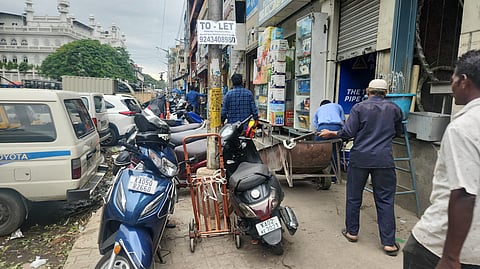
The highly publicised campaign has drawn appreciation and criticism in equal measures. But the relentless focus on street vendors as the main obstacles to a free pavement ignores the reality. That there are badly set footpaths, encroachments, parked vehicles, construction debris, etc., which obstruct pedestrian movement.
TNM checked the condition of footpaths across the city and found construction debris and garbage dumped on footpaths; broken slabs and exposed stormwater drains; live wires hanging over your head; and transformers and electricity poles in the middle of footpaths. Moreover, nowhere in the city would people with disabilities be able to use the roads or footpaths safely due to these issues.
TNM looked at pavements in KR Market, Koramangala, Vivek Nagar, Jayanagar, Magrath Road, Harlur Main Road, Old Airport Road, Hebbal Kempapura, HBR Hennur Ring Road, Mahadevapura, Kadubeesanahalli Kariyammana Agrahara, Johnson Market, MG Road, St John's Church Road, Tannery Road, Shivaji Nagar, and Fraser Town.
Here is what we found:
Broken footpaths: Many footpaths in the city are not blocked; they are physically unsafe. Broken slabs, uneven surfaces, holes, exposed drains, and missing tiles can make pedestrians trip or lose balance, especially at night or in crowded stretches. These have also been known to cause injuries.

Debris dumping: Construction materials left on footpaths are another recurring problem. Slabs, pipes, blocks, and other materials often stay on the path for days or weeks, turning a walkway into a worksite without warning or alternative access. This was seen in almost every area TNM visited, such as Magrath Road, Old Airport Road, Johnson Market, and St John’s Church Road.
Poor design: A narrow walkway leaves no room for two-way movement, and once a vendor, pole, parked vehicle, or pile of waste is added, the path is effectively blocked. Needless to say, such footpaths would not accommodate wheelchair users.
Garbage: Public walkways are turning into dumping grounds because of gaps in door-to-door waste collection and lack of dustbins in public areas for collection of household waste.
Electrical clutter: According to the IRC, poles and utility boxes must sit at the outer edge, never within the walking path. But TNM found several places across the city where transformers, electricity poles, telecom junction boxes and overhanging cables, wires tangled on the roadside and footpath posed a hazard. A few weeks ago, a motorist on Commercial Street was electrocuted during a downpour after coming in contact with overhanging electricity wires.
Parking on footpaths: Bengaluru’s poor public transport and equally poor civic sense mean that motorists frequently leave vehicles parked on footpaths, forcing people onto the road. This problem is worse in older areas of the city which have narrower streets.
Private encroachments: Private property encroachments on public space through slopes, entrance extensions, and frontage occupation can be found almost everywhere in the city. This permanently narrows the walkway or eats it away completely.
Existing law
According to IRC guidelines, footpaths are required on all streets where vehicle speeds are above 15 kmph. They should be safe, continuous, secure and comfortable for everyone, including children, older people, and people with disabilities, while also creating space for sitting, socialising, and playing. The total minimum width of the footpath varies by land use.
Footpaths should be raised about 150 mm above the carriageway and should have even, anti‑skid, well‑drained surfaces with gentle transverse slopes. Continuity across side streets and property entrances must be maintained with vehicle ramps and bollards spaced to allow wheelchair access.
Under the Rights of Persons with Disabilities Act, 2016, the government is legally obligated to make public infrastructure, including footpaths, accessible to persons with visual impairments and mobility disabilities. Section 45 of the Act requires accessibility across all public roads and spaces within a defined timeline. Most roads in Bengaluru do not comply with these requirements.
The IRC, in fact, recognises street vending as a “vibrant social space", especially for women, children and the elderly. It notes that the Street Vendors (Protection of Livelihood and Regulation of Street Vending) Act 2014 makes it mandatory for civic authorities to integrate street vending into the design of the city, to ensure that the needs and rights of all citizens are met.
Bengaluru’s street vendors have consistently demanded the implementation of the Act each time the city’s civic body has evicted them and seized their goods.
This article was written by a student interning with TNM.