
Subscribe
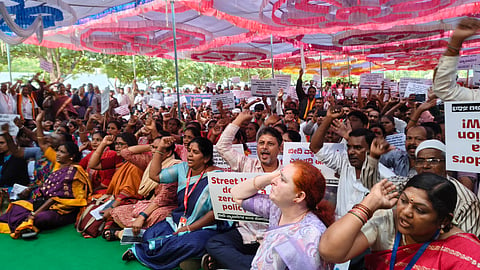
For over four decades, Anjali and Manjala have sold vegetables on Bengaluru’s streets. On Wednesday, July 8, instead of serving customers, they stood at Freedom Park with hundreds of other street vendors, asking a question they say has no answer from the government: “How are we supposed to survive?”
As cries of “Till when will we struggle?” and “Struggle for justice” rang through the protest site, vendors from across the city gathered for a bandh called by the Joint Action Committee of Street Vendors, bringing vending activity in several parts of Bengaluru to a halt.
The demonstration comes amid the Greater Bengaluru Authority’s ongoing ‘Safe Footpath Campaign’, under which authorities have removed hundreds of vendors as part of an initiative to reclaim 1,500 km of arterial and sub-arterial roads. Karnataka Development Minister Krishna Byre Gowda has said the drive is aimed at making streets “safer, more accessible and easier to navigate for every pedestrian.”
But for vendors like Anjali and Manjala, the campaign has translated into the loss of the only source of income they have known.
“By taking away our space, you are taking away our livelihoods. We are not able to live. How do we pay our rent, loans, children’s education and medical bills?” they asked.
Street vendor unions argue that the eviction drive violates the Street Vendors (Protection of Livelihood and Regulation of Street Vending) Act, 2014, as well as court directions. They allege that authorities have carried out evictions without issuing prior notice, providing alternative vending spaces where required or referring disputes to the Town Vending Committee, the statutory body established under the Act.
The unions also reject the government’s claim that street vendors are responsible for unsafe footpaths.
“If more than 300 people have died, it is because of road accidents, potholes, heavy traffic and police negligence. You are putting all these issues on street vendors,” said Hemant Kumar R, president of the Indian Telephone Industries Limited unit of the Karnataka Labour General Union.
Many vendors also questioned what they described as a contradiction in government policy. While schemes such as PM SVANidhi encourage street vendors to take loans to sustain their businesses, they said eviction drives leave them with no means to earn enough to repay those loans.
“To repay the loans, we have to keep selling. That’s the only way we can earn,” said Lakshmi, another vendor.
Pandyan, who has been vending on City Park Street, said street vendors are an integral part of the city’s economy.
“We are ordinary people. We take from them and they take from us. It is like a circle,” he said, referring to the relationship between vendors and the residents.
According to Vinay Sreenivasa of the Federation of Bengaluru Street Vendors Associations, the bandh was intended to send a clear message to the government.
“Street vendors will not accept a violation of their dignity or a violation of the law. We will stand up for our rights, and the government has to listen,” he said.
Following the protest, a delegation met Greater Bengaluru Authority Chief Commissioner M Maheshwar Rao and submitted a memorandum demanding an immediate halt to what they termed “illegal” evictions.
The memorandum sought permission for vendors to continue operating from their existing locations or, where that was not possible, to be provided temporary vending spaces on the same roads. It also demanded the return of confiscated goods, compensation for merchandise allegedly damaged during the eviction drive, and footpath designs that accommodate both pedestrians and street vendors.
This article was written by students interning with TNM.
Follow TNM's WhatsApp channel for news updates and story links.
