
Subscribe
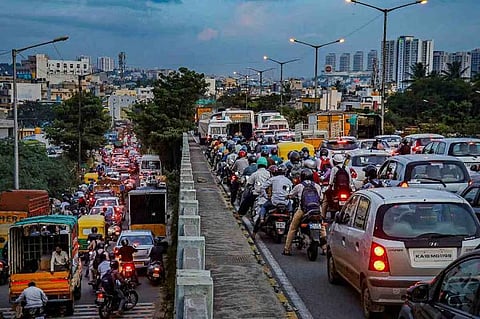
Two-wheelers will soon be barred from two of Bengaluru’s busiest elevated corridors, with the traffic police citing accident risks and congestion.
The restrictions will cover the Electronics City and International Airport Rated corridors. They are part of a trial aimed at improving safety and traffic movement.
The Bengaluru Traffic Police (BTP) announced restrictions on five flyovers and elevated corridors after reviewing accident patterns, traffic congestion and problems caused by vehicle breakdowns.
Restrictions on the BGS Flyover, Peenya Elevated Corridor, Double-Decker Flyover and International Airport Road Elevated Corridor will begin from September 4. The Electronics City Elevated Corridor too will have these restrictions from September 11.
The International Airport Road Elevated Corridor, between Sanjeevnagar Cross and Vidyashilp Junction, will no longer allow two-wheelers or passenger autorickshaws. Goods vehicles of all categories will also be prohibited on the stretch between 6 am and 10 pm.
The Electronics City Elevated Corridor will have the most extensive restrictions. From September 11, two-wheelers, passenger autorickshaws and three-wheeler goods autos will be prohibited throughout the day.
Heavy, medium and light goods vehicles will also be barred from the Electronics City corridor between 6 am and 10 pm. The corridor is currently operated by Bangalore Elevated Tollway Pvt Ltd (BETPL).
The traffic police said the restrictions are being introduced on a trial basis and their impact will be assessed before further decisions are taken. The concession period for BETPL is also nearing its end, although discussions are reportedly underway over a possible extension and eventual handover to the Greater Bengaluru Authority.
The Peenya Elevated Corridor will see passenger and goods autorickshaws prohibited at all times. Heavy and medium goods vehicles will be restricted during peak periods, between 7 am and 11 am and again from 4 pm to 10 pm.
On the BGS Flyover on Mysuru Road, heavy goods vehicles will be prohibited throughout the day. Other goods vehicles, including three-wheeler goods autos, will not be allowed during the 7 am to 11 am and 4 pm to 10 pm periods.
The Double-Decker Flyover between Silk Board and Ragigudda will also be closed to heavy goods vehicles throughout the day.
The restrictions were finalised after the traffic police examined several aspects of road safety. These included the design and width of the flyovers, the severity of accidents, congestion caused by broken-down vehicles and bottlenecks at entry and exit points.
Officials also considered how traffic could be managed during emergencies and the risks faced by pedestrians and two-wheeler riders.
Joint Commissioner of Police (Traffic) Karthik Reddy said the decision followed a comprehensive review of the available road safety and traffic data.
“The key factors that were considered while taking decisions on restrictions were road safety, road design and width of the flyover, reducing the severity of the impact of accidents, mitigating traffic congestion caused by vehicle breakdowns, easing congestion occurring at the entry and exit points of flyovers, traffic management during emergencies, safety of pedestrians and two-wheeler riders and a comprehensive road safety approach.”
The Electronics City corridor has drawn particular attention from the traffic police because of the severity of accidents reported there. According to a Times of India report, quoting Karthik, fatal accidents were higher on this elevated corridor compared with the other flyovers, although exact figures were not immediately available.
The restrictions are likely to affect a large number of commuters who use the elevated corridors to travel between residential areas and Bengaluru’s major employment hubs. The ban on two-wheelers could particularly affect office-goers who rely on motorcycles and scooters to access Electronics City and Kempegowda International Airport.
Follow TNM's WhatsApp channel for news updates and story links.
