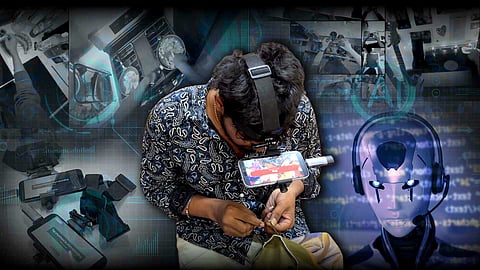
On a Tuesday morning in Bengaluru’s New Thippasandra market, Nagraj is doing what he does every day. The owner of a small grocery shop, he is sorting stock, attending to customers, keeping his shop in order. The only thing different today is what he’s wearing on his head.
A small camera, fitted into a headband, sits just above his forehead. It records everything – his hands reaching for goods, customers passing money across the counter – the ordinary choreography of a day’s work. Somewhere, on a server he has never seen, in a format he cannot read, that footage is being used to teach a machine.
“They gave us the cameras so a robot can learn what humans do,” Nagraj told TNM. “All I had to do was my regular work while wearing the camera.”
He has been doing this for five days. He had been paid for two days by then.
New Thippasandra market in east Bengaluru is not the kind of place that usually figures in conversations about artificial intelligence. It is a dense, working market housing vegetable vendors, tailors, cloth shop owners, the everyday commerce of a city neighbourhood. But in May, representatives from a company called Instawork began moving through its lanes, approaching workers with an unusual proposition.
Wear this camera while you work. Do what you normally do. We will pay you for your time.
Workers told TNM that Instawork’s representatives explained the project verbally, distributed the equipment — iPhones fitted on headbands and chargers — and they agreed. No contract was signed. Nothing was put in writing. The arrangement, as far as most workers here understand it, rests entirely on a spoken agreement made one morning in the busy market.
Instawork is a San Francisco-based company founded in 2015. Its original business was digital staffing, with an app-based platform matching hourly workers with short-term shifts. It now has over seven million workers in its network and has raised more than USD 160 million from investors including Benchmark, Greylock, and TCV. Its India office is based in Koramangala, Bengaluru.
Instawork’s project at New Thippasandra is egocentric data capture, which involves visual information recorded from the wearer’s point of view.
An Instawork employee we spoke to said his work begins with identifying suitable locations and occupations where diverse day-to-day activities can be recorded. The project, he told us, is running for three months across multiple cities in India.
The end use of the footage, he explained, is to train AI systems, specifically humanoid robots learning to navigate and operate in physical spaces.
Lack of Contract
To build a robot that can fold a shirt, pick up a tomato without crushing it, or locate a product on a shelf, AI systems need to understand how human hands and eyes work together. That requires training data, millions of hours of first-person footage showing fine motor movement in real-world environments. It is painstaking to collect, difficult to generate artificially and, in places like India, very cheap to obtain.
The workers at New Thippasandra were told this, in broad terms. They were told that future AI systems need to learn from human movement. They were told their footage would train robots. Several told us they were also told that the robots being trained might eventually do the kind of work they currently do.