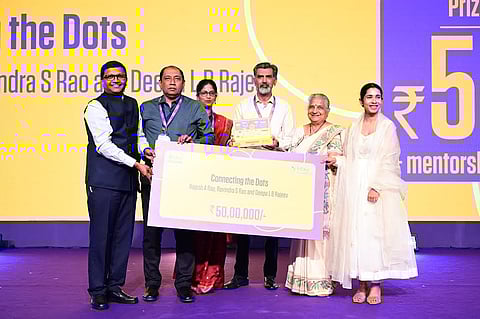

Bengaluru-based educators Rajesh A Rao, Ravindra S Rao and Deepa L B Rajeev were among the winners of the Infosys Foundation’s Aarohan Social Innovation Awards for their initiative ‘Connecting the Dots’, an interactive learning programme for government school students. The programme delivers daily live STEM and spoken English classes, hands-on lab kits, scholarships and teacher training to improve learning outcomes and access to quality education. In an interview with TNM, they discuss the gaps in public education that shaped the programme and its impact on students.
What gap in government school education prompted you to create Connecting the Dots (CTD)?
CTD was created to address two major gaps in the education system, the quality of STEM education, particularly in government schools, and access to quality education for underserved students.
STEM education in India is heavily dependent on rote learning, with limited emphasis on application, conceptual understanding, or real-world relevance. This is compounded by a serious shortage of well-trained teachers.
The second challenge is access. Over 65% of students study in government schools or non-English mediums, facing both language and economic barriers. CTD set out to build a model that delivers high-quality STEM education to government school students in an inclusive and scalable way.
What changes have you observed in students' learning outcomes, especially in STEM and spoken English?
We have robust monitoring and evaluation systems to track learning outcomes. Over the years, schools in our programme have shown clear improvement in Class 10 board exam performance, particularly in Science and Mathematics. A higher proportion of students now score an aggregate grade of A or above and qualify for our scholarships.
Even at lower grades, we see significant improvement in basic mathematical skills. Importantly, more students choose STEM streams beyond Class 10, which aligns with our goal of building a strong pipeline of future STEM professionals. We have also observed reduced dropout rates after Class 10.
What challenges did you face in reaching remote schools and delivering live classes consistently?
We face two broad types of challenges. The first is systemic. Education systems tend to be resistant to change, and while the world has evolved rapidly over the past few decades, curricula, pedagogy, and assessment methods have changed very little.
The second set of challenges is operational, related to physical and digital infrastructure. While this was a significant hurdle in the early years, the situation has improved considerably and is now a smaller constraint than it was a decade ago.
How do you adapt lessons for students who are first-generation learners with little academic support at home?
Our programme places strong emphasis on foundational Mathematics and spoken English in Classes 6 to 8, ensuring that by Class 9, students have solid fundamentals.
Our teaching philosophy is centred on simplicity and relevance. We focus on breaking concepts down and connecting them to real-life applications, helping students understand why Science and Maths learning matters. We also use experiments and demonstrations to bring Science alive.
Another key principle is moving from the familiar to the unfamiliar, anchoring new ideas in everyday experiences to build confidence. In addition, all students and teachers have access to our digital library of lectures, experiments, notes, worksheets, and assessments, which complements our live classroom sessions and supports practice at home.
How do you ensure students without stable internet access or devices are not left behind?
Limited internet access is far less of a challenge today than it was when we started 12 years ago. Our model is designed to be inclusive by delivering live sessions in classrooms during school hours, ensuring every student in the class benefits regardless of home access.
For schools in very remote locations with unreliable connectivity, we also provide learning content on-premise within classrooms.
How receptive were government school teachers initially to external live classes?
Teachers and school leadership have generally been supportive. A key part of our approach is clear communication about our programme, its benefits, and our track record, as well as emphasising that we complement, not replace, classroom teachers.
Over time, we have built strong goodwill with teachers and principals. Our teacher training programmes directly support teachers’ professional growth, and we see enthusiastic participation and openness to adopting new ideas in their classrooms.