
Subscribe
Before sunrise on April 1, Bengaluru witnessed an unusual form of protest. As early as 3 am, citizens began assembling at key locations across the city, setting up installations and artwork. By dawn, groups had gathered at Rajarajeshwari Nagar (RR Nagar) and the Mysore Lamps site in Malleswaram, using performance and collective expression to voice their frustration with the city’s infrastructure failures and environmental concerns.
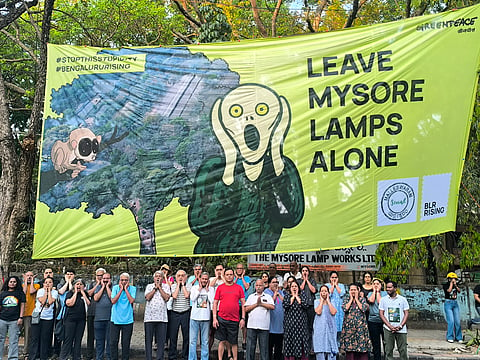
At the heart of both protests was a powerful visual reference: The Scream by Edvard Munch. Drawing from the 1983 iconic imagery, participants used their own voices as instruments of protest, literally shouting into the cityscape as a form of resistance.
In Malleswaram, around 40 participants, including members of Greenpeace India, Citizens for Sankey, and local residents, assembled at the Mysore Lamp Works site between 6.30 and 7.30 am. They unveiled a banner reading “Leave Mysore Lamps Alone,” opposing a proposed convention centre project that could take over 21–22 acres of green cover.
Residents argue that the land, once an industrial site, has evolved into a crucial urban green space. Production at the Mysore Lamp Factory ceased years ago, and the area now supports biodiversity, including species such as the slender loris. For locals, the space is more than unused land, it is an ecological asset. Many fear that large-scale construction will increase traffic congestion, worsen pollution, and permanently erase one of the neighbourhood’s few remaining green pockets.
Campaigners say the resistance is not just about opposing development, but about reimagining it. The protest forms part of Greenpeace India’s broader “Scream” initiative under the Bengaluru Raising campaign, which encourages citizens to question what they see as unsustainable urban planning.
The campaign itself grew out of participatory workshops called “The Imaginarum,” where residents were invited to envision the future of their city. According to campaigners, the responses were striking in their simplicity: people asked for more green spaces, walkable streets, cycling infrastructure, better public transport, community areas, and improved waste management. Notably absent were demands for flyovers, tunnels, or large commercial developments.
In Malleswaram, this vision has translated into a clear demand, to preserve the Mysore Lamp Works area as a shared, community-oriented green space rather than convert it into a convention complex.
Vaishali Upadhyay, another 26-year-old Climate and Energy campaigner volunteering with Greenpeace, explained that residents of Malleswaram often refer to the Mysore Lamp Works area as the “green lungs” of the neighbourhood, owing to its dense tree cover. “The residents of Malleswaram are using this space to convey that they do not want it to be cut down and turned into a concrete development,” she said. Just as Selomi said, she added that many residents envision the space as a community-oriented area, with public parks, shared spaces, and cycling paths rather than large-scale construction.
Speakers at the protest emphasised that urban heritage extends beyond buildings. For them, protecting the environment is equally critical to preserving the city’s identity. With the climate crisis intensifying, they argue that safeguarding and expanding such green spaces should be a priority, not an afterthought.
Preeti Sunderajan, co-founder of Citizens for Sankey, a Bengaluru-based residents’ collective comprising mainly members from Malleswaram and Sadashivanagar added, “We want to protect our heritage and heritage is not only buildings but also the environment and ecological heritage.”
Meanwhile, in Rajarajeshwari Nagar, a different but equally pressing concern brought residents together. Protesters gathered at the RR Nagar Arch between 5 and 6 am to highlight the long delays in the construction of the Rajarajeshwari Nagar flyover, as well as the Dommasandra flyover.
Originally launched in 2022 and scheduled for completion by 2024, the RR Nagar flyover project was intended to ease traffic congestion. Instead, residents say it has had the opposite effect. With only a few incomplete pillars standing and no visible progress in recent months, the project has become a symbol of stalled infrastructure and poor planning.
The initial design included two major ramps – one connecting Mysuru Road to Kenchanahalli Main Road, and another linking University Circle to Vrushabhavathi Valley. However, years after construction began, the project remains incomplete, forcing commuters to take long detours and navigate worsening traffic conditions.
However after 4 years of its inception, the ground reality is only four isolated pillars stand today and the construction is abandoned. Vinutha Devi, a resident and activist at The Green Space, called the project “an iconic example of construction stupidity.”
With an estimated ₹71 crore of public funds already invested, many are now demanding answers for what they describe as mismanagement and neglect.
This article was written by a student intern working with TNM.
