
Subscribe
Follow TNM's WhatsApp channel for news updates and story links.
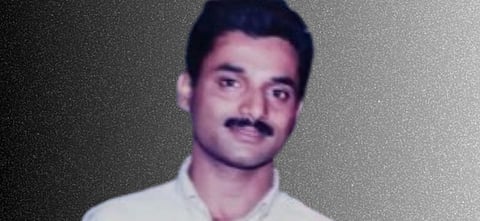
Six police officials in Kodagu district are facing trial for the alleged illegal confinement and brutal assault of Roy D’Souza, a 50-year-old man, in their custody in June 2021. Roy’s death two days after the alleged assault sparked accusations from his family that his death was due to custodial torture. While the official medical opinion attributed his death to cardiac failure, forensic doctors who reviewed the post-mortem report at TNM's request say the autopsy findings themselves do not support that conclusion.
On July 9, the Principal Civil Judge and Judicial Magistrate First Class Vishwanath A accepted the charges framed by the CID against six police officers then attached to the Virajpet Town police station. Police officers Thanukumar HG, Lokesh NS, Sunil MU, Sathish NS, Nehru Arun Kumar KC and Sangamesha are accused of assaulting 50-year-old Roy D’Souza on the night between June 9 and 10 in 2021. They are accused of illegally confining and assaulting Roy with weapons.
Police records say Roy turned violent and attacked officers and Home Guards with a sickle before being brought to the Virajpet Town police station. His family says he returned home unable to walk, soaked, and covered in wounds. He died two days later without regaining consciousness. An inquest recorded nearly 20 injuries on his body. Three witnesses present at the inquest said they suspected the police assault had caused his death.
The post-mortem, however, attributed his death to cardiac failure from heart disease. Forensic doctors who reviewed the reports for TNM say this conclusion isn't supported by the medical evidence. Neither the autopsy nor the histopathology findings point to heart disease, they said. The reports also did not explain why the 24 injuries found on Roy's body were ruled out as a contributing cause. In the days after his death, the family alleged they faced attempts to pressure them into dropping the case.
The events leading to Roy’s death have been pieced together by TNM based on documents obtained under RTI, court records, media reports and the FIR.
Roy D’Souza went missing from his house in Virajpet town in Kodagu district around 11 pm on the night of June 9, 2021, during the COVID-19 lockdown. According to his mother, he had been agitated the whole evening as he had not taken his epilepsy medicines.
When his mother Matilda realised that Roy was not at home, she sought the help of her relatives who lived nearby to look for him.
According to the police, Roy was behaving strangely, screaming ‘murder for wealth', and allegedly attempted to assault police officer Thanukumar and Home Guard Baby, who were on duty near Boyikere Road. The two managed to evade him. Roy then headed towards Murnad Road where, repeating the same cries, he attempted to attack Home Guard officers NS Lokesh and Ranjith, who also escaped. Roy then allegedly accosted another police officer named Sangamesh, who was riding a motorcycle, shouting that he would kill Sangamesh. Roy then allegedly swung a sickle at Sangamesh’s neck, but the latter sustained an injury on his left arm while attempting to thwart the blow.
Around 1.20 am on June 10, Matilda’s relative Judy David D’Souza received a call from Sunil, an official of the Virajpet police station, saying that Roy had allegedly attacked police personnel and that he was in the police station.
At the station, Matilda, Judy David and other relatives found around 15-20 police officials, including Nehru, Sunil, Tanu, and Satish, surrounding Roy. He was soaking wet and unable to walk, so his relatives lifted him into the auto and took him home. At home, when they changed his clothes, they saw wounds on his body. They washed him with warm water and put him to bed.
Later that morning, around 10.30 am, when Judy David went to Roy’s house to ask about his health, Matilda said that he was not yet awake. Judy tapped Roy to wake him, but there was no response. He realised that Roy’s arms had swollen up.
The family took him to a doctor who advised that he needed a hospital. The family then took him to Ashwini Hospital in Madikeri, and then the district hospital in Madikeri where he died on June 12.
His mother Matilda filed a complaint with the Virajpet Town police station, alleging that the police had assaulted her son. A case was registered under Sections 323 and 324 (assault and assault with weapons) of the Indian Penal Code (IPC) on June 10, 2021.
The inquest done on June 12, 2021, noted nearly 20 injuries all over Roy’s body. “Serious wounds are visible on the body, medical treatment given to the deceased was unsuccessful, and he died. The cause of death is to be determined by post-mortem,” the report said. The inquest report was done by PN Mahesh, the Tahsildar and Taluk Magistrate of Madikeri.
Three witnesses at the inquest expressed their suspicion about Roy’s death and said they suspected his death was due to the “murderous attack” carried out by the police and home guards.
Intimidation
In the days after Roy’s death, local newspapers reported that his family was under pressure to drop the allegations.
On June 14, 2021, four women turned up at Matilda’s house on the pretext of offering their condolences, Kannada daily Shakti reported. However, even as they seemingly consoled the family, they also asked many questions, rousing suspicion. Robin later alleged that they were the wives of four of the accused cops. Shakti also published pictures along with this news report.
Shakti also reported that the next day, on June 15, two local police officers in uniform turned up at Matilda’s house soon after Roy’s brother Robin left the house. They allegedly pretended to be CID officers who were investigating the case and asked Matilda to hand over the clothes Roy was wearing and also sign a blank sheet of paper. Robin told Shakti that Matilda refused to do either.
Kannada daily Vijayavani also reported on the findings of the post mortem report and the grievous injuries on Roy’s body. In the wake of the assault, the police suspended Thanukumar HG, Lokesh NS, Sunil MU, Sathish NS, Nehru Arun Kumar KC, BT Pradeep and A Ramesh, Vijayavani reported.
The medical opinion and police version
The CID has charged six police officials with wrongfully confining Roy and assaulting him with weapons. However, two senior forensic doctors who reviewed the post mortem, histopathology and toxicology reports said that the findings noted in the medical reports don’t quite lead to the conclusion that death was due to cardiac failure as a result of heart disease.
The doctors, who requested anonymity, said that nothing in the post mortem and histopathology reports indicated that Roy had heart disease. In their assessment, the doctors who conducted the autopsy did not explain how they concluded that Roy died of a heart attack. Equally significantly, the final opinion also did not explain why the role of the injuries in causing the heart attack was ruled out.
The post mortem performed by doctors at Kodagu Institute of Medical Sciences in Madikeri showed that Roy was brutally assaulted. The autopsy found 24 external injuries on Roy’s body—six abrasions (scratches), 17 contusions (bruises) and one fingernail torn off. According to them, death was due to cardiac failure as a result of disease of the heart.
The CID’s Investigating Officer (IO) sought a medical opinion on whether the four lathis seized during the investigation could have caused the injuries on Roy’s body. The doctors wrote back saying, “The injuries 1 to 24 are possible to be sustained by the wooden sticks (four), i.e., lathis, examined.”
When the police sought clarifications on the cause of death, the doctors said that the injuries could not have caused the heart attack and that the role of his past epilepsy treatment in causing death could not be ruled out.
Inconsistencies in the post mortem
Roy had wounds all over his body—on both his arms and legs, fingers, back, face, abdomen, buttocks and scrotum. One of his fingernails was torn off. Both forensic doctors who examined the post mortem reports at TNM’s request noted that the injuries were serious and several of them were typical of police torture.
At least two of the bruises on Roy’s back and lower back were what forensic doctors call “tram track” injuries—clear, parallel lines.
Tram track injuries are marks left on the body when hit with considerable force by a rod-like object. The bruise consists of two parallel linear bruises separated by paler skin. When such a blow lands on the body, the blood vessels at the point of impact get compressed. The blood vessels at the edges of the rod suddenly stretch and rupture from the force. Blood leaks into the surrounding tissues in two parallel streaks, giving the injury its distinct appearance.
Similarly, they said that the torn fingernail of the right index finger was also a sign of police torture.
Several of the bruises, such as those on his arms, hands, legs, feet, buttocks, back and scrotum, were quite large, and many of them suggest defensive wounds sustained when trying to protect oneself, Dr Reena* said.
However, Dr Deepan* pointed out that the language used to describe the injuries was vague. “The description should be three-dimensional. Here, the depth is not mentioned,” he said, referring to how the autopsy had only noted the length and breadth of the injuries.
Autopsy reports of several other alleged instances of custodial deaths investigated by the CID note the depth of the injuries by describing them as skin-deep, subcutaneous deep, or muscle deep, which indicate the strength of the blows.
Both Deepan and Reena said that although the autopsy said Roy died of a heart attack due to heart disease, there was little evidence for it.
Dr Reena said, “The histopathology report noted that he had early atherosclerotic changes, but these are consistent with his age,” she said.
Dr Deepan also broadly agreed, saying, “His heart is as good as anybody else’s. His histopathology report is also normal, like anybody else’s.”
Both doctors also said that the role of the injuries in causing death was not ruled out clearly.
Reena said that the post mortem report contained about 30% of the information she would have noted if she were doing the autopsy. She explained that she would have noted the absence of things as well, which would later help in evaluating possible causes of death and also in assessing the impact of the injuries.
Giving an example, Reena said the doctors had given no credence to bruises on the chest and neck and whether they had played a role. “Whether the heart attack was solely responsible (for death) or whether it was aggravated by the injuries… This was not explored,” she said.
If the two doctors are right, and if Roy did die due to his injuries, the police have a lot more to answer for than just assault.
Names have been changed to protect their identity.
(Students Shreya Thakur, Nayana Navin, Syed Shahid helped translate police records.)
