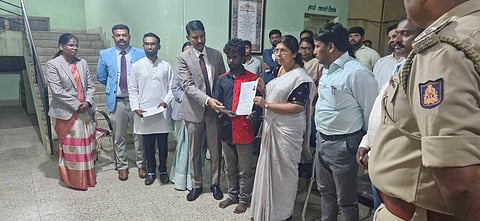

Twenty-eight members of the Soliga tribal community, including children, were rescued from alleged bonded labour at a brick kiln in Bevinahalli village of T Narasipura taluk in Karnataka’s Mysuru district on June 22. Many of the workers had reportedly been trapped in debt and forced to work for nearly eight years on meagre wages, with strict restrictions on their movement and allegations of physical abuse.
An FIR has been registered at Bannur Police Station under the Bonded Labour System (Abolition) Act, the SC/ST (Prevention of Atrocities) Act, and provisions of the Bharatiya Nyaya Sanhita relating to trafficking, wrongful confinement, assault against women, and voluntarily causing hurt.
The rescue operation was carried out jointly by the District Legal Services Authority (DLSA), the Tahsildar, the Labour Department, the Department of Women and Child Development, and the Bannur police, with support from NGOs Vikasana and Madilu.
The case came to light after one labourer managed to escape from the kiln and contacted NGO Madilu on June 19. The organisation subsequently alerted Vikasana, which coordinated with authorities to facilitate a rescue operation.
According to Vibha Varghese, CEO of Vikasana, the kiln owners allegedly discovered the worker’s escape before officials could intervene. The escaped labourer, along with his wife and mother-in-law, was allegedly tracked down and brutally assaulted the night before the rescue.
“The labourer who escaped was severely beaten. His wife and mother-in-law were also assaulted and sustained serious injuries,” Vibha told TNM.
Following the complaint, the NGOs approached the Mysuru Superintendent of Police and the DLSA, leading to the rescue of all 28 workers on June 22.
Of those rescued, 16 are from villages around T Narasipura, while two are from Tamil Nadu’s Vellore district. Most of the workers had migrated from Tamil Nadu decades ago and later settled in Karnataka. All belong to the Soliga community, a Scheduled Tribe.
NGO representatives said many of the labourers had accepted advances of around Rs 25,000 from the kiln owners and remained trapped in bonded labour for nearly eight years. Despite years of work, they allegedly continued to receive extremely low wages and remained indebted.
One family reportedly worked from 5 am to 6 pm daily for eight years after accepting an advance. The parents and their two sons, aged 9 and 13, earned only Rs 500 to Rs 1,000 a week. The younger child attended school but was allegedly required to work before and after classes and on weekends.
Workers told authorities that rice supplied by the employer was sold to them at Rs 30 per kilogram, with the cost deducted from their wages. They also alleged that only one male member from each family was allowed to leave the kiln premises when necessary, while women and children remained confined.
According to the victims, they were barred from visiting relatives or attending family functions and were subjected to physical violence if they requested leave or questioned working conditions.
The rescued workers, aged between 9 and 50 years, underwent medical examinations, with several found to have injuries. Authorities have arranged treatment for those requiring medical care.
A formal inquiry was initiated by the Tahsildar on June 23. Officials are processing release certificates and compensation under the Bonded Labour System (Abolition) Act, 1976. Under the law, each rescued labourer is entitled to a release certificate and immediate compensation of Rs 30,000.
Many of the survivors currently have no homes to return to after spending years at the kiln. The district administration has temporarily accommodated them in a social welfare hostel while rehabilitation measures are explored.
This story has been written by a student interning with the TNM
