
Subscribe
Follow TNM's WhatsApp channel for news updates and story links.
Thirty years ago, in 1996, activist Sunitha Krishnan started Prajwala — an NGO that assists sex workers and survivors of trafficking.
Sunitha has worked for three decades combating sex trafficking and sexual exploitation in India. By Prajwala’s own account, she has helped rescue 32,000 girls and women.
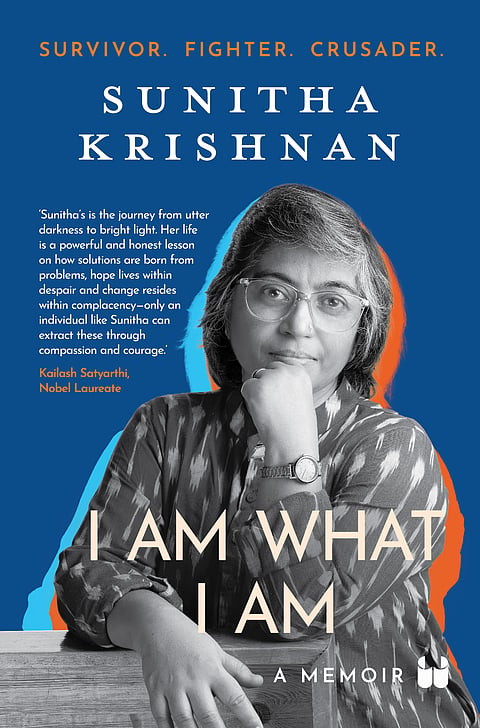
Sunitha Krishnan sat down with TNM to discuss her book titled I Am What I Am: A Memoir.
What inspired you after three decades of work – you started off in activism in 1996 – to write the memoir now?
I have been involved in social work from early childhood. But the big realisation, I guess, really comes when you witness death.
This was something that became very clear to me after my father died. He wanted to publish his autobiography that he’d written. It never happened. Two months after his death in 2021, I made it possible. I self-published it in Malayalam and English. The feedback for that book made me think I should write my own memoir.
I realised that I don't want people to say how good or how bad I was after I'm dead. Whatever it is, I want it to be known now.
In early January 2022, I got a call from a producer in Mumbai who said he wanted to make a biopic about me. He was just informing me. I asked him how he knew about me. He replied that he’d Googled me. When I looked myself up, I found different stories about me — all starting with my gang rape.
After that, everything changed. I wanted to tell my truth, my reality. I didn’t want any masala to be added.
How much of the book is about Sunita Krishnan, the person and the activist? And how much of the book is about Prajwala?
You can't separate the two in many ways. But I would say it is mostly about Sunita Krishnan. Because it is about Sunita Krishnan's journey, her life, her failures, her vulnerability and her struggle to understand stuff. These are very mindful decisions that I made before I started writing the book. I decided that I don’t want to name and shame people. I wanted to write about my evolution as a person
The initial idea of Prajwala started when I was 17. So while the organisation is 30 years old, the thought behind it is 35 years old.
What, in your view, is the single most misunderstood aspect of victim-centric policing? You speak about it in your memoir quite a bit. How important is it to centre victims while you are carrying out investigations?
One of the biggest misconceptions among both the police and the public is
that no woman actually gets trafficked, especially an adult woman. There is a belief that they are willing participants or that they are seeking short-lived income.
This belief erodes compassion and empathy. It impacts how police conduct themselves with a victim. Their attitude is ‘she’s doing it by choice and now paying for it’.
Changing that attitude has been one of my biggest challenges with the criminal justice system. I have had to repeatedly explain that women do get trafficked and that emotional manipulation, threats, deception and luring all play a role.
There is a whole range of sensitisation that needs to happen. It requires careful planning and a mindfully designed curriculum for everyone involved, starting with the police officer to the prosecutor to the judicial officer.
You also talk in your book about how rescued women often see shelters, such as Prajwala’s, as just another form of captivity.
There are no instant results. It's about time, skills and creating a mindful, trauma-informed space.
This is one of the reasons I keep telling people that removing someone from a place of exploitation and telling them to find a new job is futile.
A shelter is an interim space where healing happens. This takes a few months. It might take more time for individuals who deal with substance abuse. After they reach that point of healing, survivors begin to think about how they want to move forward in terms of life skills, education, livelihood training and fighting for justice.
That has to be their call but we can show them what choices they have
Last evening, we won a case for a 12-year-old girl who was trafficked. The accused received 30 years of imprisonment.
It took the child nine months to be able to do this. She kept saying that if she called out her captor, it would be pointless to go back to her village. She said that she would make enemies.
What made her change her mind then?
A seven-year-old child had testified against 40 people. That was this 12-year-old’s inspiration.
Let’s talk about the Telugu states a little. Is there anything unique about the Telugu landscape which makes this kind of work difficult or, perhaps, easier?
The Telugu states have been predominantly nice to me. I am not a Telugu person. I am originally from Kerala. Across party lines, the Telugu regional powers have been far more accepting that sex trafficking is a problem.
Even in 1996, when Chandrababu Naidu was the chief minister, he was very clear that this was a non-negotiable issue.
In Kerala, I had specific problems with the current CPI(M) regime. They say all the right things but don’t do it. I had better support from the Congress regime in Kerala.
In Odisha, there is significant reluctance in the state government. Both the
Biju Janata Dal (BJD) and BJP claim there is no trafficking. They say it is “just unsafe migration”. Even when you give them evidence, they are resistant.
Follow TNM's WhatsApp channel for news updates and story links.
