
Subscribe
“He had said ‘Inquilab zindabad’ and “Krantikari istaqbal”, meaning “long live the revolution” and “revolutionary welcome”. The judge said that since revolution can be violent and can be taken to mean an overthrow of the state, this must be terror.”
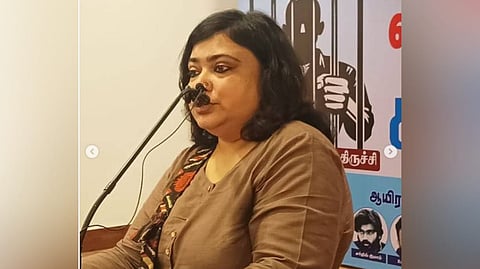
Banojyotsna Lahiri, researcher and partner of jailed activist Umar Khalid, was speaking at an event in Chennai on November 22 protesting the prolonged incarceration of activists under the Unlawful Activities (Prevention) Act (UAPA) without trial.
She was referring to the statement made by the Delhi High Court bench of Justices Rajnish Bhatnagar and Siddharth Mridul while denying Umar’s bail petition in October 2022.
“The prosecution took a clip of a speech Umar had delivered in which he said that when Trump visits India, our protests will continue, and since the riots happened in Delhi during the time of Trump’s visit, they said there was a terror conspiracy. The judge went one step further,” she said.
On Thursday, December 11, the Delhi High Court granted Umar bail for 14 days, from December 16 to 29, in order to attend his sister’s wedding.
In 2020, the country witnessed widespread protests when the Union government passed the Citizenship Amendment Act (CAA), which aims to provide citizenship to individuals based on religions, excluding Islam. The National Register of Citizens, proposed in tandem with the CAA, aimed to create a database of citizens to purportedly weed out illegal immigrants from the country.
After violence erupted in northeast Delhi in February 2020 and more than 50 people were killed, the Delhi police registered 758 FIRs and arrested 2,619 people. FIR 59 filed by the police on March 6, 2020, alleged a conspiracy behind the violence.
Eighteen people were arrested and charged under UAPA. Those arrested—including student leaders Umar Khalid, Sharjeel Imam, Shifa ur Rehman, and Gulfisha Fatima—remain in jail after multiple bail requests were denied. Five years on, the trial in the case is yet to start.
Meanwhile, the Union government has brought in another exercise to “purify voter rolls and remove illegal voters”, called the Special Intensive Revision (SIR).
Against this backdrop, TNM sat down for a candid interview on activism and politics with Banojyotsna on November 27.
It’s been 5 years since Umar Khalid was jailed. How has this prolonged detention changed your vision of justice and activism?
I’m disappointed with the justice system.
When the anti-CAA protests started, it was one of the biggest acts of civil disobedience in the country since independence. It was peaceful; people were passionate and happy. It was also becoming very weak.
This government is the most authoritarian that India has seen since independence. Therefore, we knew that there would be backlash and they would not take this lying down, especially a movement that was led by Muslims that became so big and involved people from across other communities.
The way the police and the prosecution were trying to frame these activists was not unexpected. An inclusive movement led by Muslims is something that the fascist government would not accept.
That reaction was not surprising. That’s how they behave. But we were hopeful that the judiciary would see through this plot.
When the judiciary also does not uphold justice, where do citizens go?
In 2021, it did pass a very good order to release three people on bail, but since then it has been delayed. We are still hopeful.
In the context of delayed justice, what is involved in keeping hope alive in a struggle?
The opposite of hope is despair. If I don’t hope, I slip into despair… We do not want to give up hope.
Firstly, because there have been so many people who have stood in our support, who have spoken up about this. That gives us strength; it also gives us hope that the judiciary then is also bound to see through it.
Legal experts have spoken about how absolutely rubbish this case is. There is no evidence; they have put up nothing. Despite this, people have been incarcerated. It is gross injustice. Against injustice you have to always hope, always fight, because despair is the victory of injustice. You cannot let that happen.

You have written about surveillance, House of the Dead-style incarceration, skewed media, and the framing of dissent. How does the media ecosystem manage to influence public perception?
That is what’s happening in every other instance also. The mainstream TV Indian media right now has completely turned into a propaganda machine of the state. They have lost their credibility. Before any case comes up for hearing, they create a cacophony. A media trial happens before the legal trial.
The police are also hand-in-glove with the media. For example, in our case, the chargesheet 59 filed by the police was leaked to the media before even the people under trial received it. The media then parroted the police version and started a media trial right then.
Could you talk a little bit about Umar Khalid, the researcher? Ramachandra Guha recently wrote, ‘Have I been able to carry on my research and writing, whereas he has not, because my first name is Ramachandra and not Umar?’
Yes, the whole case is political; there is nothing legal about it. It is political vengeance by the state. It is vengeance on the people who dared to protest.
From the start, dissent was curbed. Initially, it was just branding of protesters (as tukde tukde gang, urban naxal, etc.) and suppression of dissenting voices. The criminal charges came later. Now they are booked under terror laws. What is happening is a political battle, and if the government changes, the case will fall too.
Do you think there is a larger social question, though, about what led to the BJP coming to power? I would also like to link this to your own research. I think you have been working on something related to the economic marginalisation of the Muslim community.
Could you tell us a little bit about your research and what you have found?
The Muslim community in its entirety has been the primary target of this government. Fascism always finds an imaginary enemy to portray as the root cause of all problems so that no one can question them.
Everything is now linked to infiltrators. The poverty in this country, the unemployment, and the financial insecurity of people is not because of atrocities of the state or because of policies like GST or demonetisation. It is because of the infiltrators who have come and taken up the jobs and small businesses of people. This is how they created an enemy out of the Muslim community.
In the Muslim community, what is most talked about is the attacks against them and lack of security. These are important, but what is overlooked is the socio-economic marginalization of the community.
The government has stopped bringing out research and data that it used to publish. For example, the previous government had formed the Sachar Committee, which made very eye-opening revelations that led to action by the government to address this issue.
Not just for the Muslim community, but across communities the government has stopped trying to understand socio-economic marginalization. Since the Planning Commission was replaced by the NITI Aayog, they have stopped giving macro data for any community.
We have, through our research, tried to study this and found extreme socio-economic marginalisation of the Muslim community.
One way in which it happens is the disbursal of public funds; the Sachar Committee identified 10 districts as minority concentrated areas and found that they were developmentally poor. After the committee’s 2006 study came out, remedial measures were taken by the government.
We took 10 districts and looked at public schemes such as the Pradhan Mantri Awas Yojana and found that for districts with a higher concentration of minority populations, the disbursal of funds under these schemes was abnormally low in comparison to other districts. The same was observed for other schemes too, such as the Mahatma Gandhi National Rural Employment Guarantee Scheme and Swachh Bharat.
The spending on these schemes is low across the country generally too, but a segregated spending of public money was also observed.
We did another study on urban ghettos. We looked at the civic amenities in Okhla and its neighbourhoods, and found that the condition of roads, health, and education were bad.
Overall the public policy funding is extremely low, but specifically with regards to Muslims, the prejudice is widespread within the government functionaries in the country.
Having been involved in civil disobedience and seeing the state’s response, what is your one message to young researchers, students, and journalists who don’t speak out because they fear state punishment?
Fascism breeds in silence; the more we remain silent the more it spreads and nobody is safe from it. The witch hunt will come for everybody. It is always better to speak out for each other, to build a community of resistance, because in our silence they grow and they win. We need to keep speaking out because our silence is their victory.
If we say we are a democracy, then we cannot have a law like UAPA. Unlike any other law in the CRPC or IPC, where you are innocent until proven guilty, the UAPA is the only law where you are guilty until you can prove your innocence. You can be arrested on the grounds of reasonable suspicion, and reasonable suspicion can be generated.
When the Bhima Koregaon issue happened, all the news channels were blasting reports of letters with conspiracies to kill the Prime Minister. Suspicion was created in the general public and this was used to arrest activists. When the trial started, however, the letters vanished.
Even the definition of ‘terror’ is so broad that it can be applied to anyone.