
Subscribe
The English and Foreign Languages University (EFLU) in Hyderabad has announced the formation of an Internal Committee (IC) to deal with complaints of sexual harassment, in the aftermath of student protests alleging official apathy towards such incidents. While the IC was publicly announced on October 19, the order is peculiarly dated October 11 – a whole five days before the campus first saw protests demanding the reconstitution of a similar committee. Many students have pointed out that the IC order seems to have been backdated to October 11 after hurriedly constituting the IC. A woman student was sexually assaulted on campus on the night of October 18, triggering more protests with students alleging negligence on behalf of the university authorities. The IC members were announced the very next day, through an order dated October 11.
“The EFLU administration has a history of backdating orders. Under Vice-Chancellor Suresh Kumar the campus has witnessed a severe clampdown on dissent in general,” remarked a student, who did not want to be identified for fear of being punished by the administration. The IC’s formation has also been controversial because students allege that the EFLU administration has not been transparent with them.
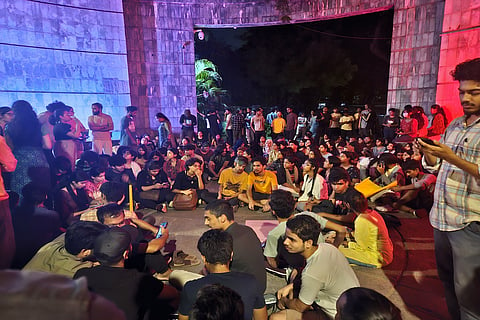
The IC was announced from EFLU’s official social media handle on October 20, two days after the woman student was sexually assaulted. Just before that, starting from the night of October 16, over 300 students held a protest for over 24 hours demanding the reconstitution of the university’s Sensitisation, Prevention and Redressal of Sexual Harassment (SPARSH) committee. Students alleged that the previous SPARSH committee, which was constituted under an EFLU ordinance based on the Sexual Harassment of Women At Workplace (Prevention, Prohibition and Redressal) Act of 2013, has been defunct since June 2023.
Before the protests, while several students were reportedly informed by the administration that Revathi Srinivas, a professor in the Department of Materials Development, was the SPARSH chairperson, the professor is said to have denied this claim. Further, other professors who are supposed to be part of SPARSH have also denied the same, leaving students confused about who was in-charge.
The students had also demanded that three elected student representatives be appointed to the SPARSH body, of whom one would be a queer person. After the protests demanding a SPARSH committee ended on October 18, the administration agreed to elect three student representatives after student elections were held. The administration also reportedly told the students’ collective that one seat could not be reserved for a queer person as the Universal Grants Committee (UGC) guidelines would not allow it.
However, while the students were keen on the SPARSH committee being reconstituted, the administration has now ensured that an IC is in place. The EFLU IC comprises two faculty members, two non-teaching employees, and one external member from an NGO. Further, three student representatives – an undergraduate student, a Masters student and a research scholar – will be elected by the student body. The circular from EFLU also noted that the IC will be established in keeping with University Grants Commission (UGC) guidelines.
