
Subscribe
Cinema has rarely allowed women the complexity of being human. Female characters are most often expected to be virtuous, predictable, and ideal. Even when women are placed at the centre of the narrative, few and far as they are, the contradictions are neatly ironed out into palatable ideas of femininity. Aasha, however, offers an interesting aside. Directed by Safar Sanal, the Malayalam film released on September 11.
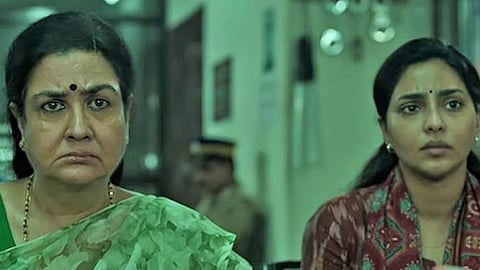
“I have never lived for myself,” says Urvashi’s titular character, in a moment of absolute frenzy. That line forms the defining conscience of the film, which presents Aasha and her daughter Anagha (Aishwarya Lekshmi) as neither entirely condemnable nor fully likeable – a welcome departure from the restrictive iterations of women on the silver screen.
The film opens at a bank. Aasha waits patiently for her turn, though visibly restless. Soon enough, we meet the short-tempered, stubborn woman beneath the one who puts up with everything, one who is not reluctant to make a scene at the slightest hint of disrespect.
As the narrative unfolds, we see her running around to oversee the construction of her elder daughter’s (Lakshmi Menon) new home and arrange a good alliance for the younger one. For a widow living alone with her young daughter in a big city, Aasha appears unbothered by social judgement on the outside. It is when she reaches for her nerve relaxants at night that we get to see her shaky hands and apprehensive eyes. But when Anagha refuses to back down from a romantic relationship with a man from a marginalised background, Aasha’s fury springs back.
The density of Aasha’s anxious rage, however, spills over when she gets into a late-night accident involving a volatile man (Joju George). We see the darkness inside her, and the lengths to which she is capable of going to earn the respect she is owed.
It is from here that the film really begins to dissect how female rage carries the weight of something far more cumulative than a personal moment provoking anger. In many instances, when people say that Aasha has lost her mind, we see her getting triggered. Subtly, but intentionally, Aasha reads into the social context that produces fear and madness in women, especially mothers.
What is more interesting is how the narrative, which maintains the tone of a dark psychological thriller, never falls back on familiar mother-daughter relationship tropes. It allows both women to be, unpacking the pressures of social threat, emotional insecurity, gendered expectations, and the negotiation of power they undergo.
In a particular scene, Anagha explains how her father passed away in bed as her mother watched helplessly. She also speaks about the domestic violence her mother had to endure, which she took care never to discuss with the girls.
But Aasha is a tough nut to crack, despite Anagha and her elder sister’s attempts at appealing to her with love, provocation, and sometimes defiance.
“Nothing can happen to my children,” she says throughout the film, as if to justify the cruelty she is capable of. But there is no way to distinguish Aasha’s madness from her love, except when the one she loves is fully compliant with her demands. And when we think about whether she herself received enough love to be more trusting of people, all judgement becomes a blur.
Urvashi brings an endearing tenderness to Aasha, revealing in fleeting expressions what untreated trauma and loneliness can do to women. She proves why she is the maverick of her craft, especially in scenes where she embodies the maddening turbulence of being a protective mother while trying to make peace with her daughter’s life choices.
Aishwarya Lekshmi too pulls her weight as the daughter who is independent enough to challenge her mother’s toxicity, but tender enough to know that she needs help, not abandonment.
It is also commendable that Joju George, who has been credited as a co-writer, does not hijack the narrative as seen in several ‘women-centric’ films with a bankable male actor.
By the time the film wraps up, several loose ends remain. But what remains consistent is the enduring resilience the women in it display, without becoming ideal messengers of goodness to be worshipped or of menace to be punished.
That is what makes Aasha such a refreshing departure. When women on screen are still so often written to either be admired or condemned, there is something quietly radical about simply allowing them to exist.
Views expressed are the author’s own.
