
Subscribe
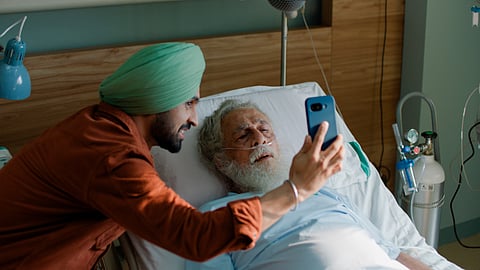
Three weeks into its theatrical release, Imtiaz Ali’s Partition saga Main Vaapas Aaunga is still moving audiences across the country, and making cash registers ring. The film, starring the inimitable Naseeruddin Shah, a restrained Diljit Dosanj, and a fierce Dolly Ahluwalia, among others, speaks of the various losses people in the Punjab suffered when Sir Cyril Radcliffe drew borders on a map in a rush, dividing it and Bengal.
The film swings between memory, lived experience, and the present, much like the mind of its protagonist Ishar Singh Grewal or Keenu (played wonderfully by Vedang Raina and Naseeruddin Shah as the young and old Keenu). As you are drawn into the story, you almost understand the ramblings of Ishar, now 95 years old — Moon, Martians, Mexico, opening bowler, cricket, and, of course, his intense feelings for his ‘Malika Dilfareb’ (a dreamy Sharvari) tattooed on his wrist.
The film is important, because at a time when everything is seen as black and white, it seeks to understand the grey zone that people operated in during the Partition. As Balli, Ishar’s younger brother (played by veteran Vinod Nagpal) says, we should not see that period through the lens of hate. “It was the atmosphere that was something else.” Cinematographer Sylvester Fonseca and editor Aarti Bajaj add life to these portions.
Happily enough for the makers, though the film began small (Rs 1.15 crore on day one), its gross collections world-wide now stand at Rs 84.40 crore.
In an interview, amid his hectic multi-city tours, Imitiaz speaks of making a necessary film, the horrors of migration, how he writes his women, and more. Here are some edited excerpts.
When was the first time you heard of the Partition, Imtiaz?
In early childhood, I am sure, there were many references to Partition, some in family conversations, some in literature, in Manto’s books, in Krishan Chander’s writings. I heard so much about Partition from Punjabi families when I travelled into Punjab, people who have been affected by the Partition, and even before that, in Bengal. Randomly, I would remember the accounts of writers, musicians, cricketers… People have mentioned it so often that I don’t remember a time that I did not know this word.

It was expected that the film would move audiences who are older, but it has also struck a deep chord among youngsters too. Did you expect this kind of reach?
I did not exactly know what the effect of the film would be. I must say it has been overwhelming and I had not calculated this. However, I was very aware of the inherent power of the material I was working with, to the extent that I would tell my producers, co-producers, actors, musicians that we are very lucky to have been given the chance to make this film. I heard accounts from Partition veterans in the past few years when I spent time in Punjab, and knew this story would affect people.
On screen, we are often told about loss, but rarely does it seep into our hearts. How did you go about showcasing the idea of loss, both tangible and intangible?
I realised that the not-so-obvious losses are very daunting upon our nation and our culture. For instance, in the generation of Raj Kapoor, Dilip Kumar, and Dev Anand, there was a certain fluency in their English, Hindi, and Urdu. Barring some, the next generation of actors did not have that. It was not expected that the general linguistic aesthetic would be that high. Then, in the third generation, it further gets lost.
In Delhi’s Rajinder Nagar (one of the areas that housed the initial influx of Hindu and Sikh refugees), I met a lot of people whose very refined parents were from Lahore and had studied abroad. And their children could only study in some Madhyamik Vidyalay (secondary school) in Delhi. That is also some sort of loss. Then, there is the loss of aesthetics, the clothes, the sophistication that pre-Partition Punjab and India had. After Partition, no one had the time to worry about the aesthetic of their clothes.
By including the shot of the copse of blooming rose shrubs, I was trying to indicate the loss of beauty, of the delicacies of life, which these people fleeing from their house would now never experience. The things they carried is also a reminder of the things they lost.
Thanks to the movie, a new generation of filmgoers has fallen in love with Naseeruddin Shah…
I did not bear the responsibility of showing Naseer in any light. I was just fortunate to have him in my film. He’s an actor of a certain class, and he has proved himself successfully over decades in various kinds of cinema. The youngest generation who might not have seen him on screen got to see him and that turned out to be a huge thing for the film. I did not do anything different, I just cast him. I am happy Main Vaapas Aaunga has carried him to the youngest generation of filmgoers, but all I did was cast him.
Sharvari’s Afsana/Jiya is, like many of your heroines, exudes a certain freshness, a whimsy. How do you write/portray your women?
I think I write about them in the way I experience them in the world, I feel. I have not met a woman who does not have these quirks. There’s an artfulness in women I deeply admire that I don’t often see in men, and this is the result of many things. That makes them very attractive to me, and very dynamic in cinema.
In today’s cinema landscape, this was a rare film that had the luxury of being handheld by the audience and which the distributors and exhibitors allowed to breathe…
A friend of mine, a major film producer, called me as the second week started, and said: ‘Congratulations Imtiaz, there is an 80’s like word-of-mouth for this film. I’ve not seen anything like this after that.’
Back in the day, when there was no complicated process of marketing and publicising your film, pretty much word-of-mouth decided things. People came out in numbers and took the responsibility of taking two other people. The audience took ownership of the film, which I have not seen in my lifetime, and I am fortunate. They have made it not a cult classic but a commercial success. I am grateful the distributors held on and gave the film a chance.
Will the film be a gentle nudge to others to engage with and try to understand the Partition?
It is not paramount for all to know what the Partition was, but it is very important for them to know the effect of a man-made crisis and the perils of migration. Migration troubles us because of natural reasons and consequences, but it is shocking that we inflict it time and again. That is why the end-credits. When anyone in the world watches the news, we see the faces of children who have been deprived and become refugees because of man-made crises. You don’t have to be from a Punjabi family to understand that.
Do you think your film, and the post-credits song which showcases the migration of refugees, especially children, in conflict zones, is also a political statement on the stigma of surviving, existing?
Ultimately, the film is a human story of a large number of people, and that is what has my attention. What I hope the audience thinks when they see the children’s faces during the end titles is that each of these is a personal story of deprivation and loss.
I’m not looking at anything through a political lens, but if you put a lot of people together in a certain way or if they have a unified experience, then it becomes political.
That said, in this film, politics is subservient to the feeling of love and of the heart. In the case of Keenu and Jiya, their political beliefs at the time of the Partition comes from the fact that they want to be with each other. They would become the worst enemies of Partition because they want to be with each other. Love triumphs politics.
The music of AR Rahman has come in for much praise, as has the lyrics by Irshad Kamil. How did you decide on the soundscape?
I’m taken aback and overwhelmed by the success of the songs, especially ‘Tere Paas Mein’. I liked the songs and actually thought it would take some time for them to step into listeners’ hearts, but no! In fact, for some songs (‘Woh Nahi’, and ‘Kamaal Hai’), the lyrics were set to tune and then tweaked.
I’m doubly happy this album has done very well quickly, because it has 10 debut singers. That is something to celebrate.
Do you think you’ve grown as a person during the making of this film?
I’ve gone back to the basics, to the understanding that you’ve got to be pure, and there are no shortcuts. Time and again, you learn the same thing. You have to communicate with yourself, do what moves you. If you have something good to say, the world will follow. Don’t calculate, just listen to your heart.
When I stood in front of the audience after the screening, it was as if they were reassuring me they would back good cinema. And so, I think I’m now this person who will follow my heart and do a job well.
Subha J Rao is an entertainment journalist covering Tamil and Kannada cinema and is based out of Mangaluru, Karnataka.
Follow TNM's WhatsApp channel for news updates and story links.