
Subscribe
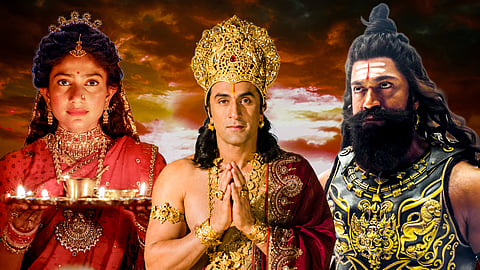
In one of the scenes in Nitesh Tiwari’s Ramayana: Part 1, Ram (Ranbir Kapoor) asks what the purpose of his birth is. He is vulnerable, confused, and deeply shaken by the odds that have consecutively been stacked against him. It is only in those fleeting moments, towards the end of the film, that we get some insight into the protagonist’s conflict in an adaptation that is otherwise deliberately held back. And this denial of interiority is neither without purpose nor limited to Ram.
Nitesh’s cinematic iteration of Valmiki’s epic anchors itself on caution. Everything is calculated, tepid even, in what seems like an attempt to prevent the story from making any detour that may offend bhakts or stir up controversy. But in its anxiety to avoid transgression, the film also relinquishes the artistic freedom to complicate inherited truths. By doing so, it reveals itself as a propaganda machine which flattens the interpretative potential of art and instead makes it a vehicle for cultural consolidation.
The irony, then, is hard to miss. In trying meticulously to offend no one, Nitesh Tiwari’s Ramayana: Part 1 appears to have not pleased people either.
For viewers who lean towards a more liberal political spectrum, the lack of explicit right-wing messaging seems to be disarming. The lack of deliberation in pushing Hindutva on a scale that was anticipated appears to have somehow become the merit of the film for them. Their criticism is more about other aspects like acting, visual language, effects and so on.
The harsher criticism of the film, however, has been from the right-wing political ecosystem, which has forever championed the epic as India’s moral “truth” and Ram as the keeper of that conscience. This politicisation of the myth has found legitimacy through the 2019 Ram Janmabhoomi–Babri Masjid land dispute verdict of the Supreme Court and the subsequent installation of the Ram Mandir in Ayodhya. Therefore, any adaptation of the epic on screen must live up to the exactions of this ecosystem if it wishes to survive.
Nitesh Tiwari does pander to that overarching context by giving us a detached, expressionless, ever-righteous Ram who embodies godliness from childhood. However, that does not seem to be enough.
If we dig deeper into the layers of the right-wing critique of the film, it becomes evident how peculiar the trap of propaganda is. For an industry that spared no opportunity to reproduce divisive political narratives under the garb of patriotism, censored films that questioned majoritarian state excess, and isolated filmmakers who tried to dissent, this is an entrapment of its own making.
When filmmakers help turn cinema into an instrument of ideological conformity, they eventually find themselves unable to satisfy even those they set out to appease.
Nitesh and team have no wiggle room, despite not even attempting to make any. The end result is an understated film adaptation of an epic, which has neither been able to take imaginative liberties nor reap the fruits of its calculated restraint.
‘This is Ravanayana’
Ramayana: Part 1 begins with the war between the devtas and the asuras. Relegated to the underground by Indra, the asuras suffer for centuries before Ravana (Yash) reinstates their dignity. The film spends considerable screen time on this origin story, following Ravana through his boyhood to adulthood, when he finally becomes the lord of all three worlds.
Nitesh attempts to delve slightly deeper into the making of this villain, whose masculine excess and thirst for power eventually trigger the main events of the Ram-Ravana clash. However, what would otherwise come across as character establishment has now become a point of contention for many viewers. The reason being that Ravana stands out in contrast to his carefully sanitised, prim and proper opponent, Ram of Ayodhya.
“Watched Namit Malhotra’s Ramayana. A flop of a film being discussed only because it bears a superficial resemblance to the Ramayana! What is promoted is essentially a Dravidianist, feminist and socialist interpretation of a Ravanayanam. Rama is reduced to a sorry figure, with a hunchback and an expressionless, stone-like face,” wrote a viewer on social media platform X.
“This is less Ramayana and more Ravanyana. Ravana has undeniably been glorified. One need only look at the number of children who, after watching the film, have begun praising Ravana to understand the impression it leaves,” wrote another viewer on X.
The criticism is primarily rooted in the presentation of Ravana as “liberal”. Though the film’s casteist visual language ensures that the asuras are made to look less milk-skinned and their women less clothed than the people of Ayodhya, the criticism is that Ravana is not cruel enough.
Actor Nitish Bharadwaj, former BJP MP who played Lord Krishna in BR Chopra’s television adaptation of the Mahabharat, wrote, “...By depicting a very liberal, socially just & fair Ravan, the film has nullified the basic purpose of Mahavishnu taking the Ram avatar to establish maryada!... This film cannot be an international representative of Indian cinema because it propagates a wrong narrative about Bharat’s history, heritage & core spiritual values.”
Essentially, what Nitish and several others from the right-wing ecosystem say is that by showcasing the vulnerabilities of Ravana, the film has humanised him instead of emphasising how barbaric he and his clan of asuras were.
“This is the purpose of this movie, is & they have achieved it: Making "Ravan" the Hero. The makers of "Ramayana" are too happy with this review. They will spend even 12000 crore rupees to brainwash the Hindu next generation. Shame on those Hindus who went to watch this movie,” wrote another viewer on X.
It is anyone’s guess where this critique comes from. Brahmanical patriarchy leaves no room to humanise the marginalised, even if the purported upper caste saviour hero has been deified in all possible ways.
The lack of a certain machismo in Ram on screen, it appears, was meant to reinforce spiritual detachment and godly foresight. A choice Nitesh and his team may have made to not malign this ideal hero whose purported existence has now transcended the realm of mythology into reality. But that choice, though meant to elevate Ram as an undisputed icon of Hindutva, and by extension, India, seems to have sorely backfired.
Not only did the restraint irk those who were perhaps waiting to see a Dhurandhar-esque Ram, seething with pride and revenge, but it also disappointed fans of Ranbir Kapoor, who say the actor was given nothing to perform.
The criticism, though, is not limited to how the men were portrayed. There is another section it takes on, and rather mercilessly: the women in the film.
‘Sita addresses Ram by his name?’
Ramayana: Part 1 is perhaps the first cinematic version of the epic in which we see a sword-wielding Sita (Sai Pallavi). The character is introduced as a knowledgeable woman who is also trained in combat. In the Aaranyakandh, where Ram, Lakshman, and Sita wade their way through a bewilderingly plastic VFX forest, she is seen to defend herself when needed. Though Ram swoops in to save her, Sita, in several scenes, is presented as having a mind and personality of her own.
This has, however, become another point of contention for several far-right groups who think that Nitesh Tiwari has made Sita “feminist” – a word that is a synonym for all things reprehensible in their glossary.
“Can’t believe some educated hindus are supporting a #Ramayana where Sita ji is scolding lakshman for cutting off innocent surpankha’s nose, Laxman is apologizing and Ram ji accepts surpanakha is the victim,” wrote a viewer on social media platform X.
To contextualise this, Ramayana: Part 1 depicts Ravana’s sister Surpanakha as a woman in a troubled marriage. It is after the murder of her husband Vidyuth that she spots Ram in the forest and becomes besotted by him. As she tries to woo him, disguised as Sita, Lakshman chops her nose off. Sita immediately reprimands him, pointing out how disproportionate his reaction was, and why disfiguring a woman is not befitting of a man with integrity.
If you look at this scene, it essentially adds to the moral compass Sita upholds. The same stance, if taken by a man, would earn him brownie points. But here, many right-wingers have taken offence, interpreting this as the filmmaker’s attempt to justify Ravana and infantilise Ram.
Many of them have also been extremely uncomfortable with Sita addressing Ram by his name and not adjectives like Aaryaputhr or Swami, as we have seen in earlier adaptations.
Similarly, the physical abduction of Sita has been omitted in the film. We see Ravana in disguise, manipulating Sita to step out of the Lakshmanrekha, and then, we see her in his pushpak vimaan. There is no visualisation of how Ravana actually put her in his vehicle. This is probably a choice Nitesh made to either not show graphic violence against a woman on screen, or to not malign Sita, who has attained godliness akin to Ram’s in people’s minds.
This too, however, has stirred fury.
“Some clown YouTubers are claiming that they couldn’t show Sita Haran the way it is described in Valmiki Ramayana because people would get offended by how brutal it is. But why would people be offended by Ravana being portrayed as an evil, ruthless demon? People have already watched Ramanand Sagar’s Ramayan, where Ravana literally abducts Mata Sita by force. Go and see for yourself how that scene was portrayed! The truth is, they wanted to give Ravana a softer portrayal, and that’s exactly why they butchered one of the most important scenes,” noted a film and pop culture page on X.
“Feminist Sai pallavi couldn't cry for help when abducted, was even wondering why Jatayu died. Next is she asking Raavan to cook his food himself for gender equality and she will drive pushpak,” noted another viewer on X.
Actor Sai Pallavi too has been subjected to cyberattacks for not “looking beautiful enough”. Several online pages have made numerous posts on how Kajal Agarwal, who plays Ravana’s wife Mandodari, should have played Sita, because “she looks better than Sai Pallavi”.
In effect, if one were to tie together all the arguments against Ramayana: Part 1 from the right-wing, it shows that even a relatively cautious adaptation that takes pains to preserve Ram's divinity can still be accused of ideological betrayal.
A demon of their own making
The Ramayana is an epic that has formed the basis of storytelling for decades owing to its narrative richness. And the history of Ramayana adaptations is also a history of departures.
For example, Mani Ratnam’s Raavanan (2010) anchored itself on police excess and marital discord, while G Aravindan’s Kanchana Sita (1977) emphasised a feminist lens on the epic. Even Karan Johar’s Bollywood blockbuster Kabhi Khushi Kabhie Gham (2001) is read to have taken its core conflict from the epic.
Though these versions of Ramayana would invariably invite offence from religious puritans, they are insulated by the fact that they are adaptations, set in entirely different contexts. Ramayana: Part 1 does not get that leeway because now, what is on screen is not just storytelling, but a sort of deity worship.
It is important to reflect on where cinema as an artistic medium stands in the middle of this. If every deviation is an affront, what remains of storytelling?
Even while promoting the film, Nitesh and his team made sure that there was a certain piety in their clothing and their conversations. Back in 2023, when Adipurush, another film version of the Ramayana, was released, the filmmakers urged everyone to leave a seat vacant in theatres for Hanuman, who is believed to have no death. There has also been considerable noise about which woman actor must play Sita on screen, because whoever takes that up must be “morally fit” to play a deity’s wife.
Therefore, there is a peculiar irony when an industry that has helped turn myth into political property now discovers that it can no longer exercise artistic ownership over it.
The right-wing prescription and backlash over Ramayana: Part 1 is, of course, unfair. But it is hard to place its makers and actors as victims because this is a demon of a complacent industry’s own making. It remains to be seen how they would take the franchise forward from here– by passing the ideological litmus test or discovering that there are only newer ways to fail.
Views expressed are the author’s own.
Follow TNM's WhatsApp channel for news updates and story links.
