
Subscribe
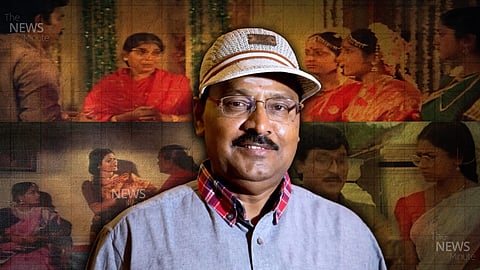
It is acknowledged by many following south Indian cinema that writer-director K Bhagyaraj, who passed away on June 27, just weeks after his mentor Bharathiraja, was one of the finest writing talents in the country. His pacy screenplay, with near-perfect proportions of humour and drama, are still spoken about. Interestingly, though he primarily worked at a time when male star power ruled, he always found a place for women in his scripts, and wrote them with nuance.
Because of his rural background — he hailed from Coimbatore — and because of his exposure to education, Bhagyaraj was able to create a canvas where the two worlds did not necessarily collide, but co-existed. Most female characters in his films were educated and had a mind of their own, and he was confident enough to allow them to dominate screentime. He was happy playing to his strengths — usually as the innocent partner, someone providing levity, and rarely as the one who strays from the straight path. This is why his films worked wonderfully well with female audiences.
I first watched Thooral Ninnu Pochu (1982) as an eight-year-old and still remember the character of Meenakshi akka, the heroine Mangalam’s (Sulakshana) neighbour. She appears for a brief while in the film, but sets the stage for everything — from Mangalam’s fear and anxiety about a prospective groom coming to ‘see’ her to how the village views girls. Despite seven ‘boys’ rejecting her, Meenakshi is a picture of confidence on Mangalam’s big day. That is a rarity for a time when village girls were written as wilting wallflowers. But the minute the grandmother throws some sharp words at her, she crumbles. A telling commentary on those times.
A year before this came Indru Poi Naalai Vaa (1981), where three boys undergo all kinds of trouble to woo a girl, even going to the extent of trying to learn Hindi. We were used to boys “teasing” girls on screen, but it was very unusual to watch three boys work very hard to earn a girl’s attention. Radhika’s character Jaya was both playful and innocent, and the film also gave us the memorable ‘Ek gaon mein ek kisaan Raghuthatha’.
The same year, in Andha 7 Naatkal, Bhagyaraj infuses the character of Vasanthi (Ambika) with verve — she’s the first to express her love to Palakkad Madhavan (Bhagyaraj), and even while being a product of her time, she is different. Later, when life throws her a curveball, she takes a decision that is in keeping with her character — because Vasanthi is never shown as someone shirking responsibility or being dependent on someone. She has a mind, and exercises it.
Bhagyaraj might have gained infamy (or fame) as the person who took the humble drumstick and elevated it to aphrodisiac levels, but he also wrote his women as people with desire. He’s an unwitting participant in the drumstick experiment in Mundhanai Mudichu (1983). Urvashi, who plays his young wife Parimalam, feeds the vaadhiyar (Bhagyaraj) the drumstick, because she craves his love.
Something similar was repeated in the 1988 Idhu Namma Aalu, where Bhagyaraj plays Gopalasamy, who pretends to be a Brahmin to eke out a livelihood. He ends up being wooed by Banu (Shobana), the English-speaking daughter of a village elder. When they begin their life together, he chooses to maintain distance, something she does not approve of. There’s enough double entendre from her side before things work out.
Bhagyaraj plays Subramani, a village boy seeking a life in cinema, quite mirroring his own life, in Dhaavani Kanavugal (1984). The only boy in a family of girls, he learns early on to keep them safe. The famous coin sequence – he throws coins on the floor to keep them from watching an intimate scene in a movie theatre – features in this film. The sisters are written with integrity, girls who are not swayed by money and who are keen on marrying the boys who liked them when they were still poor. Radhika plays Bhagyaraj’s love interest, the girl who cares for him but who never lets go of her self-respect. She course-corrects him, she’s the moral core of his life at a stage, all without expectation. Interestingly, this film is also proof of how much Radhika had grown as an actor in the three years from their first outing in 1981.
Chinna Veedu (1985) is an important example of Bhagyaraj showing the audience the mirror as to how they view women who are plump. It helps that his co-star was the fabulous Kalpana, who plays Bhagya, an educated woman forced to play dumb, only because she is not slim. Despite all that he throws at her, Bhagya never lets go of her dignity and stays true to who she is. Interestingly, Bhagyaraj introduced cinematographer BR Vijayalakshmi to Tamil through this film.
The 1987 Enga Chinna Raasa, which was remade in Hindi as the blockbuster Beta starring Anil Kapoor, Aruna Irani, and Madhuri Dixit, is another class example of how he wrote his women — two strong characters Rukmini (Radha) and Nagamani (CR Saraswathi) — on either side of the divide, with he was content playing the innocent Chinnaraasu. When Rukmini eventually gets down to battle, it is using her intelligence and moral core.
Even in his first film, Suvarilla Chitirangal (1979), the late writer-director wrote the film’s lead Saroja as possessing a spine and someone who faced her hard life head-on. With age, and time, his writing only got better, which is probably why you can rarely think of a Bhagyaraj film without remembering the heroine or what she contributed to the film.
Take, for example, Aararo Aariraro (1989), where he plays the caretaker in a hospital for those mentally unwell, and begins to look after the newest inmate Meenu (a superb Bhanupriya). She has the bigger role, the role that would get more applause, and he meant it that way.
The same happened in Mouna Geethangal, which released in 1981, a seminal year for Bhagyaraj. A film about relationship tangles, it shows a man trying to woo his former wife (Sarita) back. The film acknowledges that he strayed, but, more importantly, it also acknowledges his wife’s decision to split. Later, it also tracks her change of mind. Sometimes, Bhagyaraj placed his characters in the grey area, where it was not easy to judge them.
The only black mark in his pro-women stance probably took place in 2019 when, during a press meet, talking about the Pollachi sexual assault case, he said women too had a role to play in such cases, for which he was widely criticised. He was even summoned by the Tamil Nadu State Commission for Women demanding an official explanation. That one statement went against quite the majority of his writing.
Bhagyaraj began writing when Indian films were not questioned regarding their gender stances or political correctness. But, even then, some of his writing might pass the test of time well.
Subha J Rao is an entertainment journalist covering Tamil and Kannada cinema and is based out of Mangaluru, Karnataka.
Views expressed are the author’s own.
