
Subscribe
Landlord (Kannada)
When Tharun Sudhir’s Kaatera released in December 2023, the film gathered a positive response from all corners for two main reasons: it humanised a superstar while also elevating him, and it simultaneously tackled a subject of strong social pertinence. The co-writer of that film, Jadesha K Hampi, is now at the helm of another major release that follows Kaatera in the same vein, both in terms of its spirit and its essence.
It might seem a bit too convenient to compare Kaatera with Landlord, but their inherent natures are glaringly similar. Both feature protagonists from marginalised backgrounds who take on casteist village heads. Both employ laws and constitutional shifts to highlight what the oppressors are getting away with, as well as what the oppressed unknowingly lose in the process. Both stories also underline the rural life of yesteryear Karnataka (Kaatera is set in the 1970/80s, Landlord in the '80s), where demarcations are clear between life and dignity.
The only difference between the two films, and a big one at that, is that while the former manages to realise its potential, Landlord gets swayed by the weight of its own promise.
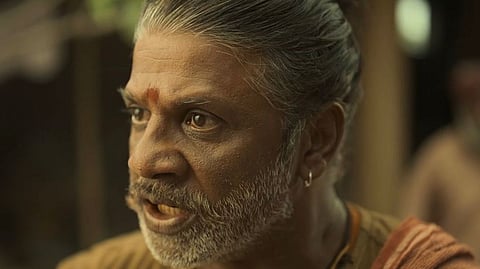
The promise begins with the film’s lead character, Raachayya, played by ‘Duniya’ Vijay. Raachayya is visibly strong, and the greys in his hair suggest a life worn by experience, but his servile attitude forces him to bow his head before his village’s Sanna Dani (meaning 'Junior Lord', a nameless character played by Raj B Shetty). Sanna Dani is the typical bloodthirsty, womanising antagonist whose upper-caste status cannot bear seeing the farm labourers around him gain an ounce of respect for themselves. He has brothers as lackeys with him at all times to slit throats, the local cops in his pocket, and the region’s MLA under his thumb, and by all means, he is the much more powerful one in the hero-villain equation. Yet, Raachayya commands a quiet potency and valour that is waiting to explode, and the film is quite simply about when the explosion happens.
For a large chunk of the first half, Landlord uses this ‘hero-in-disguise’ trope to its advantage, and things feel reasonably bright. Raachayya’s domestic life in the annexure, named Thegginakere, including his doting wife, Lingamma (Rachita Ram), and their young daughter, Bhagya (Rithnya Vijay), takes centre stage, along with the cruel politics existing in and around the village. We get to know that Sanna Dani’s grip on the landowners has resulted in labourers being paid only in grains, and not in money.
There’s Raachayya’s own personal strife with the heads to become a landlord one day, a promise he had made to his mother (played by Umashree) long ago. Bhagya’s journey as an upright police constable, her love interest and fellow feisty youth Devi (Shishir Baikady), the Basavi tradition (akin to the Devadasi system) in the village, and so many other components come to inhabit the world, which is built with some detailing by Jadesh Hampi and co.
The physical setting of Landlord has hints of artifice about it, especially in the way the homes, the lanes and other attributes are designed. But the film compensates for that with the way a culture is explored - from the spoken language (with traces of Telugu, owing to the border proximity) to the traditions and conventions (religious and exploitative), there is a layering of ‘lived-in’ authenticity that is visible throughout.
Even Raachayya’s own moniker of ‘Kodali Raachayya’ (‘Axe’ Raachayya) takes into account the vast agricultural backdrop of the story, alluding to his famed achievement of chopping down a tree in ten or fewer strikes of the axe. The aesthetic has impressions of the works of filmmakers like Sukumar and Vetrimaaran, although Jadesh Hampi adopts a temperament that is quite a few notches louder.
But, while the milieu and its characters leave a mark, the storytelling only grows haphazardly over the 156-minute runtime. Once the setup portion is seen through, Raachayya’s desire to fulfil his mother’s promise brings him face to face with Sanna Dani, and in turn, the entire community of labourers starts to bear the brunt of it.
On the one hand, sparks of a revolution are doused with bloodshed, as Sanna Dani and his men set their feet on the throats of the people of Thegginakere. On the other hand, a masked messiah named Adaviraaya enters the fray just at the right time. The inclusion of Adaviraaya makes things exciting, mainly because of the confusion he creates in the heads of the bad guys.
But the opportunity to use him in its favour is completely missed by the film; instead, it starts to run in circles, dispensing repetitive and terribly melodramatic monologues for the rest of its duration.
And that’s when the bigger concern crops up.
Landlord is filled with many opportunities to create drama, but the writing never seems to be aware of them. It introduces Adaviraaya, but has little clue about what to do with him. It builds a mythology around Raachayya, but none of that is used to enhance the intensity and deliver those massy highs. It boasts rich ideas too, relating to power dynamics in such areas, but the narrative is so incoherent that you lose track of pretty much everything after a point.
With respect to enhancing drama, as it were, a film like SS Rajamouli’s RRR comes to mind instantly. NTR Jr’s character of Komaram Bheem is introduced in the film with great gusto to showcase his physical strength and ferocity, but the film never goes overboard in underlining these traits. In fact, it backtracks a little and makes Bheem submissive until the optimum point, adding to the intrigue and mystery that are built carefully, scene by scene. In complete contrast, Raachayya is dealt with prematurely, and had the writing spotted the merits of its central character early on, the result would’ve been a far more compelling big-screen experience.
‘Duniya’ Vijay, in the lead role, has his moments, though the performance ebbs and flows throughout. His real-life daughter, Rithnya, gets to add value to the film in the role of Bhagya, whenever she is not asked to slip into a lengthy monologue.
Raj B Shetty, Shishir Baikady, Gopalkrishna Deshpande, and many others in the ensemble, too, get to do something worthwhile, but their parts are either excessively verbose or over the top with their expressions. Bhavana Rao's part as Padma is of significance to the story, but the character is barely registered.
In one way of looking at it, Landlord is an uncommon Kannada film for the themes it tackles. It doesn’t take a loose stance either about the message it wants to communicate.
That said, the very method of communication is steadily more chaotic and confused, and consequently, the film’s primary purpose of being a big-ticket watch isn’t realised. It engages in other ways, as pointed out, albeit the thrills don’t ever occur as expected.
Disclaimer: This review was not paid for or commissioned by anyone associated with the film. Neither TNM nor any of its reviewers have any sort of business relationship with the film’s producers or any other members of its cast and crew.
