
Subscribe
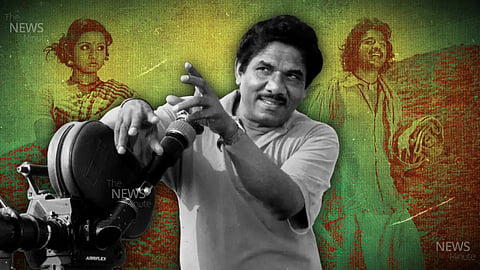
There are Tamil films, and then there are those made by Bharathiraja. The over 100-year-old Tamil film industry owes the veteran filmmaker one distinct milestone: He took cinema out of sets and set it free in the rawness of real life.
When Sridevi leapt through the sun-drenched fields and swung with carefree abandon in the celebrated ‘Chendoora Poove’ song from Bharathiraja's debut, 16 Vayathinile, she was, in a way, also leading Tamil cinema away from its sanitised, theatrical version.
16 Vayathinile was iconic in more ways than one.
Firstly, it felt real. It also brought together some of the finest performers of that generation. Rajinikanth as the menacing Parattaiyan; Sridevi as Mayilu, a vulnerable young woman who discovers a strength of her own; and Kamal Haasan as the innocent Chappani delivered some of the most memorable performances of their careers.
Over the next few years, Bharathiraja reigned over Tamil cinema as though he owned it. In 1978, Kizhakke Pogum Rail, which incidentally gifted the versatile Radhika to Tamil cinema, went on to become another superhit.
But wary of being labelled a filmmaker who could handle only rural themes, Bharathiraja turned his lens to Sigappu Rojakkal (1978), an urban thriller that proved he was equally at home in an entirely different genre.
In Sigappu Rojakkal, Kamal Haasan played Dileep, a psychopathic misogynist killer hiding behind an unassuming exterior. Bharathiraja, of course, followed it up with more thrillers, including the stylish Tik Tik Tik (1981) and Oru Kaidhiyin Diary (1985). Both films featured Kamal Haasan again.
In fact, Bharathiraja's partnership with Kamal Haasan, which began with 16 Vayathinile, is perhaps not as celebrated as it should be. Across four films, the director explored remarkably different shades of the actor’s screen persona.
There was the innocent and vulnerable Chappani, who reclaims his dignity and identity as Gopalakrishnan in 16 Vayathinile; the suave photographer Dileep in Tik Tik Tik, who finds himself wrongly accused of murder; the outwardly sophisticated but deeply disturbed serial killer Dileep in Sigappu Rojakkal; and the wronged prisoner David in Oru Kaidhiyin Diary, driven by a relentless quest for justice and revenge.
Bharathiraja's versatility was not confined to rural dramas or thrillers. In fact, his romances remain nonpareil in Tamil cinema. From Alaigal Oivathillai (1981) to Kaadhal Oviyam (1982), and from Mann Vasanai (1983) to Mudhal Mariyadhai (1985), Bharathiraja's romances rarely conformed to convention.
His 1986 film Kadalora Kavithaigal cast Sathyaraj in a completely different light. He was not the swaggering villain here but Chinnappa Das, a hardened criminal mellowed by love and capable of startling vulnerability. With her trademark umbrella and intact dignity, Rekha's Jennifer became one of the most enduring teacher characters in Tamil cinema.
In Kadalora Kavithaigal, as across Bharathiraja's films, landscapes were rarely mere backdrops. The sea, the fields, the dusty roads and village squares became characters in their own right — sometimes silent witnesses, sometimes necessary interludes.
Sathyaraj's versatility as an actor perhaps found its fullest expression in yet another Bharathiraja film, this time a searing commentary on caste. In Vedham Pudhithu (1987), Sathyaraj played Balu Thevar, an avowed atheist whose own caste prejudices are laid bare. The film was widely seen as a powerful critique of caste and Brahminical hegemony.
In 1994, Bharathiraja returned with Karuthamma, a telling commentary on female infanticide, delivered in the language of mainstream cinema. The film brought a social evil that had long remained hidden in parts of rural Tamil Nadu into public conversation without sacrificing its commercial appeal.
If Bharathiraja's filmography defied easy categorisation, it was because he never stopped experimenting. In 2008, as a new generation of successful filmmakers emerged, Bharathiraja returned with Bommalattam, a psychological mystery that once again reflected his fascination with the darker recesses of the human mind.
And then there was music. In Bharathiraja's cinema, songs were extensions of the narrative. No discussion of his work can begin anywhere but with Ilaiyaraaja, his most celebrated collaborator.
Together, they created songs that seemed to carry the scent of the soil they belonged to. Whether it was the tender yearning of ‘Poongatru Thirumbuma’ from Muthal Mariyathai (1985), the silent ache of ‘Poovil vandu’ from Kadhal Oviyam (1982) or the timeless beauty of ‘Aayiram Malargale’ from Niram Maratha Pookal (1979), the music was a storyteller in its own right.
Yet Bharathiraja was never bound by a single musical idiom. Devendran's score for Vedham Pudhithu lent emotional depth to one of his most provocative films, while Kizhakku Cheemayile (1993) saw AR Rahman immerse himself in the rhythms and soul of rural Tamil Nadu, a departure from the westernised sound that marked much of his early work.
In Kodi Parakkuthu (1988) and Captain Magal (1991), Bharathiraja joined hands with Hamsalekha, once again demonstrating his eagerness to forge new creative partnerships.
Across composers and decades, Bharathiraja possessed a rare ability to make music feel inseparable from the worlds he created.
And just like music, there is another constant, understated presence in some of Bharathiraja's most iconic films: waiting. Mayilu waits for Gopalakrishnan in 16 Vayathinile after he kills Parattai and is sent to prison. Saradha waits for Dileep in Sigappu Rojakkal after he is institutionalised. Stephen waits for Karuthamma after she kills a predatory suitor. Malaichami waits for Kuyil in Mudhal Mariyadhai, holding on to life itself until she returns from prison on parole.
Bharathiraja's stories were often about people who were flawed but real and caught in the space between desire and destiny. And in that space lived one of his most enduring emotions — waiting.
For a filmmaker who found poetry in longing, there could be no more fitting legacy.
