
Subscribe
Connecting the Unconnected is a monthly column by the Digital Empowerment Foundation (DEF) that explores how technology can drive inclusion and governance in India. Today’s Women’s Day column focuses on how DEF initiatives place communities, particularly women, at the centre of digital transformation.
As India accelerates toward an increasingly digital society, the promise of technology is often framed in terms of connectivity, innovation, and scale. Yet for millions of women living in rural, remote, and historically marginalised communities, the digital transformation unfolding around them remains uneven. Access to devices, reliable connectivity, and digital literacy is only part of the challenge.
More fundamental questions remain: Who designs digital systems? Whose realities shape them? And who benefits from them?
For many women across India’s last mile, digital systems can simultaneously promise opportunity and multiply existing inequalities. Social norms, mobility constraints, unpaid care work, language barriers, and affordability continue to limit women’s participation in digital life. When technology is designed without considering these realities, infrastructure may exist on paper but fail in practice.
Over the past two decades, the Digital Empowerment Foundation (DEF) has worked to address these gaps by placing communities, particularly women, at the centre of digital transformation. Rather than treating women as passive beneficiaries of technology, DEF’s approach recognises them as leaders, facilitators, and entrepreneurs who shape how digital systems function at the grassroots.
Across India, thousands of rural women are now acting as information intermediaries, digital service providers, and community leaders. Through initiatives that combine infrastructure, digital literacy, entrepreneurship, and governance facilitation, they are translating connectivity into meaningful access for their communities.
Two initiatives illustrate how this model is enabling women to transform digital access into agency.
Digital infrastructure is often measured through statistics: the number of towers installed, fibre laid, or villages connected. But connectivity alone does not automatically translate into meaningful access. For women in rural areas, digital participation is deeply social, shaped by trust, safety, local institutions, and community support.
One example of this approach is the Samriddh Village – Integrated Phygital Services Pilot, implemented with the Department of Telecommunications, Government of India. The initiative demonstrates how combining physical infrastructure with digital services can create inclusive village-level ecosystems. The project leverages BharatNet connectivity to integrate education, healthcare, agriculture, financial services, and e-governance through local digital hubs known as Samriddhi Kendras.
These centres bring together physical and digital service delivery, often referred to as a “phygital” model, allowing rural citizens to access government services, telemedicine, digital skilling, and market linkages within their own communities.
Equally important is who facilitates this access in meaningful ways. Women play a critical role in helping families navigate digital platforms, submit applications for welfare schemes, access tele-consultations, or connect to learning resources. The initiative anchors digital public infrastructure (DPI) in community spaces and human support systems, demonstrating that meaningful connectivity must be designed around people’s lived realities.
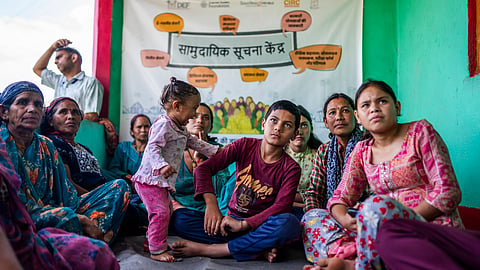
A similar principle guides DEF’s Internet Roshni initiative, which expands access to digital infrastructure and learning in vulnerable communities such as tea gardens and Adivasi communities. Community Information Resource Centres and Community Internet Libraries established under the programme act as trusted hubs where women and young people can access the internet, learn digital skills, and engage with government services.

For women who often face restrictions on device ownership or independent mobility, these shared community spaces are crucial. They offer a safe environment where digital learning, information access, and economic opportunities can begin. Over time, these centres evolve into local institutions that support livelihoods, education, and civic participation.
The lesson from these initiatives is clear: infrastructure alone does not close the digital divide. Meaningful access emerges when connectivity is embedded within community structures that recognise women’s time, responsibilities, and aspirations.
If infrastructure determines whether communities can connect, governance determines what people can do once they are connected. As public services – from welfare delivery to identity verification – move onto digital platforms, the risk of exclusion grows for those without the skills, resources, or confidence to navigate these systems.
Digital governance platforms often assume that users have devices, connectivity, literacy, and familiarity with online processes. For women living in marginalised contexts, these assumptions rarely hold true.
To address this gap, DEF has developed one of its most significant community-led initiatives: the SoochnaPreneur programme.
Launched in 2016, the programme trains rural entrepreneurs to become information intermediaries who help communities access government schemes, digital services, and financial inclusion platforms. Equipped with digital tools and mobile applications containing information about welfare programmes, SoochnaPreneurs help citizens identify and apply for schemes relevant to their needs.
Many of these entrepreneurs are women who operate community-based digital service centres. Their role extends far beyond simply providing internet access. They help villagers navigate complex online portals, correct documentation errors, track application statuses, and file grievances when necessary.
In effect, they act as translators between citizens and digital governance systems.
This human layer is critical.
The programme also highlights the transformative potential of women-led digital entrepreneurship. For many women, becoming a SoochnaPreneur represents not only economic independence but also social recognition within their communities. They become trusted sources of information, helping neighbours access healthcare schemes, education scholarships, pensions, and livelihood programmes.
Over time, this shift has broader implications for local governance. When women become facilitators of digital citizenship, they strengthen accountability and transparency within public service delivery. Communities gain greater awareness of their rights, and local institutions become more responsive to citizens’ needs.
As technologies such as artificial intelligence and data-driven governance expand into everyday life, the need for inclusive digital systems becomes even more urgent. If women, particularly those from marginalised communities, remain absent from decisions about technology design, digital transformation risks reproducing the same inequalities it promises to solve.
DEF’s work across initiatives such as Samriddh Village, Internet Roshni, and the SoochnaPreneur programme demonstrates that meaningful digital access is not achieved simply by connecting communities to the internet. It requires building systems that recognise women as leaders, decision-makers, and knowledge holders.
When women design, manage, and sustain digital ecosystems at the grassroots, technology becomes more accountable, accessible, and responsive to lived realities.
Dr Arpita Kanjilal is Head of the Research & Communications Division at Digital Empowerment Foundation.
Views expressed are the author’s own.