
Subscribe
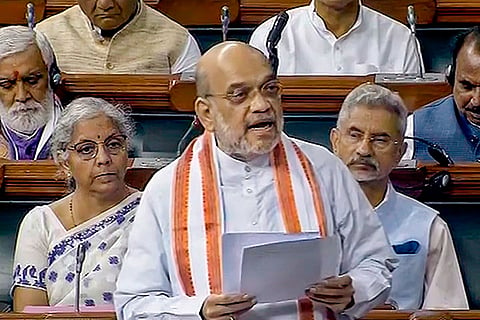
In a bid to overhaul India’s criminal justice system, the Union government, on Friday, August 11, introduced three bills in the Lok Sabha, proposing to repeal the Indian Penal Code, Evidence Act, and Criminal Procedure Code. Home Minister Amit Shah said that the proposed laws will respectively be replaced with the Bharatiya Nyaya Sanhita, Bharatiya Sakshya Bill, and Bharatiya Nagarik Suraksha Sanhita. He further made a grand claim that the sedition law will be completely repealed, positioning it as a win for the country. But on a closer reading of the provisions of the new bill, it becomes clear that sedition has been retained, with more severity, only using different words.
Senior Supreme Court lawyer and activist Vrinda Grover says that the new formulation is subjective, as the language is broad, giving more occasion for use and misuse against political dissenters. “It’s a direct assault on free speech and democracy,” she says.
Sedition is defined ,in Section 124A of the Indian Penal Code (IPC), drafted by Thomas Macaulay in 1837. It has constantly been criticised as a colonial law that was introduced by the British to stifle any kind of rebellion among the Indians. But the Law Commission backed this contentious provision, stating that repealing it would create ramifications for the country’s unity, and many called the Commission’s report shallow and devoid of reasoning.
I,PC Section 124A defines sedition as this: Whoever, by words, either spoken or written, or by signs, or by visible representation, or otherwise, brings or attempts to bring into hatred or contempt, or excites or attempts to excite disaffection towards the Government established by law in shall be punished with imprisonment for life, to which fine may be added, or with imprisonment which may extend to three years, to which fine may be added, or with fine.
The new Bharatiya Nyaya Sanhita 2023, does not have a specific provision that deals with sedition. However, ,in Section 150 of a dedicated chapter on offences against the state, it lays down: Whoever, purposely or knowingly, by words, either spoken or written, or by signs, or by visible representation, or by electronic communication, or by use of financial means, or otherwise, excites or attempts to excite, secession or armed rebellion or subversive activities, or encourages feelings of separatist activities or endangers sovereignty or unity and integrity of India; or indulges in or commits any such act, shall be punished with imprisonment for life or with imprisonment which may extend to seven years and shall also be liable to a fine.
The newly propos,ed Section 150 is not only similar ,to Section 124A of the IPC, but one can see that apart from spoken or written words, signs, and visible representation, there is an addition of two terms – “electronic communication” and “financial means”. It also mentions “secession, armed rebellion, subversive activities, encouraging feelings of separatist activities, or endangering sovereignty or unity and integrity of India,” as grounds for punishment, which were not there ,in Section 124A.
Further, whi,le Section 124A would attract a punishment of either life imprisonment, or three years in jail with a fin,e, Section 150 of the Bharatiya Nyaya Sanhita increases the punishment to seven years, along with a prescription for life imprisonment and fine if need be.
Vrinda points out that these new additions lack precision, underlining that criminal law cannot be worded vaguely. “Acts of subversive activities and encourage feelings of separatist activities – these are extremely vague, subjective, and lack any precision. The thumb rule of criminal law is that language must be precise and clear as to what constitutes an offence. If we go by the proposed new Act, will an opinion article disagreeing with the abrogation of Article 370 fall foul ,of Section 150?” she asks.
Another conspicuous detail is regarding the explanations of the provisio,n. Section 124A had three explanations which exempted comments expressing disapproval of government measures with a view to obtaining their alteration by lawful means, without exciting or attempting to excite hatred, contempt or disaffection.
It explicitly said that such comments “do not constitute an offence under th,is section [S.124A]” But the explanation ,of Section 150 of the Bharatiya Nyaya Sanhita 2023 reads: Comments expressing disapprobation of the measures or administrative or other action of the Government with a view to obtaining their alteration by lawful means without exciting or attempting to excite the activities referred to in th,is section.
The phrase “do not constitute an offence under th,is section” is missing ,in Section 150, and we don’t know whether this means there will not be any exemption to this provision or not. This is a significant detail considering how sedition has been widely used to clamp down on dissenting voices, free speech, and criticism of the government.
Interestingly, wordings similar ,to Section 150 of the Bharatiya Nyaya Sanhita 2023 also find a place in the new National Security Law (NSL) passed by China in Hong Kong in 2020, significantly reducing the autonomy of Hong Kong’s citizens. The details of the law, the BBC reports, were kept secret until it was passed on 30 June 2020.
Like the proposed Bharatiya Nyaya Sanhita, the NSL criminalises secession, which means breaking away from the country; subversion, which amounts to any act undermining the power or authority of the government; terrorism, and collusion with foreign or external forces. Many protestors and activists who expressed dissent have reportedly been arrested in Hong Kong after this law came into force, and critics say that this law, under the guise of maintaining national security, squashes dissent.
Watch:
Follow TNM's WhatsApp channel for news updates and story links.
